

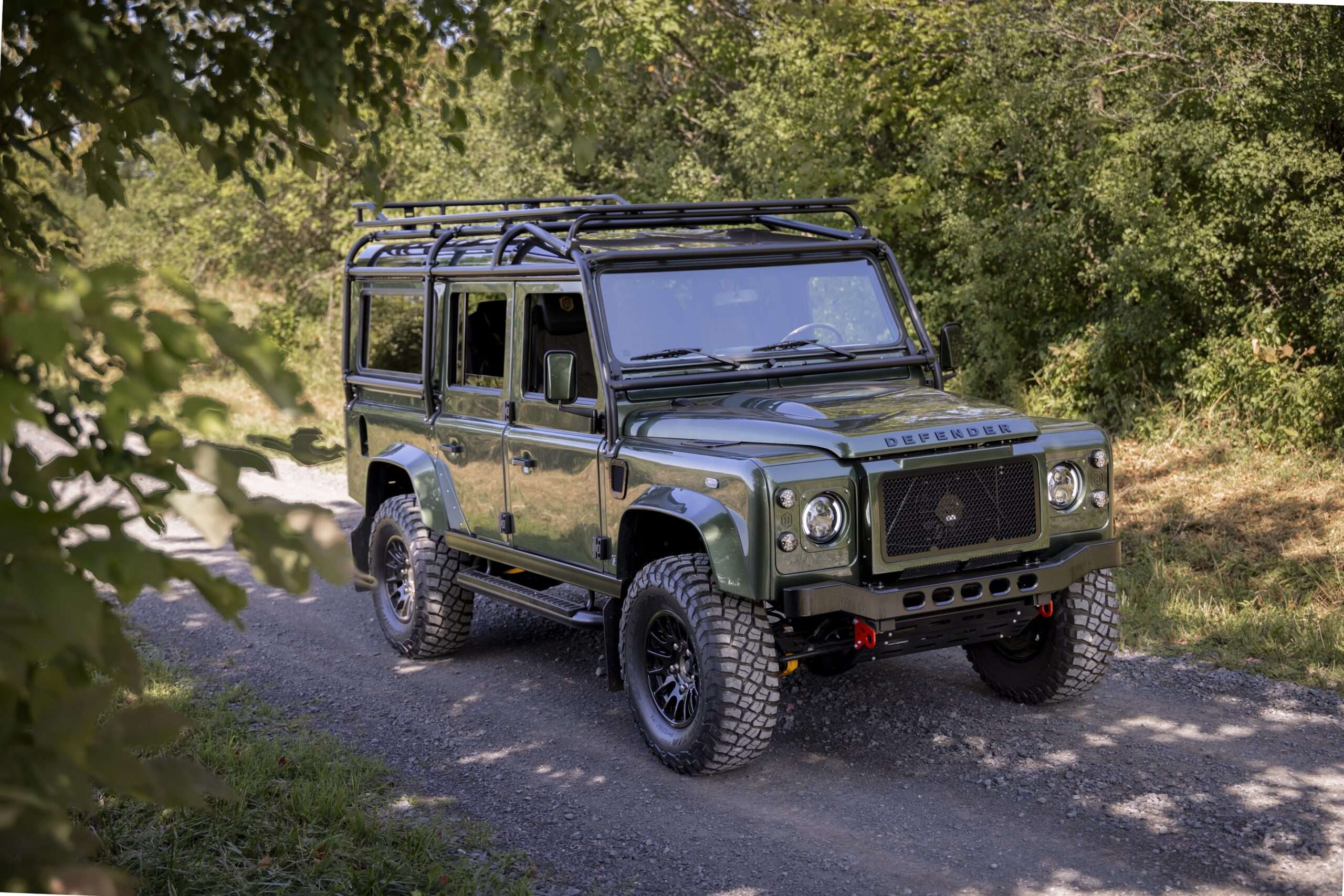
Lange, a Land Rover Defender 110 completely re-engineered by the Arkansas design house Helderburg, is back on the market at $348,720 with one owner and 4,137 miles on the clock. Read quickly, that’s a listing. Read closely, it’s a small but telling data point about how a very new category of collector vehicle behaves once it leaves the builder’s hands.
The interesting part of this story was never the diesel tune or the beadlock wheels. It’s that a commission finished in May 2024 and driven barely 4,000 miles by its original owner is already cycling back onto the market — not because anything went wrong, but because that owner simply moved up to a larger Helderburg build. That pattern reveals more about how today’s high-net-worth buyers engage with bespoke vehicles than any spec sheet can.
A Third Category, Not a Restomod
Helderburg doesn’t describe Lange as a restoration or a restomod, and the distinction is worth taking seriously rather than dismissing as marketing language. A restoration returns a Defender to original specification, with all the mechanical limitations that implies. A restomod — the approach behind builds like the LS3-powered 1962 Corvette we featured recently — typically prioritizes outright performance, often at the cost of numbers-matching identity. Lange takes a third path: the original chassis and engine block remain, re-engineered rather than replaced, so the truck’s numbers-matching identity survives a 42-percent power increase, a fully custom suspension, and a bespoke interior.
The debate isn’t abstract for Land Rover buyers, either. We recently covered a 1997 Defender 90 NAS built around a 450-horsepower LS3 V8, a textbook restomod that trades chassis-correct identity for outright power. Helderburg’s pitch is the opposite bet: that a Defender can gain the performance and comfort those swaps chase without giving up the one thing that makes it a documented, traceable object rather than a kit built around a chassis plate.
It’s a similar argument to the one Singer has made for two decades with the Porsche 911. Our recent coverage of Singer’s Sorcerer made the same case for a very different vehicle, and it’s no accident that both companies lean on numbers matching as a central credibility claim. It tells a sophisticated buyer that the object in front of them is still, legally and mechanically, the original car.
Why Numbers Matching Still Matters on a Diesel Land Rover
Land Rover ended Defender production in 2016, and U.S. import law requires a vehicle to reach 25 years of age before it can be titled here. That combination means the pool of legally importable, left-hand-drive Defenders shrinks in real terms every year, as clean early trucks are exported, parted out, or simply used up. A builder working from a genuine, documented chassis and engine block draws on a finite and diminishing resource in a way that a fabricated or import-only body never can. That is Helderburg’s own representation of Lange’s identity, and it hasn’t been independently authenticated by a third-party marque specialist — worth remembering before treating numbers matching as verified fact rather than a builder’s claim.
The Real Story Isn’t the Spec Sheet
The more revealing detail is why Lange is for sale at all. According to Helderburg, the original owner commissioned Lange for exactly the ranch-and-highway duty described in its build story, then shortly afterward ordered a larger Defender 130 that became his primary ranch truck — leaving a barely used, one-owner Lange sitting mostly idle. That isn’t the story of a collector car changing hands after a career of use and documented history. It’s closer to the pattern seen in yacht or watch culture, where buyers trade up within a single maker’s catalog rather than holding an object for what it has already done.
It also means Helderburg is, at the moment, both the manufacturer and the only real marketplace for its own cars. There is no independent auction record for a Helderburg commission the way there now is for Singer’s reimagined 911s, which have traded publicly at major auction houses and built a visible price history in the process. Until that kind of third-party price discovery exists for Helderburg builds, the word investment attached to Lange’s listing should be read as aspiration rather than established fact.
Reading the Price
Helderburg quotes roughly $387,000 to commission an equivalent Defender 110 today, against a 12-to-14-month build schedule. At $348,720, Lange is priced about 10 percent below that replacement cost — a thin discount for a vehicle that is already sorted, broken in, and available immediately rather than more than a year away. That pricing suggests the seller isn’t discounting out of distress, and that Helderburg’s internal resale market is being priced closer to replacement cost than to depreciation. Most vehicles, even desirable ones, lose value faster than that in their first two years. Lange, so far, has not.
Genuinely Collectible, or Simply Expensive?
Both, in different measures. The engineering is real and well documented: a single owner, indoor storage, no smoking, and ongoing coverage under Helderburg’s own concierge program. The scarcity underlying it — a shrinking supply of clean, legally importable Defender donor vehicles — is a legitimate long-term factor, not a marketing invention. “The difference lives in the engineering,” Helderburg says of its own work, and on the mechanical evidence, that claim holds up. But the investment case remains unproven in the way that matters most to serious collectors: verified, repeated, third-party sales. Until Helderburg commissions change hands at public auction the way Singer’s have, Lange is best understood as an exceptional, low-mileage vehicle for someone who wants Defender character without Defender compromises — not yet a demonstrated store of value.
In this corner of the market, rarity isn’t stamped on a build plate. It’s dictated by how many original chassis are left to start from — and, increasingly, by how quickly the last owner decided he wanted a bigger one.
Image via Helderburg
The collector car market, every weekday morning.
Auction results, price moves and what’s crossing the block, read in four minutes. Free, from Modern Car Collector.
No spam, unsubscribe in one click. Or read more about the Brief.
Related Posts:
- Record Ferraris, Rare Icons and 15,000 RPM: The Week…

- Kim Basinger’s Defender 90 Stalled at $91,000. The…
- Today in Collector Car History: Grace Kelly's Rover…
- A No-Reserve Range Rover Supercharged Isn't a…
- Depreciation and Market Comparison of the Pontiac…
- Range Rover's New Matched Pair at Monterey Is a…
 Elizabeth Puckett