
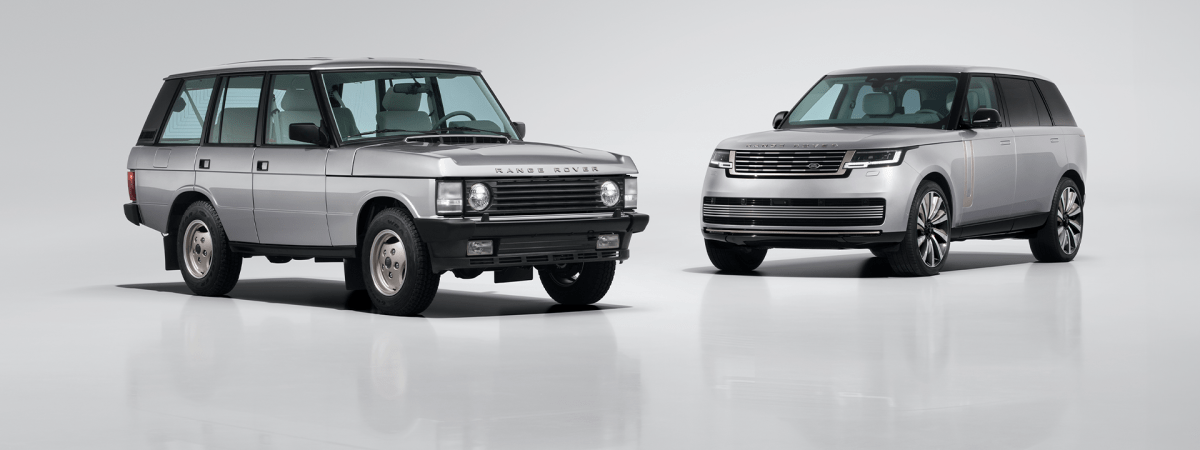
When Range Rover rolls a 1993 Range Rover Classic and a brand-new Range Rover SV Ultra onto the RM Sotheby’s stage at Monterey Conference Center this August, the temptation will be to focus on the hammer price. Resist it. The more revealing story is what the two trucks are doing standing next to each other in the first place: a factory heritage division built a vintage vehicle from scratch to visually match a car that didn’t exist twelve months ago, then packaged the pairing as a numbered, single-lot “first.” That isn’t a restoration story in the traditional sense. It’s a demonstration of how manufacturers now manufacture provenance to order.
The donor car is a 1993 Range Rover Classic, originally built as a US-market County Edition and powered by the 3.9-liter V8 paired with a four-speed automatic. Land Rover’s Classic Works team in Coventry spent roughly 2,000 hours stripping it to bare metal and rebuilding it around a bespoke design brief tied directly to the new Range Rover SV Ultra. The exterior wears Titan Silver, the iridescent, aluminum-flake finish developed for SV Ultra, with side trim deleted and 16-inch three-spoke wheels finished in Satin Platinum Atlas to echo the flagship’s cleaner surfacing. Inside, Ultrafabrics appears on a Range Rover Classic for the first time, in the same Orchid White and Cinder Grey duo-tone as SV Ultra, with the laser-etched mosaic seat perforation carried over from the new car. A plaque under the bonnet identifies it as Land Rover Classic’s first bespoke matched-pair commission.
None of that is subtle, and it isn’t meant to be. Collectors who prize matching numbers, original color combinations, and unmolested factory specification should understand plainly that this car offers none of those things by design. A four-door, automatic, US-spec County Edition was never the most coveted configuration of the first-generation Range Rover to begin with; the earliest two-door Classics from the 1970s hold that distinction among purists. This car’s value doesn’t come from its place in Range Rover’s production history. It comes entirely from the commission itself, and from the story Land Rover’s Classic division is asking buyers to purchase alongside the sheet metal.
That distinction matters more than it might seem, because it points to a shift already underway across the collector market. Heritage divisions built to restore and authenticate old cars are increasingly being used instead to originate new ones, dressed in old bodies. We’ve seen a version of this same instinct play out domestically, where independent builders are reviving American coachbuilding traditions, as our look at a coachbuilt Corvette reshaping what factory-adjacent custom work can mean explored, and in the growing appetite for thoughtfully engineered restomods that blend vintage style with modern performance. Land Rover’s approach is simply the manufacturer version of the same idea, executed with the resources and archival authority only an OEM heritage department can bring.
The timing is not incidental either. Monterey Car Week has become as much a marketing platform for manufacturers as it is a marketplace for collectors, and this year’s calendar makes that plain. RM Sotheby’s Monterey sale will present the Range Rover matched pair alongside genuinely numbers-matching, decades-proven cars, the kind of lots that built the auction’s reputation in the first place. The gap between those two categories is worth sitting with. A car like the Ferrari 250 GT California Spyder Competizione carries value accumulated over sixty-plus years of documented ownership and competition history. A gathering like the record Miura assembly at Pebble Beach or the Alfa Romeo entries heading to Gooding and Christie’s reflects decades of accumulated scholarship about why those cars matter. Range Rover’s matched pair carries none of that accumulated history. It carries a plaque dated 2026.
That doesn’t make it a bad purchase. It makes it a different kind of purchase, and serious bidders should treat it that way. The questions worth asking have less to do with the Range Rover Classic’s mechanical condition, which by all accounts was restored to a high standard, and more to do with how durable the story is. Does Land Rover Classic issue formal documentation tying this commission permanently to SV Ultra? Will the division support and service this specific build the way it supports numbers-matching originals? And, most importantly, will this car’s value still make sense a decade from now if SV Ultra itself is remembered as a footnote rather than a flagship? Buying a commissioned narrative works only as long as the narrative keeps being told.
Originality in the collector market has traditionally been something that accumulates slowly, one careful owner and one honest repair at a time. What Land Rover has built here is the opposite: originality manufactured on a deadline, in a single 2,000-hour commission, to match a car still finding its place in the world. That’s not a criticism of the workmanship, which appears genuinely excellent. It’s simply the real headline. The auction estimate, whatever it turns out to be, is the least interesting number attached to this car.
The collector car market, every weekday morning.
Auction results, price moves and what’s crossing the block, read in four minutes. Free, from Modern Car Collector.
No spam, unsubscribe in one click. Or read more about the Brief.


 Kyle Matthews