

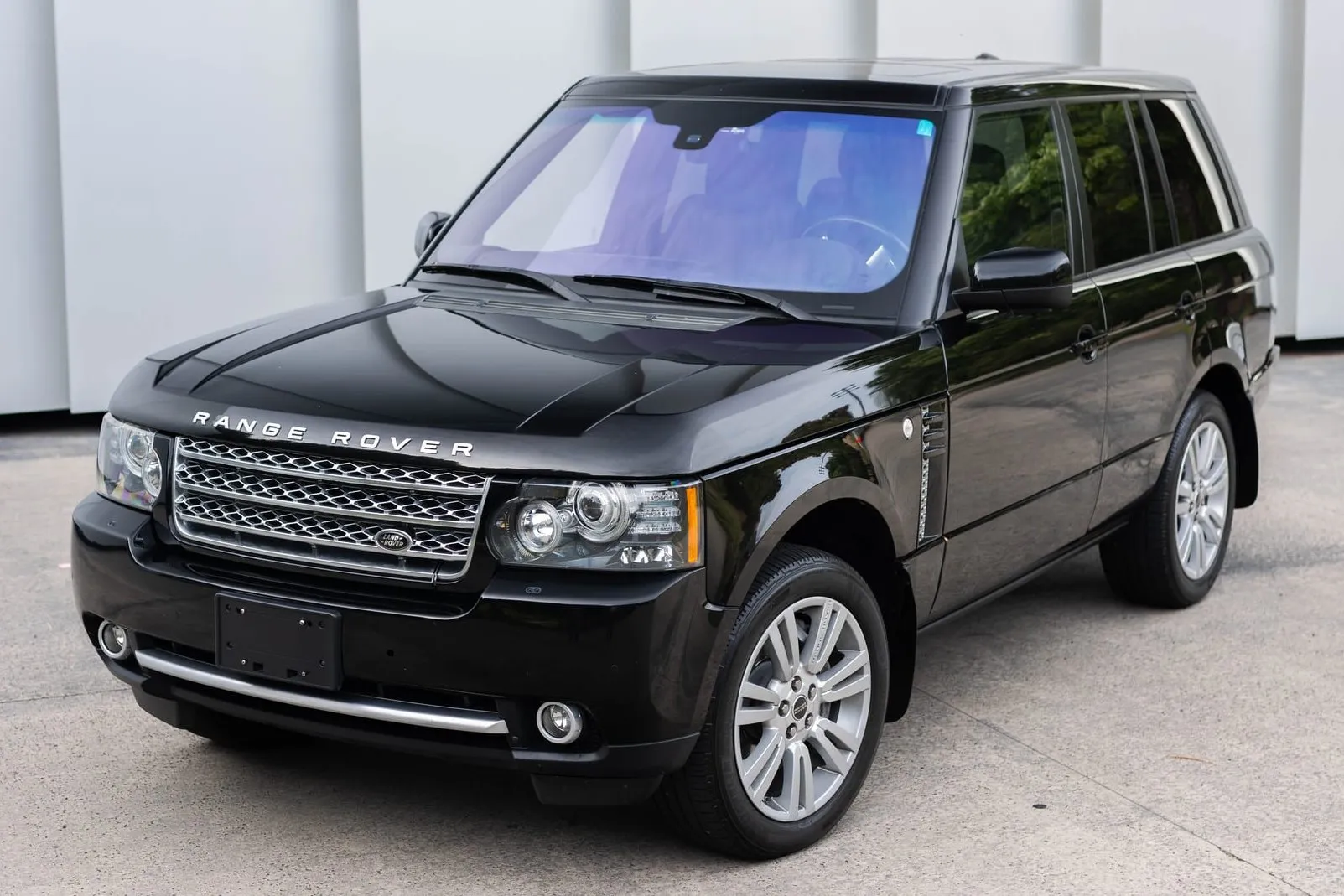
On Bring a Trailer, a 2012 Land Rover Range Rover Supercharged is currently bid to $8,700 with no reserve, set to sell this week. Finished in Santorini Black over Jet Oxford leather and equipped with the Cold Climate, Navigation, Premium Sound, Tow, and Vision Assist packages, the truck is powered by the 5.0-liter supercharged V8 that once justified a six-figure window sticker. On paper, it reads like serious luxury machinery. The bid tells a different story.
The real story here isn’t the number. It’s what that number confirms about an entire category of vehicle that keeps trying, and failing, to graduate into the collector world. Modern luxury SUVs generate enormous initial demand and enormous long-term maintenance bills, and on this listing, those two forces are fighting each other in real time.
A Generation at Its Twilight
Some context matters here. The L322-generation Range Rover arrived in 2002, the first Range Rover developed under BMW’s brief stewardship of Land Rover, and it replaced the old body-on-frame P38A with a unibody structure, fully independent air suspension, and electronics far more sophisticated than anything the marque had built. By 2010, under Tata Motors’ ownership of Jaguar Land Rover, the truck received its last major update: a 5.0-liter supercharged V8 shared with Jaguar’s performance sedans, replacing the outgoing 4.2-liter unit and pushing output past 500 horsepower. This 2012 truck, like every 2012 built, was among the last before Land Rover replaced the L322 entirely with the aluminum-intensive L405. That makes it the final expression of the modern Range Rover’s founding template, not a footnote to it. End-of-era positioning has mattered before in the collector market. Here, so far, it hasn’t.
What the Truck Actually Is
Look at the specific example, and the reasons become obvious. It has covered 124,000 miles, its Carfax notes damage reported in November 2016, and the selling dealer confirms a repainted rear quarter panel as a result. The front bumper is missing one parking sensor. Maintenance has been substantial, and appropriately so: the timing chains, guides, and front coolant crossover pipe were replaced in 2021, and the thermostat, water pump, and intercooler-to-radiator hose have since followed. None of this makes the truck undesirable as a driver. It makes it exactly what it is, a well-used example of a notoriously expensive-to-maintain platform, sold by a dealer who has already done the informed buyer’s homework.
Modern Car Collector has covered this exact combination before. Earlier this year, we wrote about a nearly identical 2012 Range Rover Supercharged that once belonged to Richard Simmons, offered with 18,000 original miles, a clean Carfax, and a documented celebrity ownership history most consignors would envy. It also sold at no reserve. Two nearly identical trucks, one with a fraction of the mileage and a famous name attached, and neither one broke free of the segment’s gravity. That is the more important data point than either individual sale price: celebrity provenance and low mileage can move a number up, but they have not yet moved an L322 Range Rover into a different collecting category altogether.
Manufactured Scarcity Versus the Real Thing
Land Rover’s current marketing leans hard on scarcity and bespoke commissioning to manufacture desirability for new Range Rovers, and we have examined why that strategy is more complicated than it looks, in our look at why bespoke programs marketed as limitless are not the same as genuine rarity, and in our analysis of a manufactured-provenance matched pair sold at Monterey this year. The lesson applies in reverse here. A no-reserve L322 selling for the price of a good watch is not rare, is not especially original, and does not carry the kind of provenance that reliably moves value, the way a Range Rover documented to Queen Elizabeth II and later owned by the Obamas does. Absent one of those factors, mileage and a clean history are table stakes, not upside.
The Arithmetic Collectors Should Actually Notice
Here is the detail serious buyers should take from this listing: air suspension components, electronically controlled dampers, and a supercharged V8 with a timing-chain service interval are expensive regardless of what the truck cost when new. On a $150,000 flagship SUV, those costs are a rounding error against the purchase price. On an $8,700 truck, they are the entire economic proposition. That asymmetry, more than rarity or styling, is what keeps modern luxury SUVs from aging like classics. Depreciation on a truck like this does not taper off the way it does on a well-regarded classic. It keeps compounding, because the ongoing cost of ownership compounds right alongside it.
Originality and documentation compound in the collector market much the way interest compounds in finance, rewarding patience and punishing gaps. That compounding only works in a buyer’s favor when the underlying vehicle is actually scarce or historically important enough to be worth preserving. An L322 Range Rover Supercharged, however well equipped, is neither. Land Rover built well over 100,000 examples of this generation, and clean, low-mile survivors still surface regularly. That is the uncomfortable arithmetic behind this week’s no-reserve bid.
What This Means for Buyers
None of this means the L322 will never mean anything to collectors. Give it another decade, let the roughest examples get scrapped or parted out for their expensive suspension components, and the handful of unmolested, low-mile, single-owner trucks left standing may well find a genuine following, the way early Land Cruisers and first-generation Broncos did once the bulk of the population thinned out. That moment has not arrived, and a truck with an accident history and 124,000 miles was never going to be the example that gets there first. The smartest use of this listing is not as a buying opportunity. It is as a reminder that depreciation curves on complex luxury machinery do not reverse just because a generation ends or a badge says Range Rover.
The collector car market, every weekday morning.
Auction results, price moves and what’s crossing the block, read in four minutes. Free, from Modern Car Collector.
No spam, unsubscribe in one click. Or read more about the Brief.
Related Posts:
- Kim Basinger’s Defender 90 Stalled at $91,000. The…
- Today in Collector Car History: Grace Kelly's Rover…
- The Collector Car Market Paid Up for Certainty This…

- Everything Modern Car Collector Covered Last Week
- Cadillac's Junkyard Dream Car Returns to Auction.…
- Record Ferraris, Rare Icons and 15,000 RPM: The Week…

 Elizabeth Puckett
  John Lloyd
  Kyle Matthews