

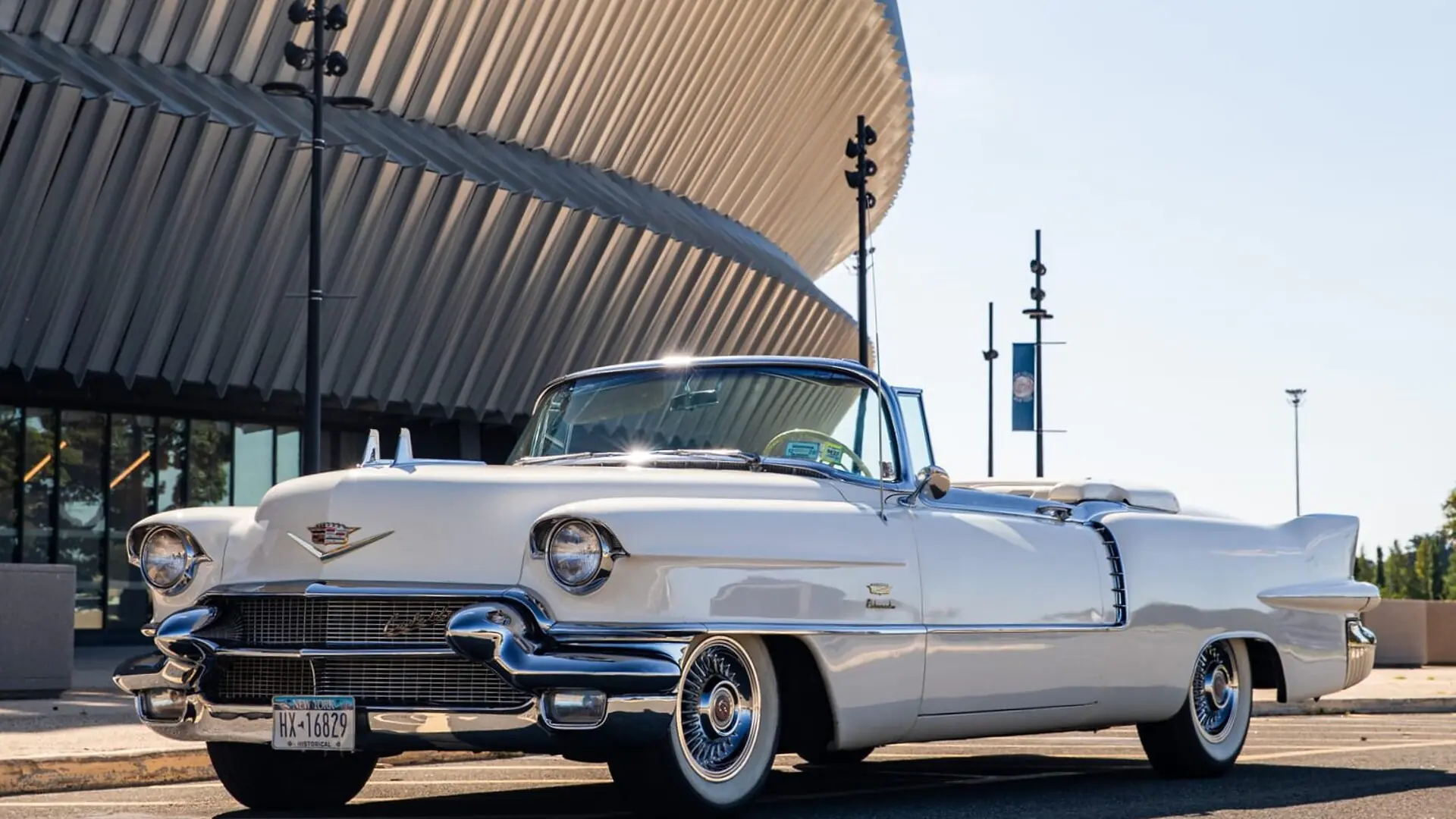
A widow in Portersville, Pennsylvania, put the family Cadillac out of sight in a storage area at the restaurant she and her late husband had run. According to the listing, the husband died in 1962, and the car stayed hidden until 1988. On Saturday, that 1956 Cadillac Eldorado Biarritz reached $47,000 on Bring a Trailer, fell short of its reserve, and then sold to the high bidder for $50,000 through the platform’s post-auction offer process.
The hide-away story is what got the car noticed. It is not what set the price. A good narrative opens the bidding; the condition of the car, and the paper behind it, closes it.
A Biarritz, but not a scarce one
Cadillac built 2,150 Biarritz convertibles for 1956, according to the listing. That is a small number by Detroit standards and an ordinary one by collector standards. The Eldorado had been Cadillac’s halo since 1953, and the Biarritz is among the best-known and best-documented convertibles of the decade, with its dual four-barrel 365-cubic-inch V8 rated at 305 horsepower, Hydra-Matic, Dagmar bumper guards, and a trim tag that decodes cleanly to Alpine White over blue and white leather.
Rarity is not the premium here. Collectors already know where the Biarritz sits. What they pay for is completeness, documentation, and the confidence that a car needs nothing. We have followed the model across several years of sales, including a restored 1957 Biarritz, a 1957 at Carlisle, and a 1959 offered in a bankruptcy sale. The pattern is consistent. The cars that carry a premium carry it for what has been done and proven, not for the badge.
The mileage math
The listing gives 21,000 miles when the car went into storage and about 24,000 indicated today, roughly 2,000 of them added since the current owner bought it in 2002. That leaves about a thousand miles unexplained between 1988 and 2002, which is entirely ordinary for a car being recommissioned after decades of sleep. It also makes the point. A time capsule is a car whose clock stopped. This one’s clock restarted in 1988.
Storage preserves a car. It does not certify one. The odometer reading is unverified, and the file, as listed, runs to a 1990s Washington Times feature on the car, recent service records, tire-changing tools, and a New York registration. That is charming provenance and useful context. It is not a build record or a continuous ownership chain, and experienced buyers weigh the difference. We made a related argument about a much more valuable Cadillac, the Al Capone limousine at Morphy, where the documentation was the lot.
Originality with an asterisk
The seller’s disclosure was commendable, and it is also what defined the car. The power top was replaced in the 1980s. A door panel was repainted decades ago after egg damage inside the restaurant. In 2013 the top and power windows were repaired, the brakes overhauled, and the exhaust replaced. Underbody corrosion is noted, the seats show wear, and a bidder asked about a possible fuel tank seep, which the seller said did not prove to be an active leak after the car was inspected.
None of that is disqualifying in a seventy-year-old convertible. But a buyer paying for originality is paying for what has not been touched, and each item above subtracts from that claim even as it adds to the honesty of the listing. The result is a very good, largely unrestored driver, not a preservation-class car. The market priced it accordingly.
The comparison that settled it
When bidding stopped at $47,000, one bidder, who later bought the car, argued in the comments that the market has softened for cars that need work. He pointed to a 1956 Biarritz with factory air conditioning and the Autronic Eye, described as the one-millionth Cadillac built, that he said sold for $50,000 eight days earlier. We have not independently verified that sale, and it is worth treating as a bidder’s claim. What is verifiable is the outcome: the price he cited is the price he paid.
The implication is the real story. A fifty-year-old hide-away tale, low indicated miles, and an unmolested look did not command more than a better-equipped, better-documented Biarritz sold a week earlier. Equipment and paperwork carried the comparison, and the story was left to do the rest.
What it means for collectors
For buyers, the lesson is to separate the narrative from the file. Ask what is documented, what is original versus period-correct, and what the car needs before it can be driven with confidence. For sellers, it is that disclosure builds trust but does not manufacture a premium; the seller here was open about every flaw and still did not reach the reserve in open bidding.
The most telling line in the thread is not about price. The buyer said he did not yet know his plans but hoped the car would one day navigate the old Bay of Kotor roads. That is how a fairly priced fifties Cadillac is meant to end up: used, not shelved. Fifty thousand dollars is not what a story costs. It is what an honest, mostly original 1956 Biarritz cost on a Saturday in October 2026.
For more on how Cadillac positioned its halo cars in the same period, see our look at the 1956 Eldorado Brougham Town Car concept, and for the wider market backdrop, this week’s collector car market brief. The Biarritz was offered by AuthenticAuctions of Mineola, New York, on behalf of the John C. Mesloh Collection.
The collector car market, every weekday morning.
Auction results, price moves and what’s crossing the block, read in four minutes. Free, from Modern Car Collector.
No spam, unsubscribe in one click. Or read more about the Brief.


 Eve Nowell
 Shawn Henry