

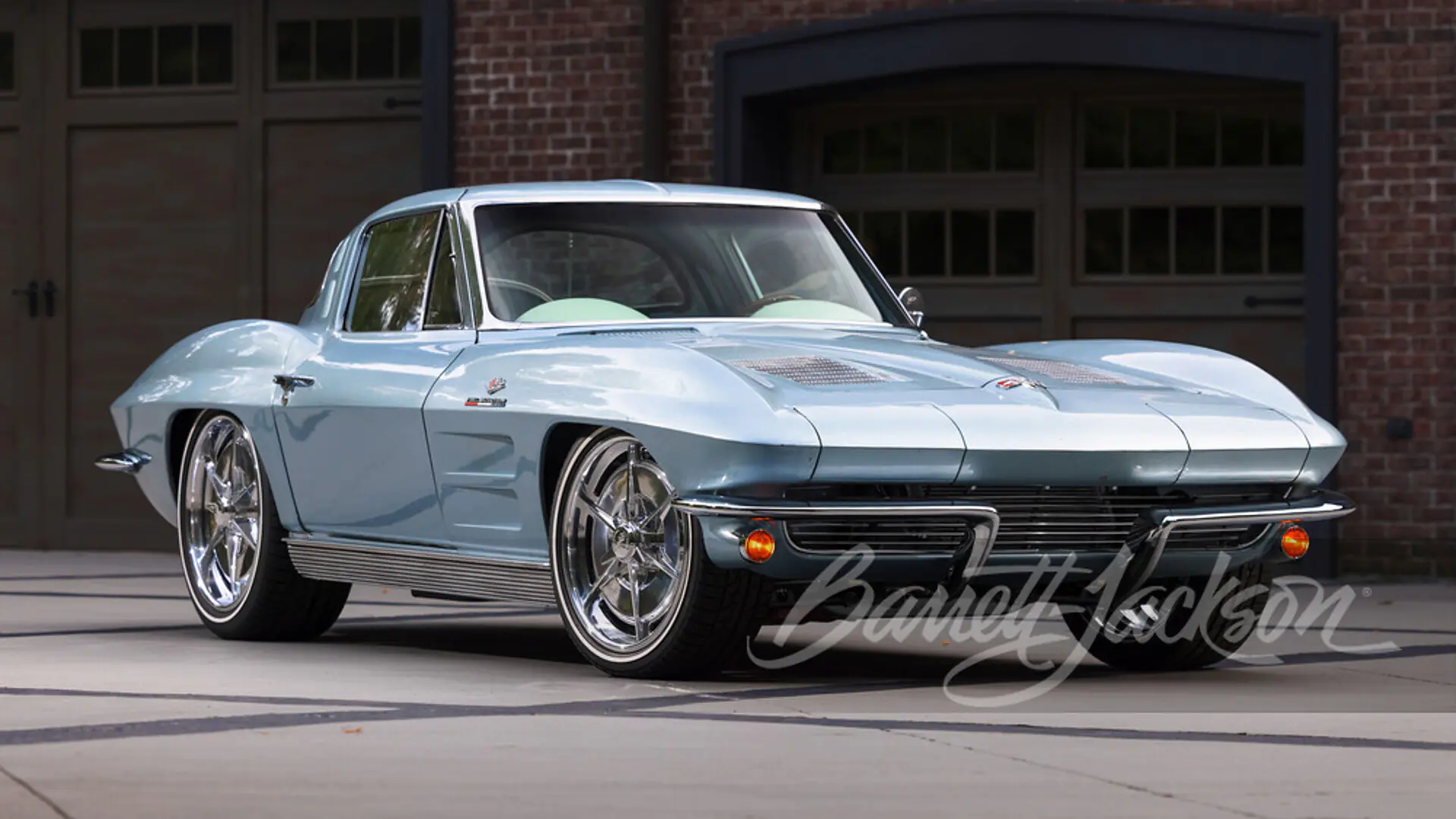
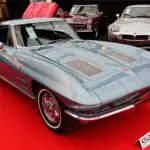
In September, we noted that the model name has stopped carrying price in the split-window Corvette market. The file does. A 1963 coupe that hammered at $425,000 during Barrett-Jackson’s Digital Select Auction this month makes the same argument from an unexpected direction, because this is not an original car at all. It is a custom, completed only in September, and the reason it brought six figures has less to do with the LS3 under the hood than with the paperwork in the folder.
The car, Lot 38, was built by Jeff Hayes Customs on a coupe that, according to Barrett-Jackson, was sold by City Chevrolet of Akron, Ohio, and remained with a single owner for 63 years. That is an ownership span matching the car’s own age. The original title, the dealer paperwork and the sales brochure all come with it. The thesis here is simple: provenance does not disappear when a car is rebuilt. It relocates, and buyers are learning to price it where it lands.
What the Buyer Actually Received
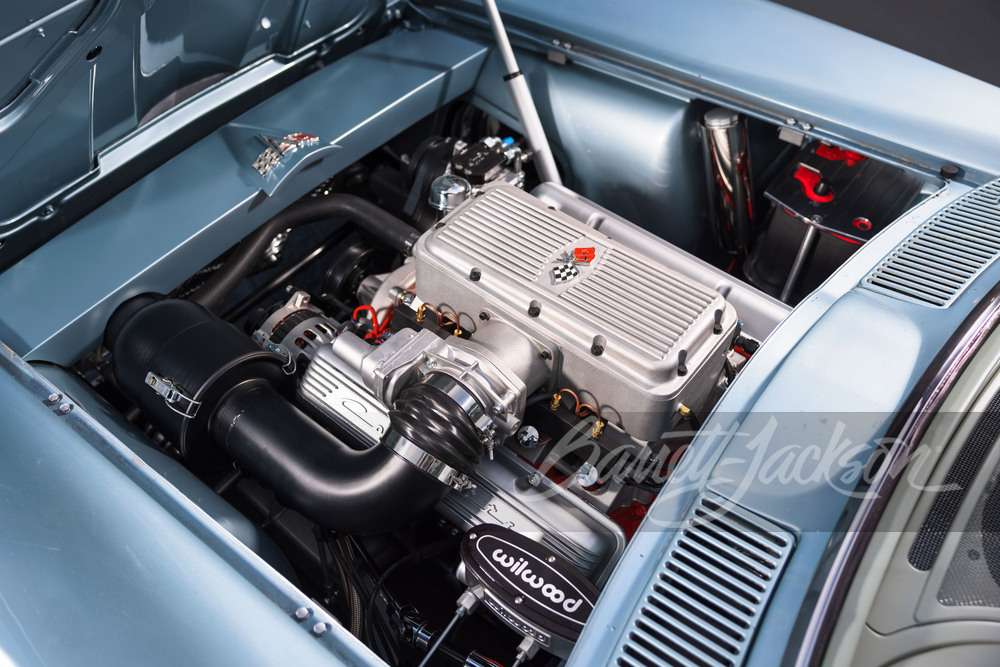
The specification reads like the current high-end custom template, executed without shortcuts. A new 500-horsepower GM LS3 sits behind a 4L70E automatic, on an Art Morrison chassis, with a full stainless-steel exhaust and an Eddie Motorsports pulley system. The Lokar intake is styled to resemble the factory Rochester fuel injection that distinguished the most serious 1963 Corvettes, a period reference that costs the owner nothing in drivability. Mike Curtis wheels fill the arches.
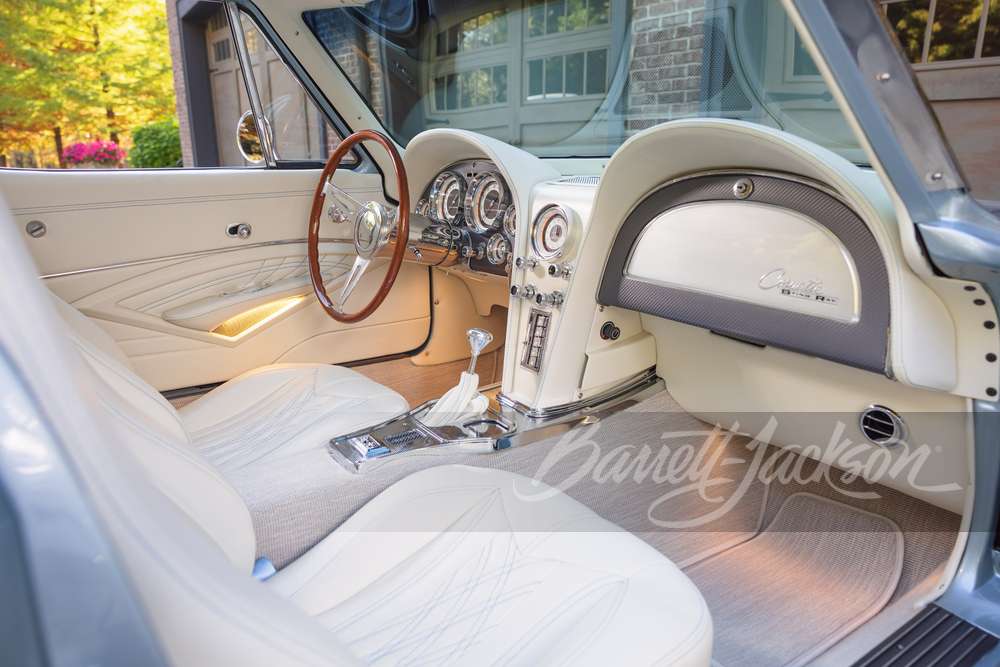
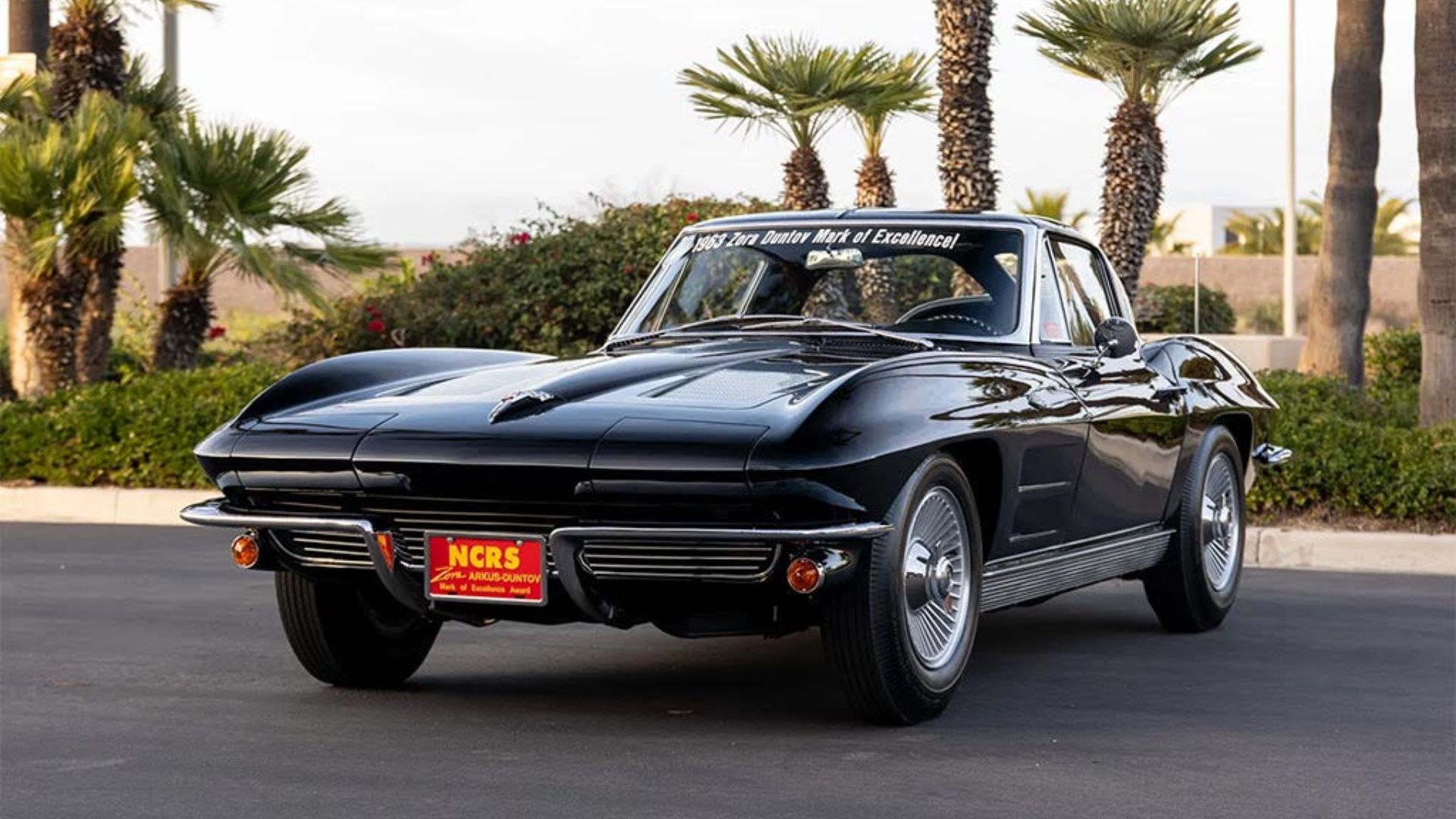
The finish work is where these builds are won or lost. The engine bay, door jambs and underside of the hood were bodyworked, smoothed and refinished, and the car kept its original Silver Blue Metallic color. Inside, linen-colored leather, extensive LED lighting, Classic Instruments gauges, a chrome Ididit column, a teak steering wheel and Vintage Air complete a cabin that is modern in function and restrained in appearance.
Why the Split-Window Is the Right Canvas
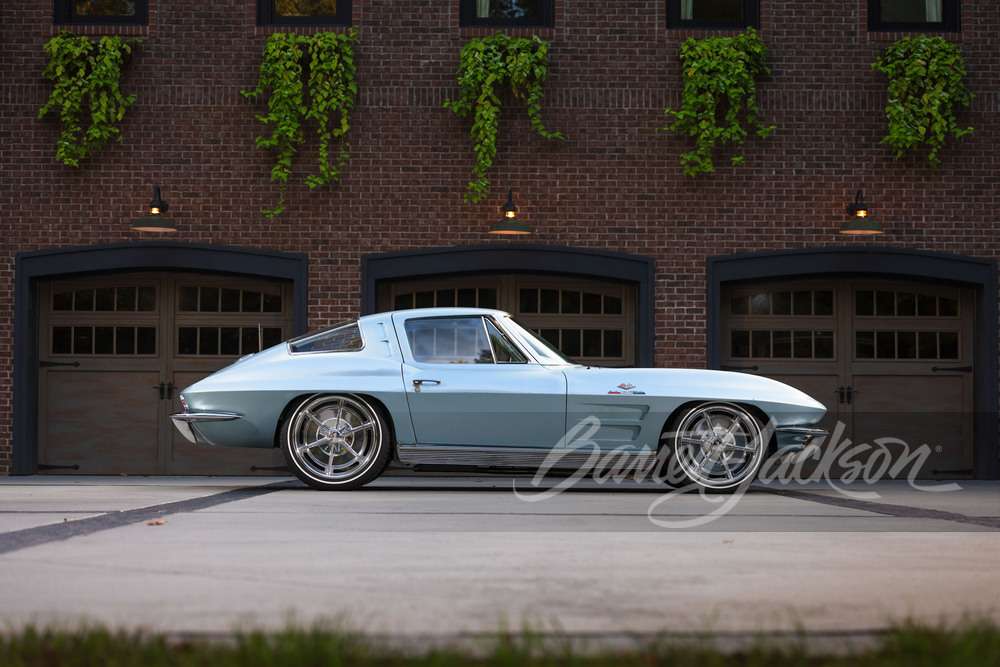
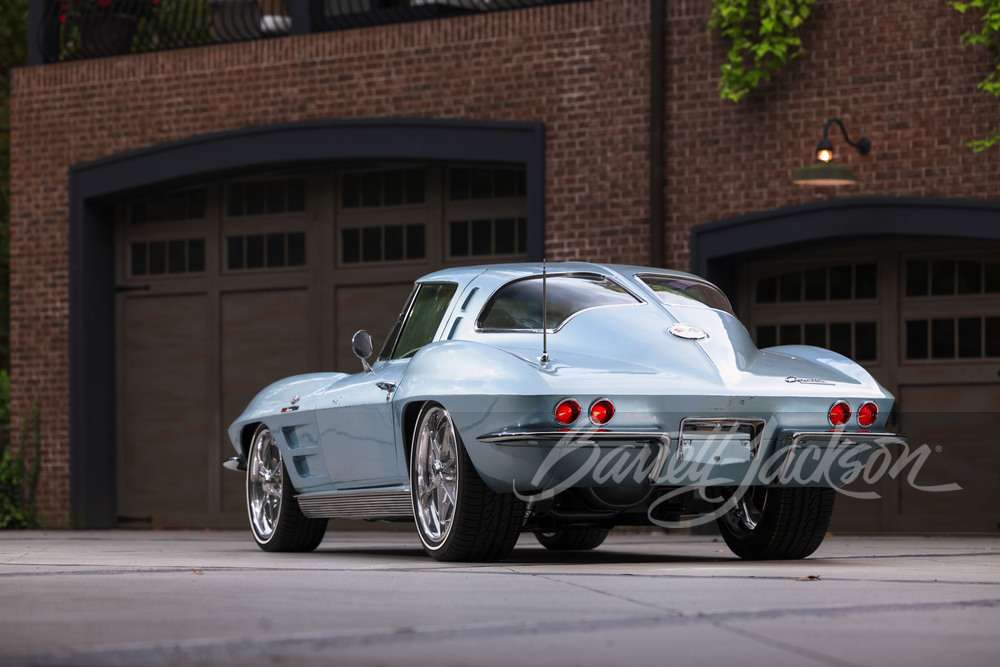
Customizers choose the 1963 coupe for the same reason originalists do. The divided rear glass appeared for one model year only, on a body of which 10,594 coupes were built, before Chevrolet replaced it with a single pane for 1964. Bill Mitchell’s design carried the idea; Zora Arkus-Duntov argued against it on visibility grounds and won the point the following year. That argument is, in effect, why the car is worth anything at all. The compromise became the signature.
A builder working on a split-window does not have to justify the styling to anyone. The silhouette makes its own case, which is why the rear window is the one element no serious custom touches. Everything else, from the chassis to the intake, is negotiable. That is a stronger starting position than most restomod platforms can claim.
Provenance Moves With the Car
This is the overlooked detail. The VIN, 30837S111532, decodes to a genuine 1963 Corvette coupe assembled in St. Louis. In a segment where donor identity can be a question, a title and a dealer paper trail connecting that number to a specific Ohio showroom are what separate a documented custom from an assembled one. The 63-year ownership adds something the build itself cannot manufacture: a continuous, unbroken account of where the car has been.
Collectors rarely pay a premium for horsepower alone. They pay for the confidence that a car is what it says it is. On a restomod, that confidence comes from the foundation, not the finish.
The Other Side of the Ledger
None of this settles the purist’s objection, and it should not. A one-owner split-window with its dealer documentation is precisely the sort of car originalists would prefer to see preserved, and an Art Morrison chassis and LS3 are not reversible. On an original 1963 coupe, the engine pad stamp does most of the talking. Here, that conversation has ended. The lot description does not say whether the original drivetrain accompanies the car, and a serious buyer should want that answer in writing.
The sale also arrived with no shakedown history. The build was completed in September, which leaves the new owner to sort out any teething issues that a longer-lived custom would already have resolved. Barrett-Jackson notes the car must be collected or shipped from the seller’s location, a practical reminder that the Digital Select format asks bidders to commit without standing in front of the car. In that setting, documentation carries more weight than it does on an auction floor.
What It Tells Us About the Market
Custom split-windows have become a recurring category rather than a novelty. A custom 1964 Corvette split-window was consigned to Mecum Monterey this summer, and a SEMA-debuted 638-horsepower restomod was offered at Mecum Nashville. The buyers for these cars are not originalists in waiting. They want the shape, the story and a car they can drive hard without anxiety.
What separates a $425,000 custom from the rest is the quality of the starting point and the evidence behind it. The market has begun to distinguish between a restomod with a pedigree and a restomod with a parts list, and it pays accordingly. Originality compounds in a car’s history the way interest compounds in an account, and when the original components are replaced, the documentation is what remains to be inherited.
If the price disappeared from this story, the lesson would survive. A custom Corvette is only as strong as the car it was built from, and the file that proves it.
Sources: Barrett-Jackson Auction Company, 2026 November Digital Select, Lot 38 listing and description. Photography courtesy of Barrett-Jackson. Hammer price as reported by Barrett-Jackson.
The collector car market, every weekday morning.
Auction results, price moves and what’s crossing the block, read in four minutes. Free, from Modern Car Collector.
No spam, unsubscribe in one click. Or read more about the Brief.


 EL Puckett
 John Lloyd