

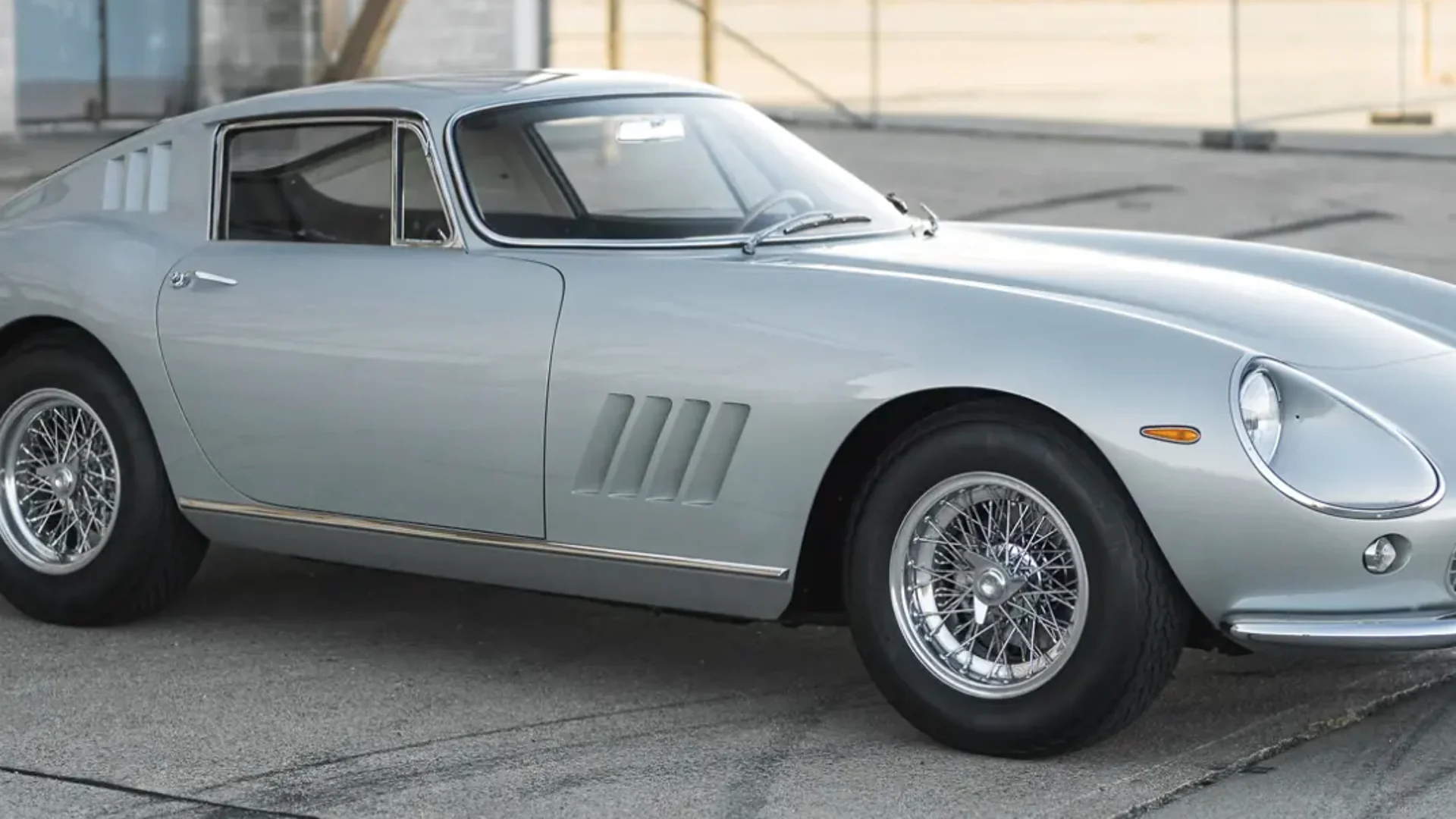
Ferrari built 453 examples of the 275 GTB, according to RM’s Paris catalog. They aren’t all worth the same. About 250 were early short-nose cars. The later long-nose two-cam cars include a much smaller group that left the factory with aluminum bodies. Citing research by Dyke Ridgley, RM’s lot description says there were “approximately 80 long-nose, two-cam examples fitted from new with alloy coachwork.”
Chassis 08059 is one of those cars. It was Lot 154 at RM Sotheby’s London Auction at The Peninsula London on October 31, 2026, with an estimate of £1,750,000 to £2,000,000. RM’s public lot page had not posted a result when this was written.
What you get for the money
The car was completed in December 1965 in Giallo Fly with Bleu Vaumol leather, its factory colors, and has instruments in kilometers. One paperwork detail is worth noting: RM’s addendum says the car is titled as a 1966. Historic events and concours classes often go by model year, so the buyer will have to explain the date difference more than once.
Related Articles
- The Barn-Find Motion Can-Am Spyder at Kissimmee Is Selling a Claim, Not Just a Corvette
- A Museum Traded Its Veyron for a Gullwing. The Swap Says More Than the Price.
Mechanically it is a standard 275. It has Colombo’s 3,286cc V12, a rear-mounted five-speed transaxle, and independent suspension at all four corners, which RM notes was a first for a Ferrari road car. “Two-cam” means one camshaft per cylinder bank, before the four-cam GTB/4 arrived. The aluminum body saves weight. It also dents easily, needs a panel beater who knows how to work aluminum, and is hard to prove original once someone has repaired it.
That last point matters at this price. When RM sold an alloy 275 GTB/6C in Monterey in 2023, the catalog disclosed that inspection by Gerald Roush had found the alloy nose replaced with steel, probably after a racing crash. That’s why chassis 08059’s Ferrari Classiche Red Book, issued in April 2004, does a lot of work here. RM says it documents a matching-numbers chassis, engine and body.
A long trip, then a lot of racing
The car’s history is well documented. It was sold new to Stabilimenti Chimico Farmaceutico G Alberani of Bologna, then went to Simona Messori of Reggio Emilia in May 1967. Its Italian registration was cancelled in January 1969 so it could be exported. Lee Wilson of Fort Wayne, Indiana, had it by 1973 and showed it at the Indianapolis Motor Speedway in 1982. Shin Takei of Sherman Oaks, California, bought it in 1986 and still owned it in 1993. Belgium’s Philippe Lancksweert bought it in 2003, and the consignor has owned it since about May 2004, roughly 22 years.
Lancksweert had the car restored in 2003. Bacchelli & Villa did the chassis and aluminum body, and Tappezzeria Luppi retrimmed the interior. Roelofs Engineering then prepared it for historic racing with six Webers, an external fuel filler, a roll cage and 15-inch wheels. Marcel Massini’s history report says the car was built with three carburetors. Since then it has run several Tour Autos from 2004 to 2024, the 2004 Le Mans Classic and the 2017 Modena Cento Ore.
Related Articles
- Bring a Trailer Offers a 44,000-Mile 2009 Porsche 911 Carrera in Guards Red With a Six-Speed at No Reserve
- Two 9/11 Angel Tribute Camaros Sell at No Reserve in Las Vegas, and the Camaro Is the Least of It
The buyer has two options. One is to keep using it at historic events, where the FIA papers and race preparation are a real advantage. The other is to return it to road specification for concours, which means removing the cage, going back to three carburetors and accepting that it will no longer qualify for some of the events it was prepared for. Insurance follows that choice. A car that runs timed stages needs a specialist agreed-value policy that covers event use, because standard classic-car policies usually exclude it.
Getting it out of Britain
RM’s addendum says an export licence is needed if the car leaves the UK. Under Arts Council England’s open licence limits, an item over 50 years old can usually be exported under the general licence only if it is worth less than £65,000. This car is far above that, so the buyer needs an individual licence. Government guidance says that objects above the threshold that have been in the UK for more than 50 years are normally referred to an expert adviser for review. The car’s recorded history runs through Italy, the US and Belgium, so a national-treasure review looks unlikely. Even so, a buyer outside the UK should allow time for the licence application.
The addendum also says the car’s UK V5C is being corrected with the DVLA, so the registration document may arrive late after the sale.
The practical lesson
For anyone shopping for a 275, the alloy body is where most of the premium goes, so check it yourself. Run a magnet over every panel, because it won’t stick to aluminum and will show any steel repairs. Read the Red Book carefully, and check that the history report matches the car in front of you. Chassis 08059 has all three, plus about 20 years of racing in a color that’s hard to miss.
Images Via: Rm Sothebys
The collector car market, every weekday morning.
Auction results, price moves and what’s crossing the block, read in four minutes. Free, from Modern Car Collector.
No spam, unsubscribe in one click. Or read more about the Brief.
Related Posts:
- A €5.2M LaFerrari, a Valkyrie With a Haircut, and…
- A €5.2M LaFerrari, a Valkyrie With a Haircut, and…
- Collector Car Market Brief: A $92.8M Vegas Record,…

- Cadillac's Junkyard Dream Car Returns to Auction.…
- Today in Collector Car History: Jacques Swaters Is…
- The First Auburn 851 Speedster Heads to Hershey. Its…
 Shawn Henry