

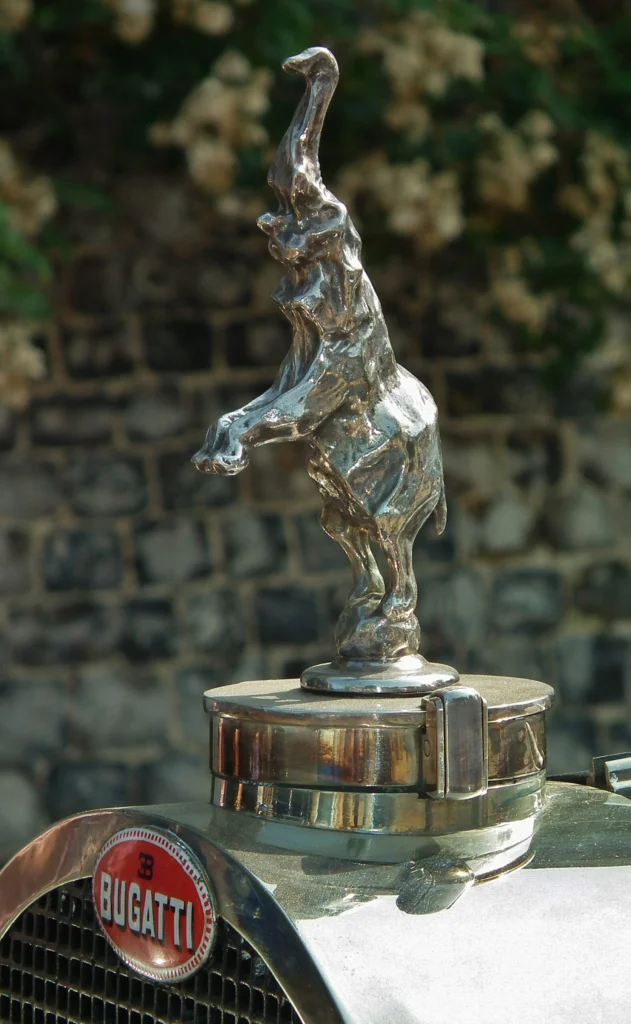
Very few objects let a collector hold a piece of the Bugatti Royale without owning one of the cars, and fewer still come from the Royale that Ettore Bugatti kept for himself. The silvered-bronze elephant that stood on the radiator of his personal Type 41, the Coupé Napoléon, is one of them. It spent decades in the orbit of Fritz Schlumpf, the Mulhouse textile magnate whose appetite for Bugattis produced episodes like the $85,000 Shakespeare collection deal. On November 30 it will be offered by Germann Auction House in Zurich as Lot 41, a coincidence of numbering that will not be lost on anyone in the room, with an estimate of CHF 200,000–250,000 (roughly €210,000–270,000, or $250,000–310,000).
The provenance is the headline. The price is the story. This exact mascot sold at Molsheim in July 2009 for €238,000. Its only known sibling, the other period cast to come out of the Schlumpf family, made €229,500 at Christie’s in Paris in 2015. Seventeen years after the first sale, the estimate sits almost exactly where the 2009 result landed. For an object tied to the most mythologized automobile of the prewar era, that flat line says something precise about how the market values automobilia, even at the very top.
What is actually being sold
The model is Rembrandt Bugatti’s Petit Éléphant dressé of 1904, an elephant rearing on its hind legs with its trunk raised, developed from his studies of animals at the Jardin des Plantes in Paris. Rembrandt, Ettore’s younger brother, was among the most gifted animalier sculptors of his generation. He took his own life in Paris in January 1916. When Ettore and his son Jean created the Type 41 a decade later, they adapted the elephant as the car’s radiator mascot in tribute, and the Valsuani foundry cast a small number in silver-plated bronze.
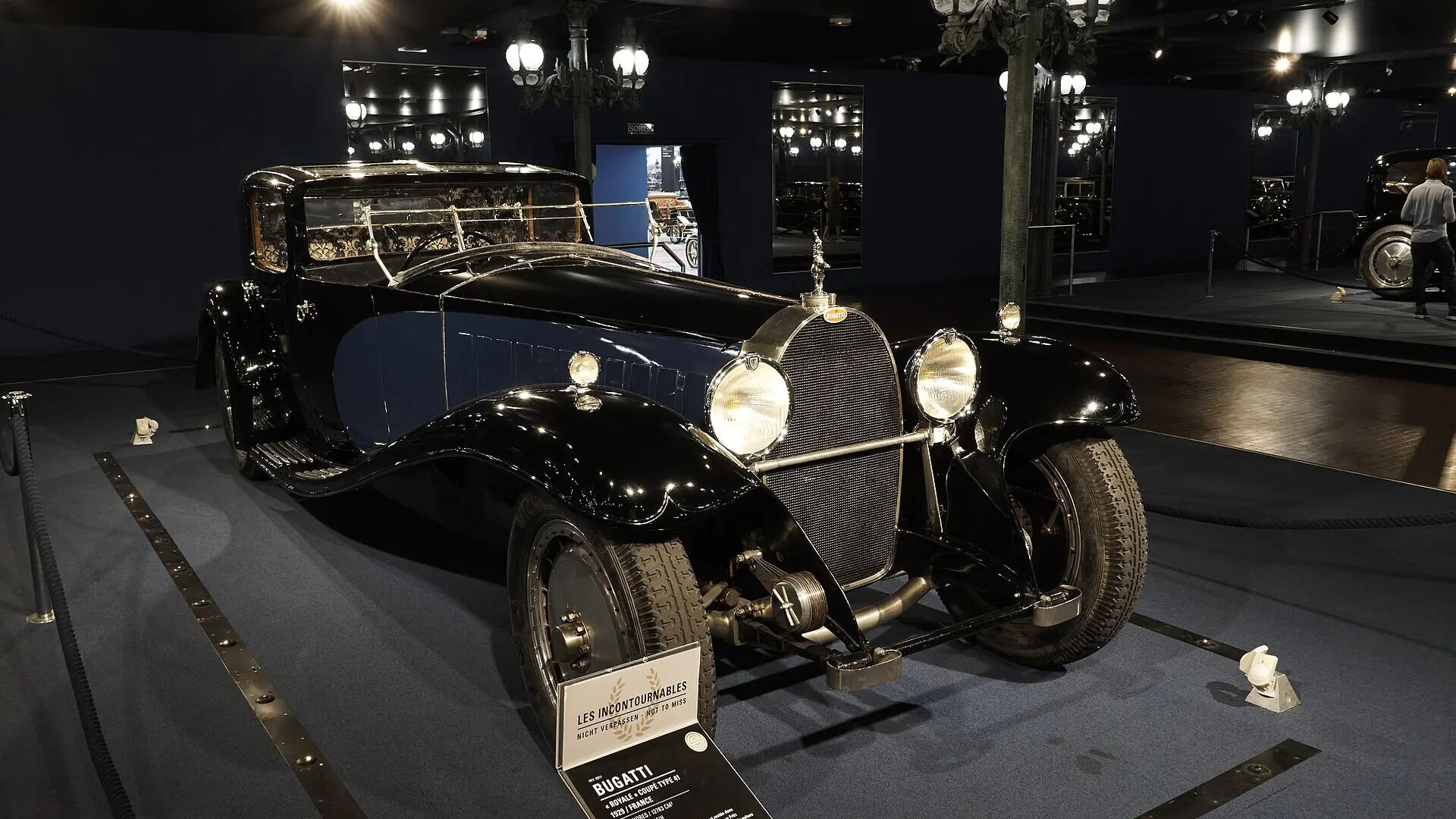
The Germann lot stands 190 mm tall, carries the foundry stamp “CIRE PERDUE C. VALSUANI,” and is catalogued as the mascot from chassis 41100, the Coupé Napoléon. Only six production Royales were built, which is why the Type 41 sits on any serious list of the rarest classic cars ever made, and Ettore held on to the first of them. Véronique Fromanger, author of the Rembrandt Bugatti catalogue raisonné in which the model is listed as no. 44, confirmed the mascot’s authenticity in October 2026.
A provenance chain with four links
Fritz Schlumpf bought the Coupé Napoléon in 1963, when the remaining Bugatti holdings were sold, and added a second Royale, the Park Ward limousine, the following year. The car is now part of the national collection in Mulhouse, where it is displayed at the Cité de l’Automobile. The elephant took a different path. It passed to the Schlumpf family by inheritance, was sold at the Schlumpf estate auction held by Étude Gasser Audhuy at the Hôtel de la Monnaie in Molsheim on July 5, 2009 (Lot 198), and has been in Swiss private hands since.
That separation is the reason this object exists on the market at all. The Coupé Napoléon is a museum car and is not going anywhere. Germann states that only two original period casts of the mascot are known, both from the Schlumpf collection. One of them is the closest a private collector can now come to Ettore Bugatti’s own Royale.
Why the price has stood still
Three forces explain the flat line, and none of them reflects weakness in the object.
The buyer pool is split. Germann is not selling the elephant at a car auction. It opens the house’s Part I sale of paintings, works on paper and sculpture, which frames it as a Rembrandt Bugatti bronze first. Yet to an art buyer it is a small-format mascot rather than one of the sculptor’s major animal studies, and to a car collector it is a part that has been separated from its car. The object lives where two markets intersect, and intersections are thin.
The image is everywhere. The rearing elephant has been reproduced by the Franklin Mint and the Bugatti Owners’ Club and reissued in crystal by Lalique, and the modern company still trades on it, as the one-off Chiron Super Sport “Éléphant Blanc” showed. Familiarity with the motif doesn’t raise the price of an original. If anything, it makes the original harder to explain to anyone who has not studied it.
The comparables are tight. €238,000 in 2009, €229,500 in 2015, and an estimate of €210,000–270,000 in 2026: three data points over 17 years, all within a narrow band. That is a market that has found its level, not one that is drifting. It also means that in real terms, after nearly two decades of inflation, the estimate values the elephant below what it cost in 2009.
Provenance has to be carried. While an object stays on the car that gave it meaning, the car carries the story. Once it leaves, the documents have to carry it, and documents do not appreciate on their own.
What serious buyers should check
- Period cast versus later cast. A Valsuani stamp alone does not make a Royale mascot. Silvered-bronze Valsuani casts described as posthumous have come to auction carrying estimates of €120,000–160,000, as at Artcurial’s sale of Pasquale Giordano’s mascot collection. The premium on this lot comes almost entirely from the documented chain back to chassis 41100.
- The material description. Christie’s catalogued the 2015 sibling as silver; Germann describes this example as silver-plated bronze. The difference may come down to cataloguing convention rather than metal, but at this level a buyer should ask what the description rests on.
- The paperwork. The 2026 Fromanger certificate, the 2009 Gasser Audhuy catalogue entry and the Schlumpf family provenance are the asset. Ask to see originals, not summaries.
- Landed cost. Budget for the buyer’s premium and, if the elephant leaves Switzerland, import VAT at its destination. On a six-figure object, the gap between hammer price and landed cost is material.
Significant, not speculative
Is this genuinely significant or simply expensive? Significant, without question. It is one of two known period casts of the emblem of the most ambitious car of its age, and it comes from the car its maker drove. But significance and appreciation are different things. A result within estimate will confirm a price band set in 2009 rather than break it, which is a useful reminder that at the top of the automobilia market, collectors pay for a moment in history, not for growth. Whoever wins Lot 41 should be buying the elephant, not a return.
Sources: lot description and estimate from Germann Auction House; provenance and 2009 result reported by The Bugatti Page; 2015 Christie’s Paris sale reported by RTBF and France 3 Grand Est.
The collector car market, every weekday morning.
Auction results, price moves and what’s crossing the block, read in four minutes. Free, from Modern Car Collector.
No spam, unsubscribe in one click. Or read more about the Brief.
Related Posts:
- The Delahaye 165 That Went to Sea Just Won Newport.…
- The $85,000 Bugatti Deal That Changed Automotive History

- Zurich Didn't Re-Rate Bugatti's Legends Veyrons. It…
- Six of the Rarest Classic Cars Ever Made

- We’ve Never Seen So Many Bugattis For Sale At Once
- Three LaFerraris, Three Rooms, and the Estimate That…

 Shawn Henry