

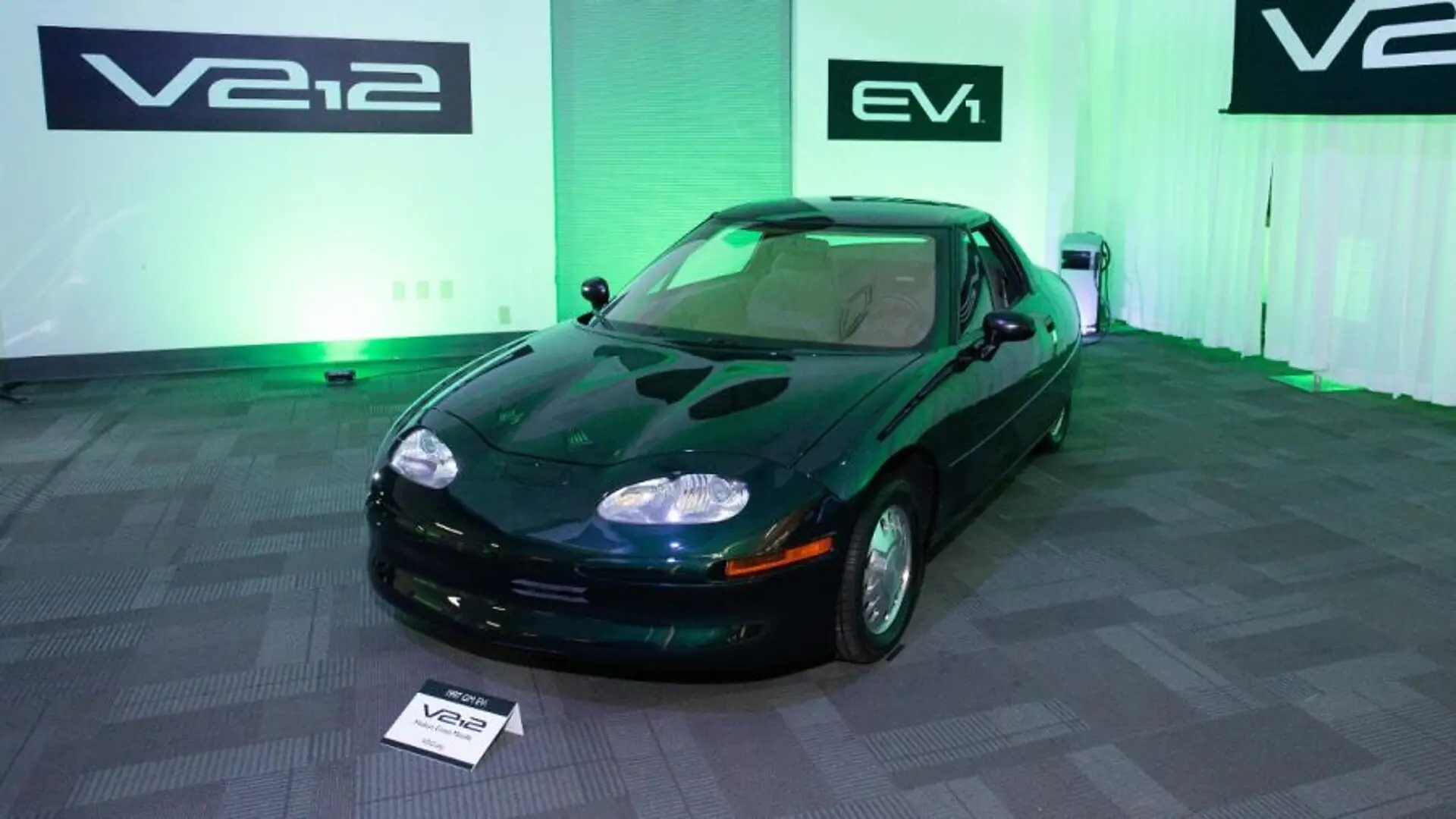
For two decades, the General Motors EV1 has been the rare collector car whose scarcity was engineered on purpose. GM leased roughly 1,000 of them, took them back and crushed most of the fleet. It then released a handful of disabled survivors to museums and universities on the condition that they never be driven again. Rarity of that kind usually helps a car’s value. Here it worked the other way: there was nothing to collect, because nothing could legally be owned.
That is why V212 matters. On November 14, 2026, thirty years to the day after the first EV1 customer cars drove away from the factory, a dark green 1997 EV1 bearing VIN 212 drove out under its own power in a building in Fairfield, Ohio. Its owner, software engineer and early-EV collector Billy Caruso, bought it as a water-logged wreck at a Georgia impound auction on October 28, 2025. By the team’s count, 383 days later it was finished. The modern-classic collectors watching online will be tempted to read this as a restoration story. It is really a story about ownership. Every other surviving EV1 exists by permission. V212 exists by title.
The Car That Slipped Through
The EV1 was never sold. GM built the cars at a dedicated facility in Lansing, Michigan, and leased them through Saturn dealers in California and Arizona starting in late 1996. When the program ended, the company recalled the cars and destroyed most of them. The few that escaped were deactivated and handed to institutions under paperwork that limited them to educational or exhibition use and barred the new keepers from ever putting them back on the road. That paperwork became public this year when The Questionable Garage, the YouTube workshop working on V212, showed an example on camera.
V212 escaped that process. GM has said the car “slipped through the cracks,” without explaining how. It surfaced, sun-bleached and battered, in a Georgia impound lot. A court-ordered sale followed, and in GM’s own account, the winning bid of more than $100,000 marked the first time an EV1 had ever been publicly sold. That sentence matters more than the dollar figure. A car with no public sales history has no market. One sale creates a reference point, a chain of title and, for the first time, the possibility that an EV1 could someday change hands again.
The condition was dire. A garage had collapsed on the car. Water had reached almost every electronic module and corroded it. The windshield was broken, the seats and dash were rotting, and Caruso reported early on that the charge cable had been cut and key control electronics were missing. For a car whose drivetrain was built entirely from EV1-specific hardware, much of it destroyed along with the rest of the fleet, that list could easily have ended the project.
GM’s About-Face Is the Provenance
What saved it was the company that once tried to make cars like it disappear. GM President Mark Reuss saw video of the auction and asked his team to contact the buyers. Then he met Caruso and Jared Pink of The Questionable Garage in person. “Whatever you need, we’ll help,” Reuss told them on camera. In March, GM confirmed publicly that it was supporting what the team calls Project V212. The company invited the crew to its Global Technical Center in Warren, Michigan, where GM’s design fabrication staff removed parts from a GM-owned donor EV1.
That donor was V159, a red car from GM’s own inventory. It gave up the trunk and latch, among other pieces, so V212 could be completed. Over the following months the team visited the Pontiac Engineering Center, Factory ZERO and the Milford Proving Ground. Original EV1 program engineers worked alongside current GM staff, and the Mechanical Assembly group that maintains GM’s historic fleet donated heritage components.
For collectors, this is the overlooked detail. Factory involvement is normally discussed in terms of authenticity: a build sheet, a heritage certificate, a marque specialist’s inspection. Here GM’s participation does something more fundamental. It turns an object the manufacturer once treated as contraband into one it has publicly embraced. A future buyer of V212 will not be wondering whether GM might someday want the car back. The company documented its own help in its newsroom. In the collector market, the most valuable document is sometimes not a certificate at all. It is the absence of a restriction.

Restored, Not Preserved, and That Is the Point
Collectors trained on matching numbers and unrestored survivors should be clear about what V212 is now. It wears fresh paint by Paintucation. It has a new battery pack, a new windshield, new wheels and tires, and replacement seat frames; the originals were magnesium and too corroded to save. It also carries body parts and components taken from another car. By the logic applied to a 1960s Ferrari, that is a lot of non-original material.
That logic does not fit here, for two reasons. First, an electric car’s traction battery is a consumable, closer to tires than to an engine block. No running EV1 from 1996 or 1999 could plausibly still use its factory cells, and expecting one to would be like asking a vintage race car to keep its original brake pads. Second, V159’s parts are EV1 parts from GM’s own stock, fitted with GM’s knowledge. They are period-correct factory components with a documented source, which is the standard that sophisticated buyers of rare cars apply to replacement parts everywhere.
The more meaningful test of originality is what the car does. On November 14, the 12-volt systems were live, the dash lit, the radio played and the pumps ran. Caruso entered the five-digit code on the console’s Run-Shift Assembly, put it in gear and rolled out beneath a recreated “First Drive Away” banner dated November 14, 1996. According to GM, more than two decades had passed since a private owner last drove an EV1. Several of the people who designed and built the original were there to watch.
Why the EV1 Earns a Place in the Canon
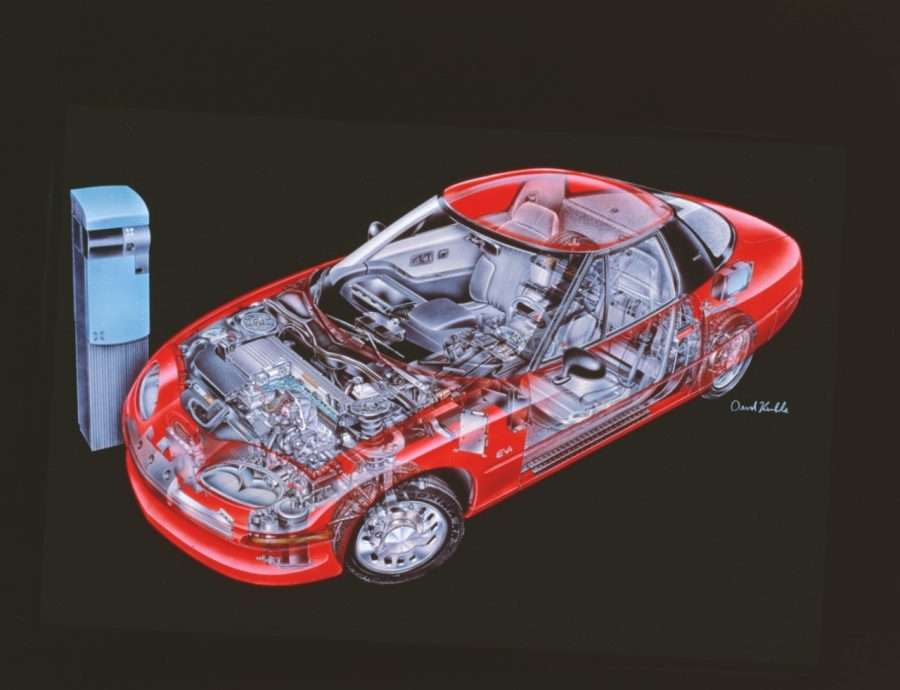
Strip away the controversy and the EV1 still holds up as an engineering object. It was a purpose-built electric car from a major automaker, not a gasoline model converted to batteries. It used an aluminum space frame to save weight, low-rolling-resistance tires developed for it, an aggressively aerodynamic body and fully electronic controls for the accelerator, brake, parking brake and gear selector. GM credits it as the first vehicle to use a heat pump for climate control, technology every GM EV now uses. Its blend of regenerative and friction braking is the direct ancestor of the one-pedal driving found in the company’s current products. GM has put it plainly: “EV1 set in motion everything we’re doing in electric right now.”
That is the profile of a historically important car: a technical first whose ideas became industry standard, built in tiny numbers, with a cultural afterlife of its own. The 2006 documentary Who Killed the Electric Car? turned the EV1’s demise into a story that buyers who were children in the 1990s know well. They are exactly the generation now driving demand for the period’s cars. Collectors rarely pay a premium for technology alone. They pay for cars that mark the moment an industry changed direction.
What It Means for the Market
It would be easy to treat the $104,000 auction result as a valuation. It isn’t one. It was paid for a non-running wreck by a buyer who understood he was acquiring the only EV1 he could ever own outright. That figure set a floor for a car with no comparables, not a market price. A fully restored, running, GM-supported V212 is a different asset. What it might bring if ever offered is guesswork, and any figure would be a fiction.
Two caveats deserve attention. The first is liquidity. A market of one car has no depth. Its value would rest on a small number of institutions and serious early-EV collectors who want the only drivable EV1 in private hands, and that is a narrow pool. The second is serviceability. V212 now depends partly on GM’s goodwill and partly on a finite stock of EV1-only parts, one donor car of which has already been consumed. A future owner inherits the car and that relationship, and the relationship is not written into the title.
GM’s change of heart also speaks to a broader shift: manufacturers increasingly see their heritage as an asset to promote rather than a liability to manage. It mirrors the thinking behind the Ford Vault and its collection of historic cars, where the manufacturer’s curation is itself the value. It also echoes a pattern we have seen elsewhere, in which buyers pay for the end of an era rather than the car itself. With V212, GM has added a third variation: paying, in parts and engineering time, to rewrite the ending.
What Serious Buyers Should Take From V212
The lesson for anyone collecting compliance-era and early electric vehicles, from the Chevrolet S-10 Electric and Ford Ranger EV to Toyota’s first-generation RAV4 EV and Honda’s EV Plus, is that paperwork comes before condition. Many of these cars were leased, not sold. Many were returned under terms that limit what can legally be done with them. Before judging battery health or cosmetics, establish how the car left the manufacturer’s control, what agreements traveled with it and whether a clean, transferable title exists. Then confirm where replacement modules will come from. For these cars, electronics, not bodywork, decide whether a restoration is possible at all.
The broader point is simpler. V212 is not valuable because it is rare; every EV1 is rare. It is significant because it is the one example that can be owned, driven and eventually sold without anyone’s permission, and because the company that built it has now written itself into that car’s provenance. Thirty years after the first EV1 drove away, the most important one may be the car GM never meant to let go.
Sources
- General Motors: A GM EV1 drives again and brings a community together
- General Motors: Driving the future, then and now: the story of the EV1
- The Questionable Garage: V212 restoration (YouTube)
- The Questionable Garage: Project V212 visit to GM (YouTube)
- The Autopian: first-hand account of the V212 unveiling and drive
- The Drive: Inside GM’s decision to help restore a rare EV1
The collector car market, every weekday morning.
Auction results, price moves and what’s crossing the block, read in four minutes. Free, from Modern Car Collector.
No spam, unsubscribe in one click. Or read more about the Brief.


 Eve Nowell
 Shawn Henry