


Most restorations are additive: new paint, a rebuilt engine, a fresh interior. The more revealing line in Bugatti’s account of chassis 8.100 describes the opposite. The aluminum-bodied Veyron Grand Sport Vitesse that Modern Car Collector first reported on when it was offered for sale last December has been back to Molsheim, and part of the work was the removal of later personalization elements so the car could be seen again as it originally left the factory.
Forget the polish. Bugatti hasn’t disclosed a price anyway. The interesting part is that the factory took things off. This Veyron is a case study in how a manufacturer’s heritage program turns itself into the final authority on what “correct” means for a modern hypercar, and in why that authority may matter more with every year that passes.
A Veyron built around its material
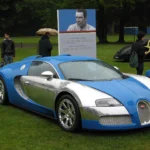
The car is a one-of-one Veyron 16.4 Grand Sport Vitesse, ordered in 2014 and completed in 2015, the final stretch of a production run Bugatti capped at 450 cars: 300 coupés and 150 roadsters. Its defining feature is a body of exposed, polished aluminum, which Bugatti says required blocks weighing up to 20 tons to be delivered to Molsheim. Inside, Carmine Red leather sets off exposed carbon fiber, polished aluminum and handcrafted details.

Underneath, it is a Vitesse in the full sense: the 8.0-liter quad-turbocharged W16 making 1,200 PS and 1,500 Nm. That specification is not incidental. In April 2013 a Grand Sport Vitesse reached 408.84 km/h (254.04 mph) at Volkswagen’s Ehra-Lessien test track, with Anthony Liu driving, to become the fastest production roadster in the world. A one-off commissioned on that platform is not a styling exercise on a lesser car; it is a bespoke body on the most capable open Veyron Bugatti ever built.
Why a factory certificate is the real asset
Bugatti launched La Maison Pur Sang at Rétromobile in 2020, and its first project was a Veyron: the first Grand Sport prototype, certified in 2021 as the first modern classic to receive the program’s authenticity certification. The pitch has not changed. Operating from Molsheim, the program researches a car’s history and provenance and confirms its authenticity, whatever its age.
For a series-production car, that is useful. For a one-of-one, it is close to indispensable. There is no sister car to compare against and no production population to benchmark a questionable detail. The only reference for what chassis 8.100 was supposed to be is the record kept by the people who built it, and Bugatti says every stage of its creation was documented in the Atelier at the time. The maker went back to its own archive, removed what was added later and signed off on the result. That’s more than a restoration. It’s the official version of the car’s provenance, written by the people who built it.

Subtraction as a collector signal
Bugatti does not say what the later personalization consisted of, who commissioned it, or what became of the removed parts, and buyers of any comparable car should ask all three. What the release does make clear is the direction of travel. The work focused on restoring the car to its original vision while protecting the character and provenance that define it. In this case the factory chose to subtract.
It did not have to. The same program has shown the opposite instinct this year. In August Bugatti unveiled the Veyron 20 Years at Monterey Car Week, a bespoke one-off restoration that went well beyond returning a car to stock, and in March it completed the restoration of a Veyron Super Sport prototype linked to the record-breaking era. La Maison Pur Sang will preserve, refine or reimagine, depending on the owner’s wishes. Each certified car therefore carries an implied statement of intent. Chassis 8.100’s is that originality is the scarcer asset.

What it says about the Veyron market
The Veyron has become a serious collector category, and this autumn’s Zürich results made the point that the market is discriminating between chapters instead of lifting the whole model. MCC’s analysis of what Zürich did and did not re-rate among the Legends Veyrons argued exactly that, and a separate piece on a Grand Sport Vitesse without a Legends badge made provenance, not specification, the real test. A certified, documented one-off sits squarely in that logic.
Caution is warranted. Bugatti has disclosed no sale price, and a single private transfer, in which the factory thanks Mechatronik for its part in the delivery and the photography, is not a market. When MCC reported the listing in December, the seller cited 497 miles and one owner, with pricing available only on request. Certification reduces uncertainty about what the car is. It does not tell anyone what it is worth.
What serious buyers should take from it
Ask what a certificate is built on. A factory document is strongest when it rests on contemporary build records, as it does here, and weakest when it merely blesses a car’s present state. Ask what was changed after delivery and whether the factory documented its removal. And treat “as delivered” as a claim that someone with authority has to verify, not a description a seller can supply.
Originality used to be something a car kept by being left alone. Now Molsheim hands it out. Is that a better guarantee, or just a more expensive one? If you owned a hypercar with dealer-added bits, would you send it home to have them removed?
Sources: Bugatti Newsroom, “La Maison Pur Sang: where engineering becomes art” (Oct. 15, 2026); Bugatti Newsroom, La Maison Pur Sang Veyron 20 Years (Aug. 20, 2026); Bugatti Newsroom, first La Maison Pur Sang certification (July 2021); Bugatti Newsroom, 408.84 km/h roadster record (April 2013); Bugatti Newsroom, final Veyron sold (Feb. 2015); Bugatti, La Maison Pur Sang.
The collector car market, every weekday morning.
Auction results, price moves and what’s crossing the block, read in four minutes. Free, from Modern Car Collector.
No spam, unsubscribe in one click. Or read more about the Brief.
 Shawn Henry
 Eve Nowell