
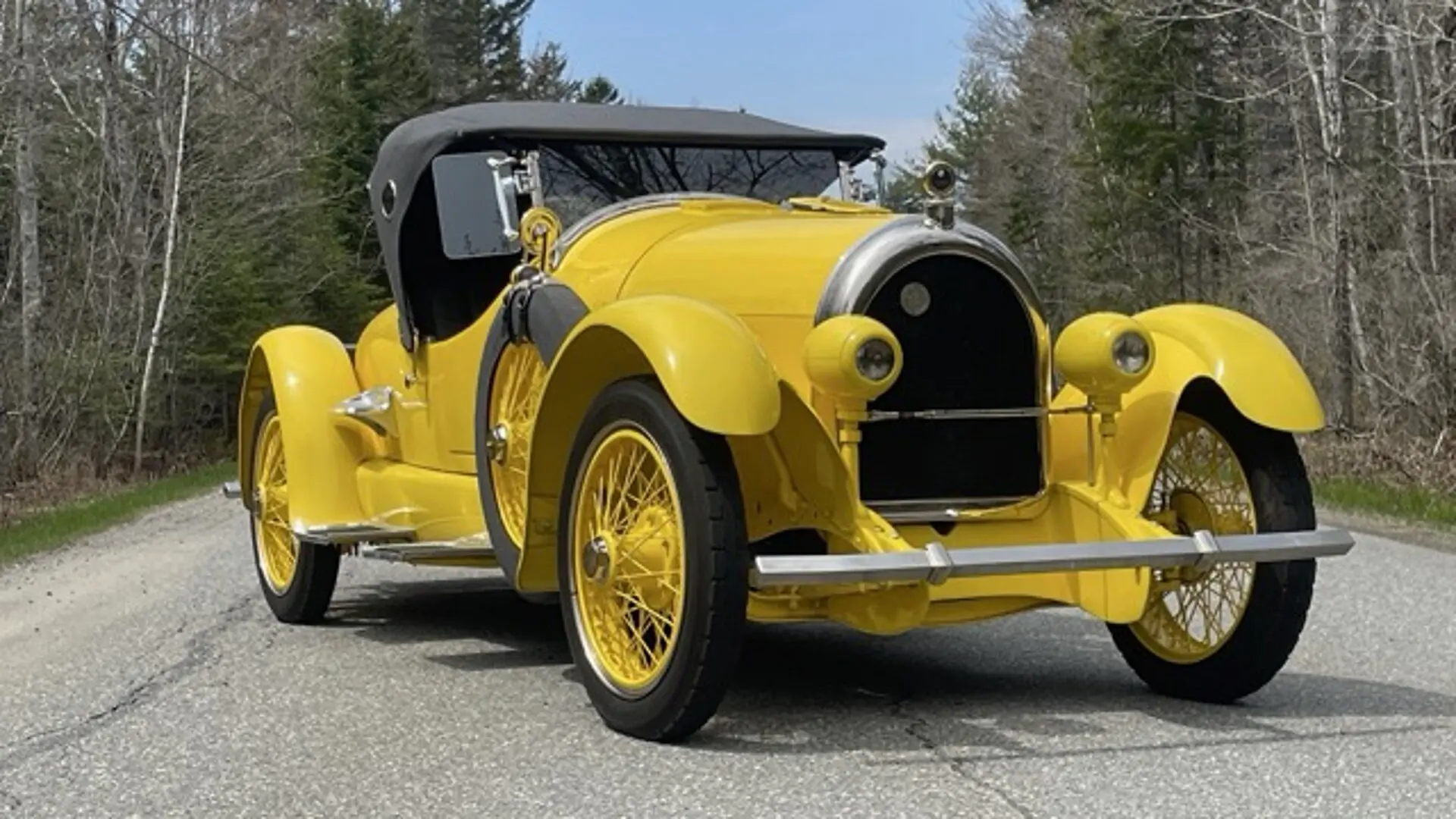
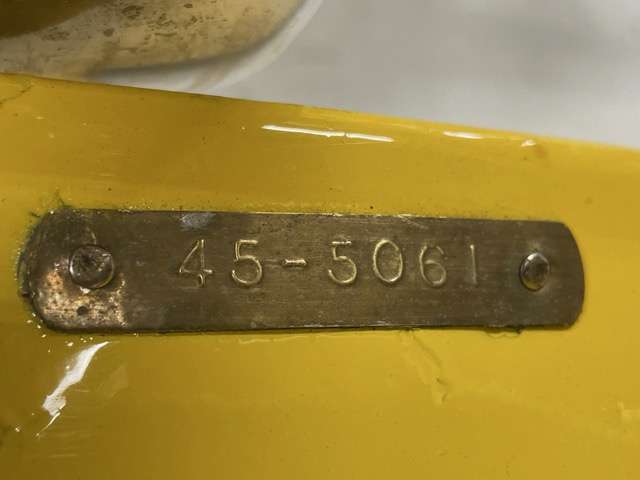
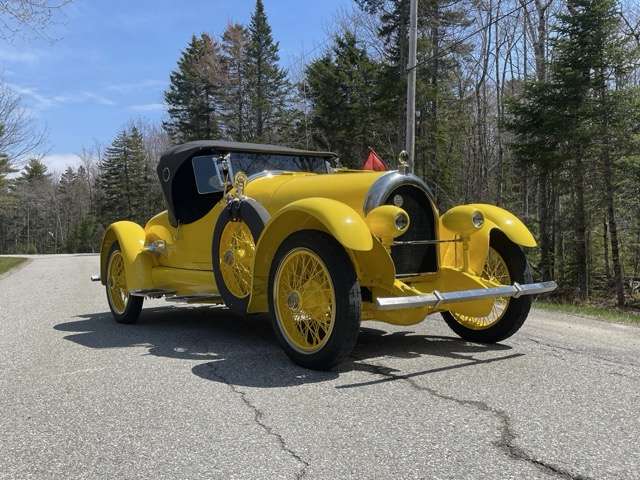
Every Kissel Gold Bug has the same raw material: a Hartford, Wisconsin, chassis, a six-cylinder engine, a boat-tailed two-seat body and a coat of Chrome Yellow. What separates one from another is rarely visible from the show field. When chassis 45-5061 crossed the block as Lot 070 at the Owls Head Transportation Museum’s 48th New England Auto Auction on August 22 and sold for $244,750, buyers were not paying for the shape. They were paying for the file. As with the Packard 734 Speedster whose value rested on who owned it, the price makes sense only once you read the history attached to the car.
The result has been described elsewhere as a record for the marque. It is not. Bonhams sold a 1926 Kissel 6-55 Gold Bug for $286,000 in Scottsdale in January 2015, and a second 6-55 brought $209,000 at the same sale a year earlier. What Owls Head produced is something more useful to collectors: the strongest public result for an early 6-45 Gold Bug that we could find, achieved at a volunteer-run regional sale in Midcoast Maine, not at Monterey, Amelia Island or Scottsdale. That combination tells you more about how the pre-war market now works than a marque record would.
The Gold Bug in Brief
Brothers George and Will Kissel founded the Kissel Motor Car Company in 1906, and by the end of World War I the firm was building well-engineered, expensive cars for a prosperous clientele. The Speedster that became its signature product was conceived by Conover T. Silver, Kissel’s New York distributor, and introduced on the 6-45 chassis in 1919. The first Speedster shown publicly, at Chicago, wore Kissel’s Chrome Yellow, and the factory adopted “Gold Bug,” the winning entry in a naming contest, as the car’s popular identity. The 6-45’s inline six made roughly 61 horsepower; the larger 6-55 followed in 1923 and carried the body through 1927.
The Gold Bug’s cultural reach was outsized for a small Wisconsin maker. It was the speedster of choice for a Jazz Age generation of celebrities, with Douglas Fairbanks, Al Jolson and Jack Dempsey among the names associated with the model. Survivors are scarce: the Owls Head listing estimated roughly 35 remain, and a 2026 Broad Arrow catalogue put the figure at fewer than 40 Kissel Speedsters of all types. Early 6-45 cars are the thinner slice of that population.
A Life That Can Be Accounted For
The car’s first owner was Henry P. Kraft, who had begun as an apprentice to Augustus Schrader in 1882 and worked on the valve patents that still carry the Schrader name. Kraft became president of the company in 1922 and bought this Gold Bug the same year. He died in 1924, and the car passed through several hands before settling with Jackson Barnhart, a Jazz-era saxophonist who kept it for more than 40 years. Its most recent owner then spent roughly a decade restoring it.
That chain matters more than it would on a later car. Pre-war automobiles routinely lose their early decades to wartime scrap drives, barn storage and undocumented parts swaps, and a great many Gold Bugs survive with gaps in the record. The consignor’s claim that 45-5061 can be traced from original owner to the present, supported by surviving documents, is unusual in this model. It is the reason a bidder could pay a premium with confidence, not hope.
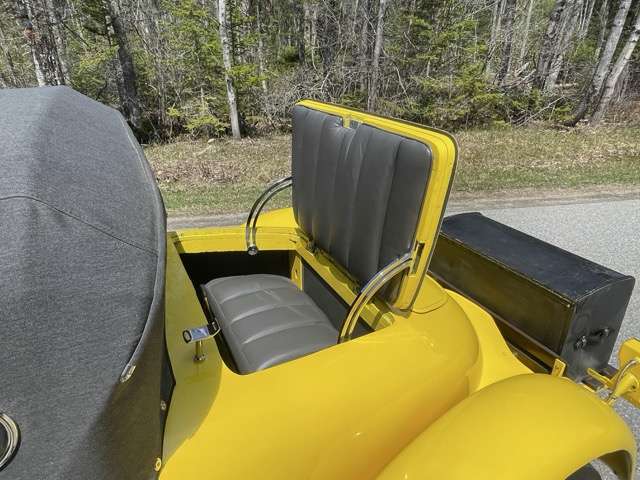
The body adds a second distinction. Gold Bugs are known for their pull-out outrigger seats, which slid from the body sides to carry extra passengers precariously. This car instead has a rear rumble seat, and the listing describes it as the only known surviving Gold Bug so equipped. Here is where collectors should be careful: a one-off configuration on a car this old raises the obvious question of whether it was factory, dealer or later work. The consignor’s documentation and the Kissel Kar Klub’s records are the place to settle that, and a variation is worth a premium only when its origin is proven. The bidding suggests the room was satisfied.
Restoration: Faithful, Not Pretend-Original
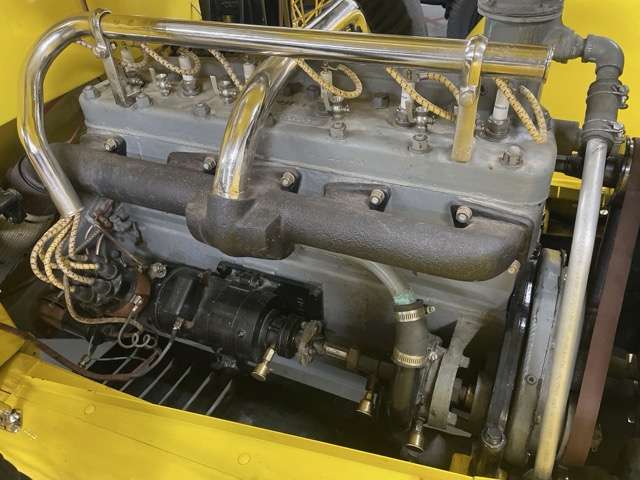
Nobody should mistake 45-5061 for a preservation car. The restoration was comprehensive, and the listing is candid about it. The original engine was professionally rebuilt, with records on file. Rotted structural wood was replaced with hand-made pieces patterned on the originals, and some body panels were recreated the same way. The aluminum running-board steps were recast from molds taken from the originals. Dayton Wheel re-spoked the wire wheels while retaining the original hub centers. Upholstery, top and paint are new, and the car had covered only about 13 miles since completion, all on museum grounds.
This is the correct approach for a wood-framed 1920s car, where original timber is often structurally finished, and the decision to copy instead of reinterpret is what protects value. The practical caveat is that a fresh restoration with 13 miles on it has not been sorted. A buyer should budget for a careful break-in and the inevitable teething work before taking it on tour.
The Overlooked Comparison
The most instructive Gold Bug sale of the past decade is not this one. In March 2019, RM Sotheby’s sold the car catalogued as the earliest surviving Kissel Speedster, a 1919 6-45 that predates the Gold Bug name, for $196,000 at Amelia Island. When it was offered again from the Janet Cussler Collection at RM’s Arizona sale in January 2025, carrying a Best in Class award from the 2024 Arizona Concours, it brought $123,200. It is not an isolated case. A 6-45 Gold Bug carrying chassis number 1964 sold for $165,000 at Greenwich in 2014 and for $106,400 in Monterey in 2023. On the 6-55 side, RM sold a 1926 car at Hershey in October 2024 for $195,250.
Put those numbers side by side and the lesson is plain. Being the earliest survivor of an important model did not hold value, and neither did a Gold Bug’s reputation alone. Being the best-documented example of one did. In the pre-war market, a complete paper trail now outranks an early chassis number, and Owls Head is the latest proof.
What the Rest of the Sale Says
The Owls Head results sheet shows 189 vehicles sold from 214 that reached a result, an 88 percent sell-through, with 25 lots passed. The Kissel was the only car to clear $100,000. The next-highest result was $94,600 for a 1966 Corvette 427, and the Kissel brought more than two and a half times that figure.
The more telling contrast is with the other pre-war cars in the room. A 1910 Hudson Model 20 Touring Car made $22,000. A 1937 Packard 115C Tudor Sedan brought $14,950, a 1928 Chevrolet National AB Touring Car $9,625 and a 1924 Dodge Brothers Series 116 Touring Car $6,600. Generalist pre-war machinery remains soft, as it has been across the fall auction calendar, Hershey included. Owls Head did not reveal a rising tide for 1920s cars. It revealed a widening gap between ordinary pre-war cars and the handful with genuine sporting character, cultural recognition and a provable history. Collectors interested in that gap should study results like the Buck Jones Cadillac V-12 Speedster at Hershey and the pre-war icons of the Jack Shewmaker Collection, where the same premium for story and documentation shows up.
The venue deserves credit too. The Owls Head Transportation Museum, founded in 1975, stages the New England Auto Auction with its own staff and volunteers as its largest annual fundraiser. Consigning a car of this calibre there instead of a major house was a bet that serious buyers will find a properly presented, well-documented car wherever it is offered. Online bidding made that bet reasonable, and the result vindicated it.
What Serious Buyers Should Take From It
Start with the paperwork, because the museum’s own results sheet already got it wrong. It lists Lot 070 as a 1924, while the chassis plate, the listing and the ownership history all say 1922. Probably a typo. Get it corrected on paper before this car sells again.
Treat a unique body feature as an asset only when its origin is documented. And don’t read this price as a new floor for Gold Bugs. The 2025 result for the earliest survivor shows how quickly a well-known example can retreat when the story is thinner. A comparable 6-45 with a broken history should still be priced against the $106,000 to $165,000 band, not against $244,750.
In 1922 Henry Kraft bought a yellow speedster to be seen in. In 2026 someone paid $244,750 for the receipts. Kissel Kar Klub members: does anyone know whether that rumble seat left Hartford with the car? It’s the one question the file still has to answer.
Sources: Owls Head Transportation Museum 2026 New England Auto Auction results; Owls Head lot listing for chassis 45-5061; RM Sotheby’s Arizona 2025, 1919 Kissel Model 6-45 Speedster; RM Sotheby’s Hershey 2024, 1926 Kissel Model 6-55 Gold Bug Speedster; Broad Arrow Auctions, 1927 Kissel Model 55 Gold Bug Speedster.
The collector car market, every weekday morning.
Auction results, price moves and what’s crossing the block, read in four minutes. Free, from Modern Car Collector.
No spam, unsubscribe in one click. Or read more about the Brief.
Related Posts:
- The First Auburn 851 Speedster Heads to Hershey. Its…
- Supercharged 1936 Auburn 852 Boattail Speedster For…
- This 1930 Packard 734 Speedster Isn't Valuable…
- Record Ferraris, Rare Icons and 15,000 RPM: The Week…

- 1935 Packard Twelve Series 1208 Seven-Passenger…
- Early Porsche 356 Values Are Rising in Hagerty's…
 Shawn Henry
 Eve Nowell