

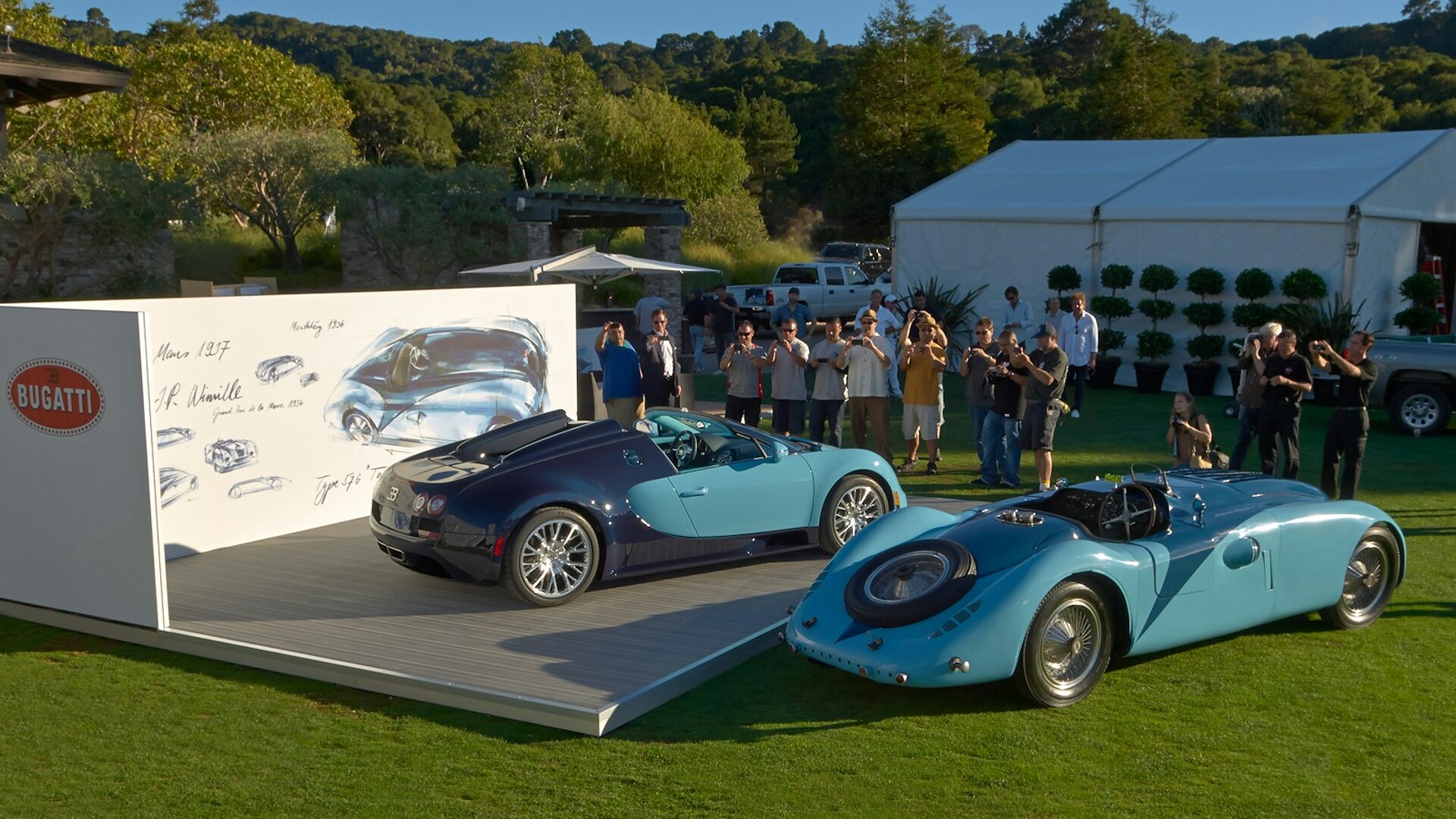
On Saturday night in Zurich, a 2014 Bugatti Veyron 16.4 Grand Sport Vitesse sold for CHF 4,505,000, about $5.4 million. It was the top result of RM Sotheby’s Zurich Auction. On paper, it has the same 1,200 horsepower, the same 410 km/h top speed and the same quad-turbocharged W16 as every other Grand Sport Vitesse. Yet it sold for about two and a half times what a standard Veyron has ever brought at auction.
The engine doesn’t explain the difference. The difference comes from a blue Bugatti that won Le Mans in 1937, and from the driver whose name is on the sill plates.
This is the ‘Jean-Pierre Wimille’ edition, one of three built and the first chapter of Bugatti’s Les Légendes de Bugatti series. Its result is the clearest evidence yet that the Veyron has changed category. It’s no longer valued as a used hypercar. The best examples are now traded as historical objects, and the Veyrons that tell Bugatti’s own history are pulling away from the rest.
The Room Told the Story
Look at the whole sale before the Bugatti alone. RM Sotheby’s had estimated Lot 113 at CHF 2.4–2.8 million. The all-in result cleared the top of that range by more than CHF 1.7 million. It also finished well ahead of the 1991 Ferrari F40, which made CHF 3,323,750, and of the René Arnoux–provenance 1969 Lamborghini Miura P400 S at CHF 1,805,000.
Several newer and technically more ambitious cars in the same sale did not sell on the night. RM’s results list them as “Price Upon Request.” They included a 2024 Mercedes-AMG ONE estimated at CHF 2.3–2.5 million, a 2020 Pagani Huayra Roadster estimated at CHF 2.5–3 million, a 2021 Ford GT Carbon Series and a 2016 Porsche 911 R. We asked in September what a nearly new AMG ONE is actually worth. Zurich gave a partial answer: less than its consignor hoped, at least on Saturday.
So the same bidders held back on the latest Formula 1–derived hypercar and then competed hard for a 12-year-old Veyron. That tells you what they were buying. It’s the same pattern we saw earlier this month, when the market paid up for certainty and walked away from everything else. In Zurich, the Veyron was the certainty: a finished story, not an open question.
Why Wimille, and Why It Matters
Bugatti revealed the Wimille car at Pebble Beach on August 16, 2013. Beside it stood the surviving Type 57G “Tank,” lent by Dr. Fred Simeone’s museum in Philadelphia. Molsheim built only three 57Gs, in 1936 and 1937. Jean Bugatti gave them a low centre of gravity and enveloping aerodynamic bodies wrapped around a 3.3-litre straight-eight of about 200 horsepower. In 1937, Wimille and Robert Benoist drove one to Bugatti’s first overall win at Le Mans, averaging 136.99 km/h over 3,287.938 kilometres.
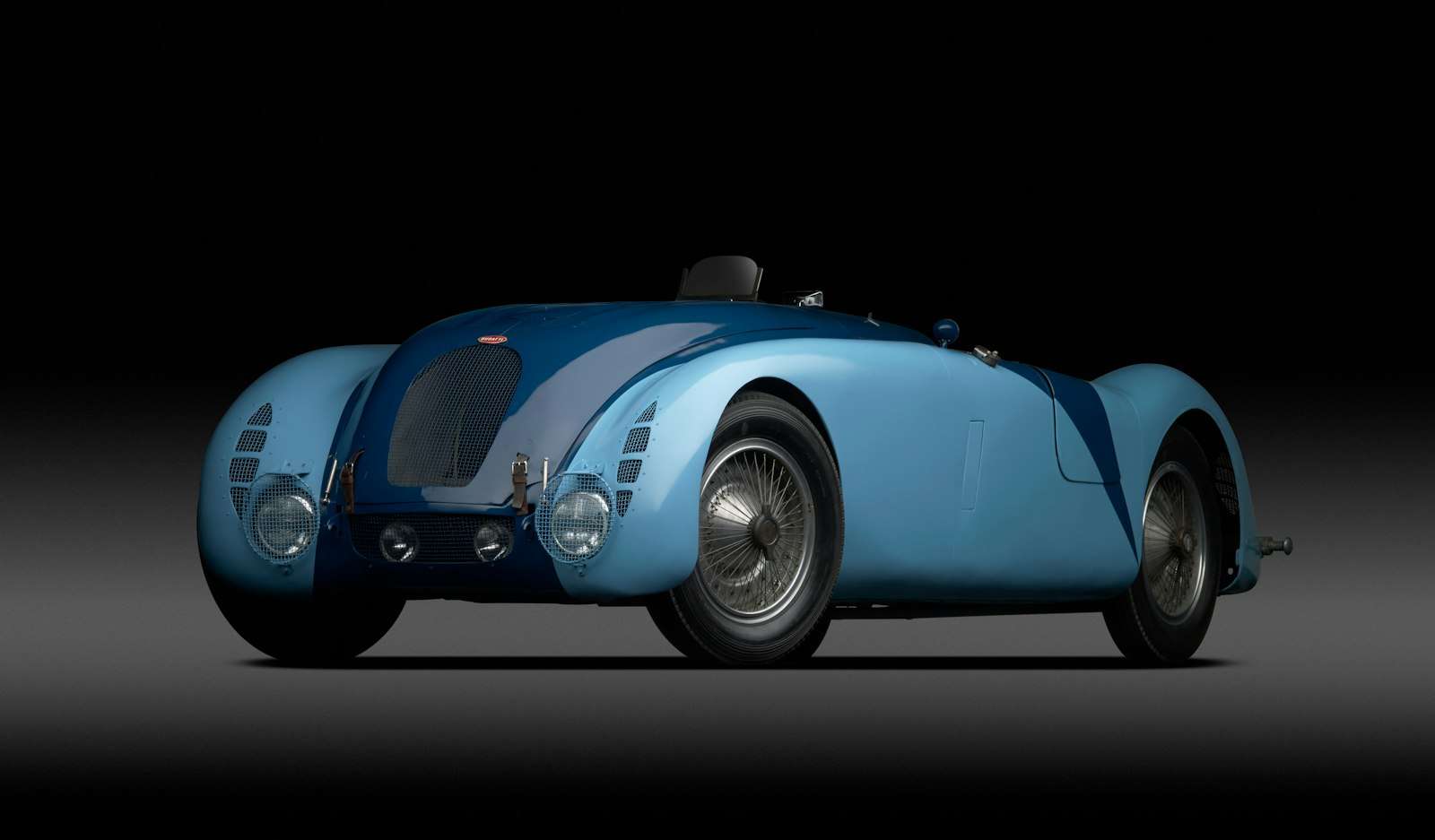
Two years later, Wimille won Le Mans again in a Type 57C Tank. His co-driver was Pierre Veyron, the man Volkswagen-era Bugatti later named its hypercar after. Many buyers overlook this detail, and it’s the one that makes this edition matter. The Veyron always carried a racing driver’s name without much racing substance behind it. The Wimille car closes that gap. It ties the modern car directly to the victory its namesake shared.
The execution is more careful than most special editions of its time. The exposed carbon body pairs dark blue weave with a specially developed Bleu Wimille on the front panels and doors, a direct reference to the Tank’s two-tone livery. The Circuit de la Sarthe is outlined under the active rear wing and milled in polished aluminium into the carbon lid of the centre storage compartment. Wimille’s signature is laser-engraved on the fuel and oil caps and embroidered into the headrests. The steering wheel and gear selector carry French tricolour cross-stitching. This is not a paint-and-badge package. It’s a car designed around one historical argument.
That argument is the real subject of this sale. Collectors rarely pay a premium for performance that has since been surpassed. They pay to own a piece of an event. A Grand Sport Vitesse was the world’s fastest production roadster in 2013. That claim has since been passed many times. A car built to honour Bugatti’s first Le Mans victory will never be superseded, because 1937 isn’t going anywhere.
Scarcity With a Structure
Rarity alone doesn’t explain the result. The Veyron world is full of small-batch specials. What sets the Legends cars apart is that Bugatti planned them as a set. There were six editions of three cars each, 18 in total, all on the Grand Sport Vitesse. They honoured Wimille, Jean Bugatti, Meo Costantini, Rembrandt Bugatti, Ettore Bugatti and the Type 18 “Black Bess.”
Bugatti’s own announcement from February 2014 confirms that the first three editions sold out at a net price of about €2.2 million each. Twelve years on, the first car in the series has sold for a little more than twice that in nominal terms. That’s a respectable return, not a spectacular one, once you account for inflation, carrying costs and a Veyron’s well-known servicing demands. The investment case is not the story here. The relative case is.
Consider the numbers. When Broad Arrow sold a low-mileage 2010 Veyron coupé for $2,205,000 in Las Vegas last October, the result was billed as a record for a standard Veyron. Zurich has now set a public data point for a Legends car at well over double that figure. The distance between an ordinary Veyron and a meaningful one is now measured in millions, not hundreds of thousands. The same split is already visible in the Bugatti EB110 market, where paperwork and provenance now set the price. It usually signals that a model has moved from car market to collector market.
Timing helps as well. Bugatti has spent 2026 telling its own history. The company revealed the one-off F.K.P. Hommage through its Programme Solitaire in January to mark 20 years of the Veyron. It also closed out road-going W16 production this summer. When a manufacturer starts treating its own recent past as heritage, collectors tend to follow, and first-generation cars with a clear place in that story benefit most.
Chassis 795063: What the File Shows, and What It Doesn’t
The car itself deserves a close look. RM’s catalogue records a delivery date of May 21, 2014, to a first owner in Dubai. Bugatti Dubai serviced it in May 2016, at 655 km, and again in October 2017, at 2,553 km. Registration documents show later ownership in Germany and then Switzerland. The odometer read 3,766 km at cataloguing. Owner’s guides are included, and the car sold on a Bill of Sale only.
Serious buyers should take note of three things. First, the published service history ends in 2017. A Veyron’s maintenance schedule is not optional, and at this level a bidder will have wanted the record for the years since, especially for tyres, fluids and time-based items rather than mileage. Second, low mileage is not the same as good condition. A Veyron that has barely moved needs recommissioning as much as one that has been driven hard. Third, the car was in Switzerland on a temporary import bond. The buyer must either export it with proper customs documentation or pay Swiss VAT and import duties to keep it there. That’s routine for an international sale, but it is a real cost that a headline price never shows.
None of this lessens the result. It explains why the file matters. With only three Wimille cars built and few reasons for their owners to sell, the next public comparison may be years away. Whoever sells next will be judged against this chassis, this mileage and this documentation.
What Collectors Should Take From Zurich
Take the price away and the lesson still holds. The first-generation modern hypercar is maturing into a collectible, but not evenly. Veyrons that can point to a specific moment, such as early production cars, record cars or a coherent factory tribute like the Legends, are being valued on history. The rest are still valued on condition and running costs, like very expensive used cars.
For buyers, the takeaway is not to chase every Veyron special. The Legends series earns its premium because each car is rooted in a documented piece of Bugatti’s pre-war history, from the Molsheim works to Le Mans. Special editions without that grounding may not follow.
For sellers of newer hypercars, Saturday’s lesson is harder. A Mercedes-AMG ONE carries a Formula 1 powertrain, and it still couldn’t find a buyer in a room that paid CHF 4.5 million for a Veyron. A newer car’s spec sheet is still being written. The Wimille car’s story was written at Le Mans, in 1937 and 1939.
Sources: RM Sotheby’s catalogue and official results, The Zurich Auction, September 26, 2026 (Lot 113); Bugatti press releases, August 2013 and February 2014; Broad Arrow Auctions results release, October 2025.
The collector car market, every weekday morning.
Auction results, price moves and what’s crossing the block, read in four minutes. Free, from Modern Car Collector.
No spam, unsubscribe in one click. Or read more about the Brief.
Related Posts:
- Collector Car Market Brief: A One-of-Three Veyron…
- Zurich Didn't Re-Rate Bugatti's Legends Veyrons. It…
- Restored 1937 Cord 812 Supercharged Phaeton For Sale…
- Ferrari Daytona SP3 Value Jumped 168% in Ten Months.…
- The Collector Car Market Paid Up for Certainty This…

- Ferrari F50 Value Nearly Tripled in Two Years.…
 Eve Nowell
  Shawn Henry