

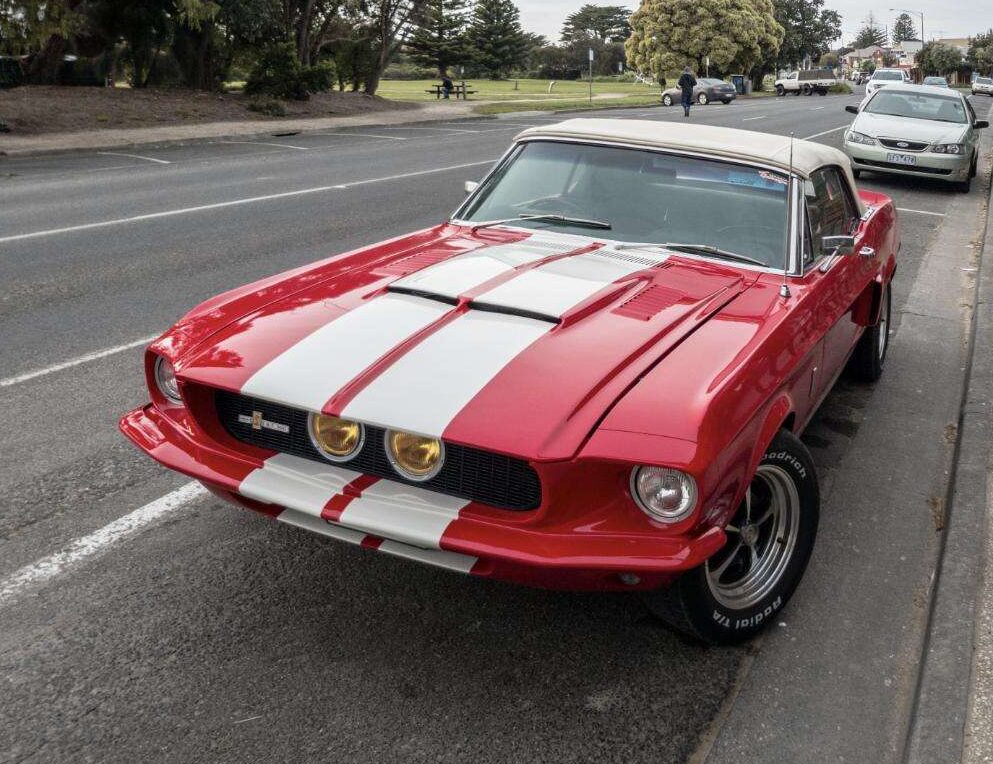
Five years ago today, on September 16, 2021, Barrett-Jackson opened its inaugural Houston Auction with a reunion decades in the making. Inside the official Ford Motor Company display at Houston’s NRG Center, Craig Jackson placed his fabled “Little Red” — the only Shelby GT500 notchback coupe ever built — alongside the only 1967 Shelby GT500 convertible ever produced. The two big-block prototypes had never shared a room before, and the pairing turned a routine auction preview into a genuine piece of Shelby history.
What Happened on September 16, 2021
At Barrett-Jackson’s first Texas sale, held September 16-19, 2021, the auction house used its new Houston stop to showcase two cars that had nothing to do with the auction docket itself: Jackson’s personal “Little Red” and a privately owned 1967 GT500 convertible carrying chassis number 67413C9A00139. Neither car crossed the block. Instead, both sat inside the Ford exhibit for the full run of the show — a display Jackson framed as a fitting way to mark Barrett-Jackson’s first Texas auction in the company’s 50-year history, and one he said put the two cars together publicly for the first time ever.
The Car Nobody Was Supposed to Find Again
Ford and Shelby American built “Little Red” in 1967 as an experimental GT500 — internally coded EXP500 — to trial ideas that never reached production as a single package: a restyled body, dual quad carburetors, twin Paxton superchargers, and a black Connolly leather interior. It served as the development mule for what became the 1968 California Special, making it a double concept car with a direct line to a production model. Shelby American sold the car after testing, and it disappeared into private hands for roughly fifty years until Jackson’s team traced it to a Texas field and confirmed its identity in 2018. A multi-year restoration followed, and the finished car made its public debut at Barrett-Jackson’s Scottsdale auction in January 2020 alongside its stablemate, the 1968 prototype “Green Hornet.” One-off Shelby news isn’t limited to the 1960s, either: Modern Car Collector recently covered the first-ever public sale of a one-of-one Shelby GT350/TA, another case of a unique factory car reaching the open market.
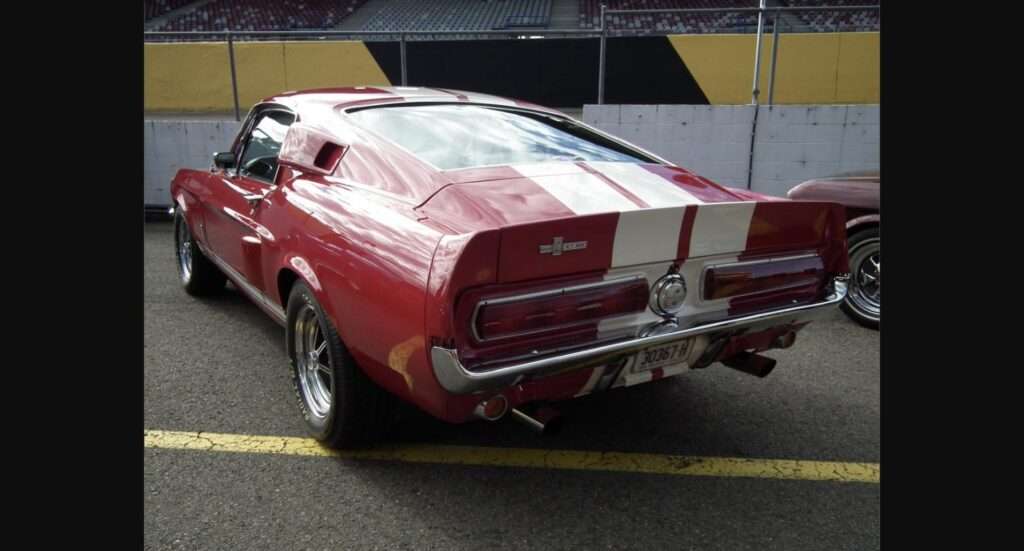
A 1967 Shelby GT500 fastback in red with white stripes, representative of the model debated in this story. Photo by Dietmar Rabich, CC BY-SA 4.0, via Wikimedia Commons.
The Convertible With an Even Odder Story
The car sharing the spotlight with Little Red in Houston has its own unusual claim to fame. Shelby American and Ford had planned a mid-year GT500 convertible for 1967, but production bottlenecks and the relocation of Shelby operations to Michigan killed the plan before it reached buyers. One convertible had already rolled off Ford’s San Jose assembly line and was completed as a GT500 with the marque’s dual four-barrel 428 “Cobra” engine, making chassis 0139 the only multi-carbureted Shelby Mustang convertible ever built — and, by extension, the only 1967 Shelby GT500 convertible in existence. Shelby researchers say it later served as the development template for the 1968 GT500 convertible line, giving it the same double-duty status as Little Red.
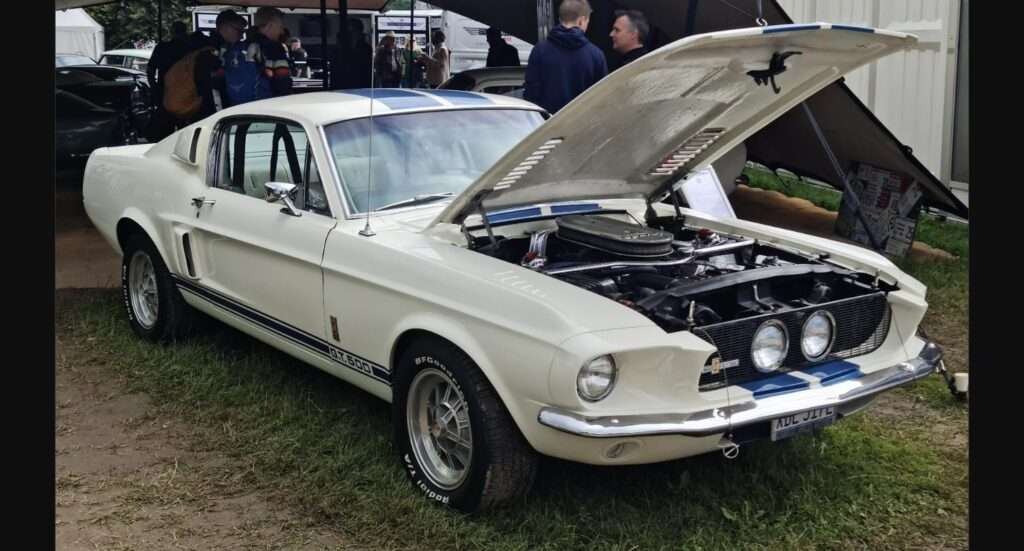
The GT500’s dual-quad-carbureted 428 under an open hood, a nod to the twin-supercharged, dual-carbureted engineering Little Red was built to test. Photo by MrWalkr, CC BY-SA 4.0, via Wikimedia Commons.
Why a Display, Not a Sale, Still Matters to Collectors
Because neither car sold in Houston, the event didn’t produce a hammer price collectors can point to — but it did something arguably more useful for cars like these: it added another documented public appearance to a chain of custody that is the entire basis of their value. Neither Little Red nor the GT500 convertible is a numbers-matching production car in the way a standard 1967 GT500 is. Their worth rests almost entirely on Shelby American factory build records, ownership research (much of it credited to Shelby historian Brian Styles), and continuous public documentation such as the Houston display, the earlier Henry Ford Museum unveiling, and two Barrett-Jackson-sponsored documentaries. For a similar lesson in how paperwork drives value more than horsepower, see our recent piece on the Bugatti EB110’s market at 35.
What a Standard 1967 GT500 — and a One-Off Prototype — Are Worth Today
A production 1967 Shelby GT500 in good condition with average options carries a Hagerty base value of roughly $175,000 today. Documented prototypes and one-off big-block Shelbys sit in an entirely different bracket. The most direct public comparable is chassis 0100, the original 1967 GT500 “Super Snake” built as a one-off promotional car; it sold at Mecum’s 2013 Indianapolis auction for $1.3 million. Neither Little Red nor the GT500 convertible has traded publicly in the current ownership era — both remain in private collections and are not currently for sale — so the Super Snake result is the closest benchmark collectors have for what a fully documented, one-of-one 1967 Shelby experimental car can bring if one ever reaches the block. Collectors curious how a numbers-matching alternative compares can look at a recent numbers-matching 1969 Shelby GT350 that went to auction at Carlisle, or the licensed 1967 Mustang “Eleanor” tribute that brought $550,000 at Barrett-Jackson’s inaugural Columbus sale — both useful reminders of how much of the Shelby market sits well below prototype territory.
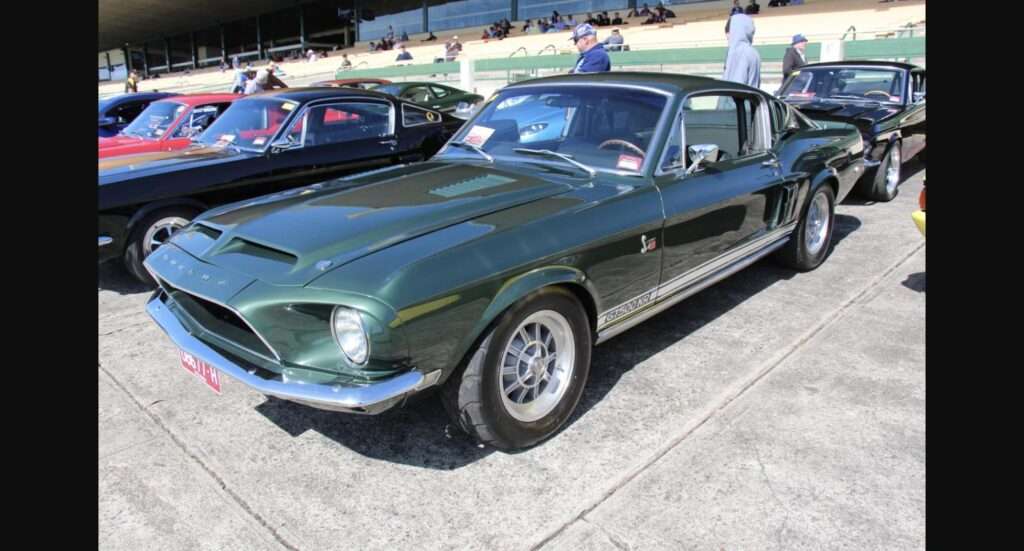
A Highland Green 1968 Shelby GT500KR, the production-line cousin of the “Green Hornet” prototype that shares Craig Jackson’s collection with Little Red. Photo by Sicnag, CC BY 2.0, via Wikimedia Commons.
What Collectors Should Know Today
- Prototype claims require paper, not stories. Little Red and chassis 0139 are valuable specifically because Shelby American factory records, continuous ownership research, and public exhibition history back up their identities. Treat any “experimental Shelby” without that paper trail as a clone until proven otherwise.
- A display isn’t a sale, but it isn’t nothing either. Museum and auction-house exhibitions build the documented public record that eventually supports a valuation if a one-off car ever changes hands.
- Use Super Snake money as your one real anchor point. At $1.3 million for chassis 0100 in 2013, a documented one-off 1967 Shelby big-block prototype is the best public comparable currently available for cars like Little Red.
- Standard production GT500s are a different market. At roughly $175,000 for a good #3-condition car, a numbers-matching 1967 GT500 remains far more accessible than any of Shelby’s one-off development cars, and is the realistic entry point for most collectors.
- Watch for future exhibitions. Jackson has shown Little Red and its siblings at Scottsdale, on A+E documentaries, and now in Houston; each public appearance adds to the documented history that will matter if the car is ever sold.
Sources
Barrett-Jackson — “Little Red” press release, September 16, 2021
Hagerty Valuation Tools — 1967 Shelby GT500
The collector car market, every weekday morning.
Auction results, price moves and what’s crossing the block, read in four minutes. Free, from Modern Car Collector.
No spam, unsubscribe in one click. Or read more about the Brief.

 EL Puckett
  Eve Nowell