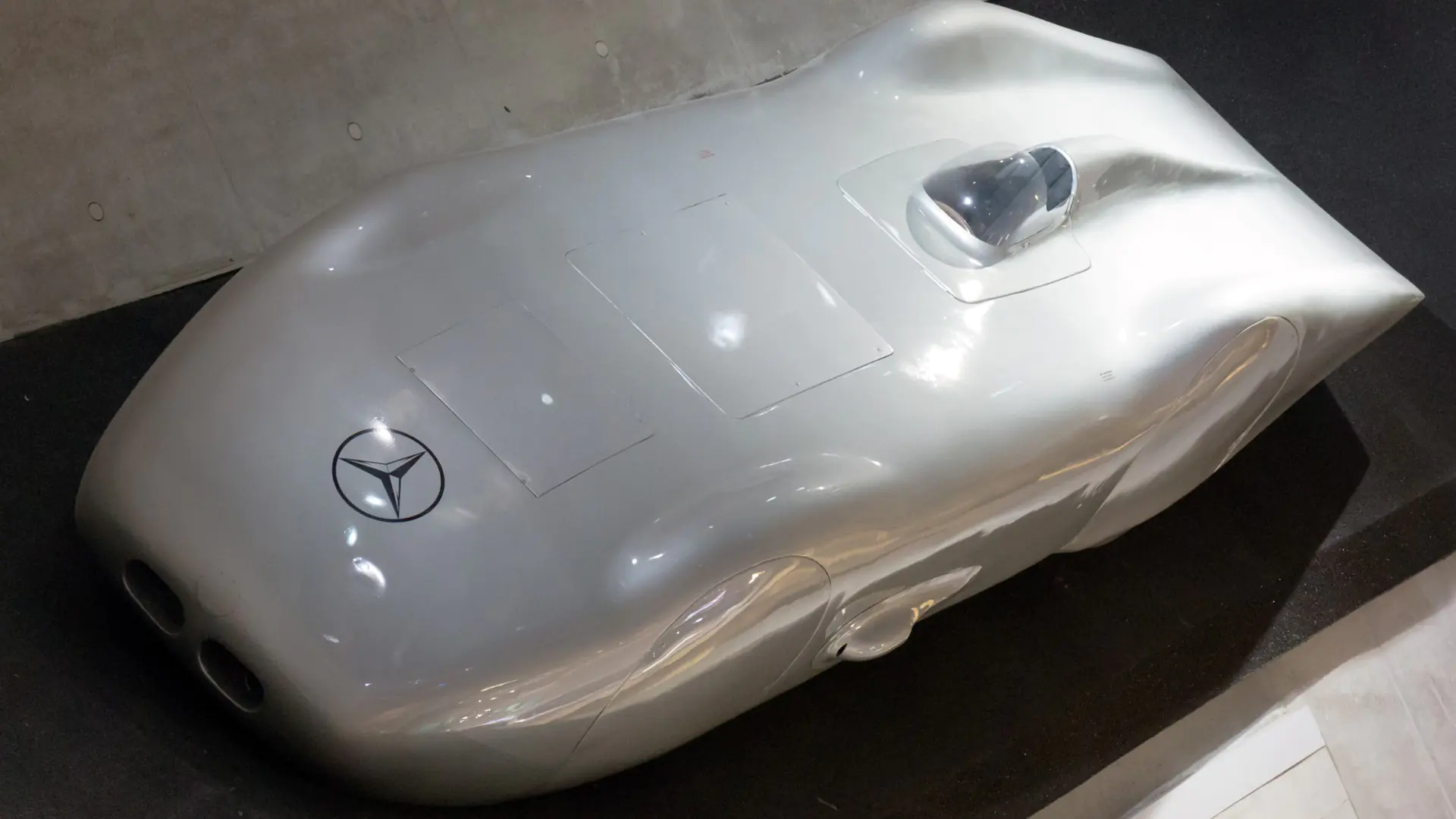
On October 26, 1936, Rudolf Caracciola took a streamlined Mercedes-Benz record car down the Frankfurt–Heidelberg autobahn, today’s A5, and recorded a peak of 372.102 km/h (about 231 mph) on the return leg of a mile run. The official figures were the two-way averages, and they still beat existing class records. For collectors, though, the Mercedes-Benz record car matters less for the number than for what it was: a purpose-built machine on a Silver Arrow chassis, and one step in a line of streamliners that now trades in a price bracket no grand prix car had reached before 2025.
The 1936 car itself is a different story from the one that sits in a museum today. This entry separates the two, because the history gets blurred often enough that it affects how collectors read the market.
A Silver Arrow Chassis Under a Different Skin
Daimler-Benz did not adapt a race car for the autobahn runs. The record car used the chassis of the W 25 Grand Prix car but wore a flatter, streamlined body with the wheels largely enclosed in the bodywork, an idea credited to the young designer Josef Müller after wind-tunnel work in Friedrichshafen. Under it was a new supercharged 5.58-litre V12 designated M 25 DAB, initially rated at 453 kW (616 PS).
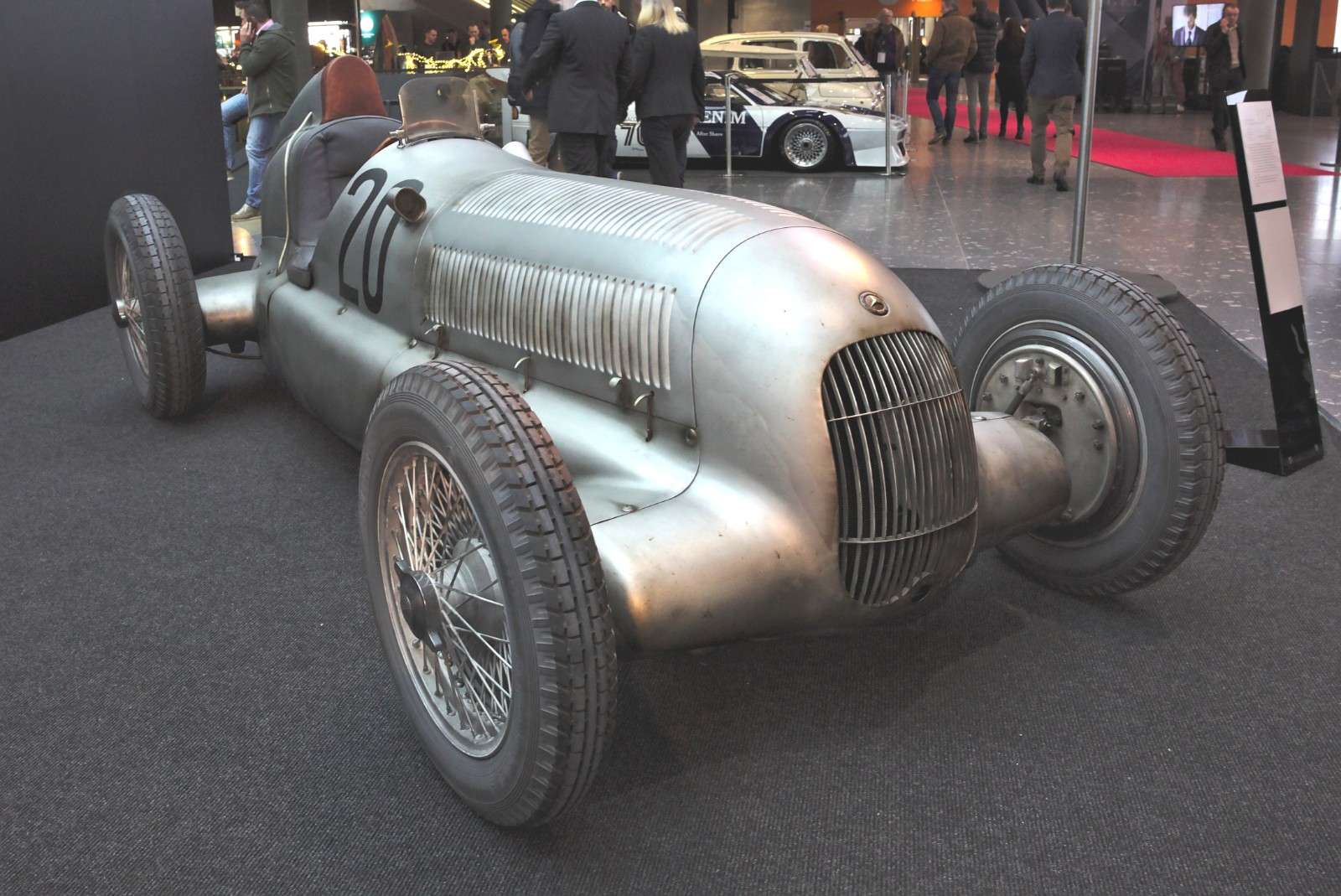
The driver was the obvious choice. Caracciola was the 1935 European Grand Prix champion, and record runs with standing and flying starts had been part of the racing calendar since 1934, under the 750-kilogram formula.
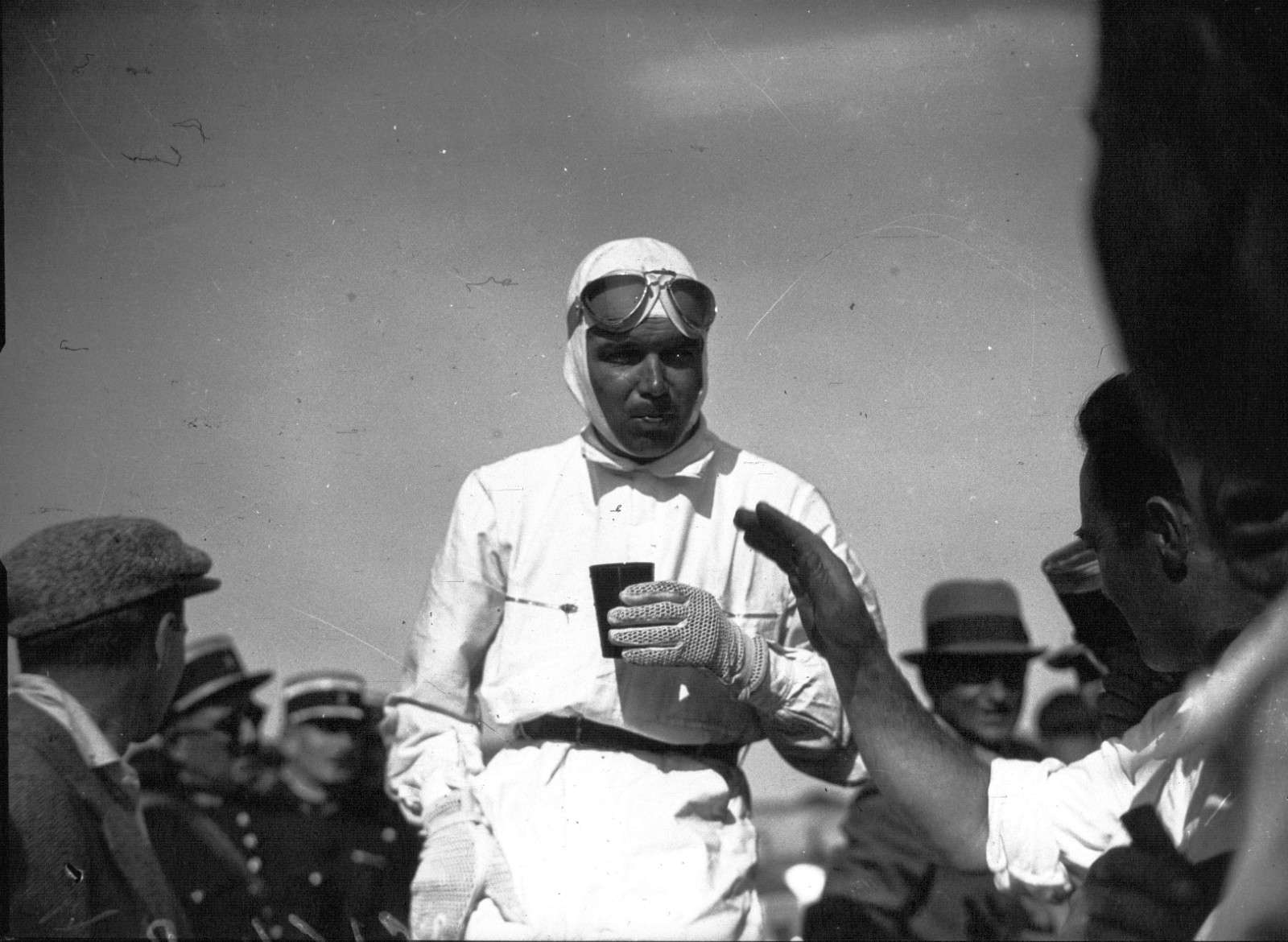
What Happened on October 26
The runs on October 26 produced three class records. Over the kilometre with a flying start, Caracciola averaged 364.38 km/h across both directions (about 226 mph). Over the mile, the two-way average was 366.9 km/h (about 228 mph), with the 372.102 km/h peak coming on the return run. Over five kilometres he averaged 340.554 km/h, up from the previous class record of 312.419 km/h. Rising wind then ended the session.
The team returned on November 11 with gearbox and bodywork improvements, and Caracciola drove with an open cockpit rather than the planned closed one. That day he took the five-mile record (336.838 km/h), the 10-kilometre record (331.899 km/h) and the 10-mile record at 333.489 km/h, which was a world record rather than a class record. Across the two sessions he improved five international class B records, for cars of five to eight litres, and set that one world record.
Why It Mattered in 1936
Mercedes-Benz was marking what it called fifty years of the automobile that year, and Auto Union, barely five years old, was its strongest rival. Records were publicity, but they were also a way to test aerodynamics and engine output away from a Grand Prix field. The numbers show how quickly the work moved: the V12 that produced 616 PS in 1936 was developed to 765 PS by early 1938.
That is the thesis worth carrying away. The October 1936 runs were not a standalone stunt. They were full-scale, on-road evidence that enclosing the wheels and smoothing the body paid off at the speeds the company wanted, and the later record programme built on it. Auto Union pursued the same territory with its own streamliners, a story we touched on when Audi revived the Auto Union Lucca.
From the 1936 Car to the 1938 Rekordwagen
Mercedes-Benz tried again in October 1937, and the car fell short of its targets. After revisions, on January 28, 1938, Caracciola recorded 432.7 km/h (about 269 mph) over the flying kilometre in the W125 Rekordwagen, powered by the 5.6-litre MD 25 DAB/3 V12 rated at about 765 PS. Later wind-tunnel testing put its drag coefficient at 0.157. That car is on display at the Mercedes-Benz Museum in Stuttgart.
What became of the 1936 car is not something the sources I reviewed document, and I have not found a reliable account of it, so this entry does not guess. The surviving record car most visitors and collectors encounter is the 1938 machine, not the one from October 26.
Value Context: A Lineage, Not a Listing
There is no market for the 1936 record car to quote: no auction result, private-sale report or insurance valuation that I could verify. The relevant evidence is the lineage. In February 2025, RM Sotheby’s sold a Mercedes-Benz W196 R streamliner, chassis 00009/54, at the Mercedes-Benz Museum in Stuttgart for €51.155 million, the highest price paid for a grand prix car at auction. It had been owned by the Indianapolis Motor Speedway since Mercedes donated it in 1965, and the previous grand prix car record was about £19 million, set in 2013 for a non-streamlined W196. We covered that result in Stirling Moss’s 1955 Mercedes W196 R.
For perspective, the same report ranks that sale second among all cars sold at auction, behind the 300 SLR Uhlenhaut Coupé at €135 million in 2022. Our list of the most expensive classic cars ever sold at auction puts those results in context, and The Fangio Family Couldn’t Buy a 300 SLR. So They Built One. looks at the 300 SLR from the replica side. None of those results prices the 1936 car, but each shows that buyers pay for factory provenance and period racing history, and that the streamlined bodies of this era are part of the appeal.
What Collectors Should Know
First, keep the cars straight. The 1936 car used a W 25 chassis and the M 25 DAB engine; the 1938 car is the W125 Rekordwagen with the MD 25 DAB/3. A listing or a story that blurs the two, or that credits the museum car with the October 1936 runs, is wrong on the facts.
Second, read record claims precisely. Only the 10-mile result on November 11, 1936, was a world record; the October 26 figures were class records, and the 372.102 km/h figure was a single-direction peak, not the officially recognised average.
Third, treat anything marketed as a record-car relic, component or replica with caution unless it comes with factory documentation. Daimler-Benz’s own archive and museum are the primary sources for these cars, and the burden of proof sits with the seller.
Speed records have a long afterlife in the collector world. For a later chapter in the same pursuit, see our October 23 entry on the Blue Flame rocket car at Bonneville.
The collector car market, every weekday morning.
Auction results, price moves and what’s crossing the block, read in four minutes. Free, from Modern Car Collector.
No spam, unsubscribe in one click. Or read more about the Brief.