

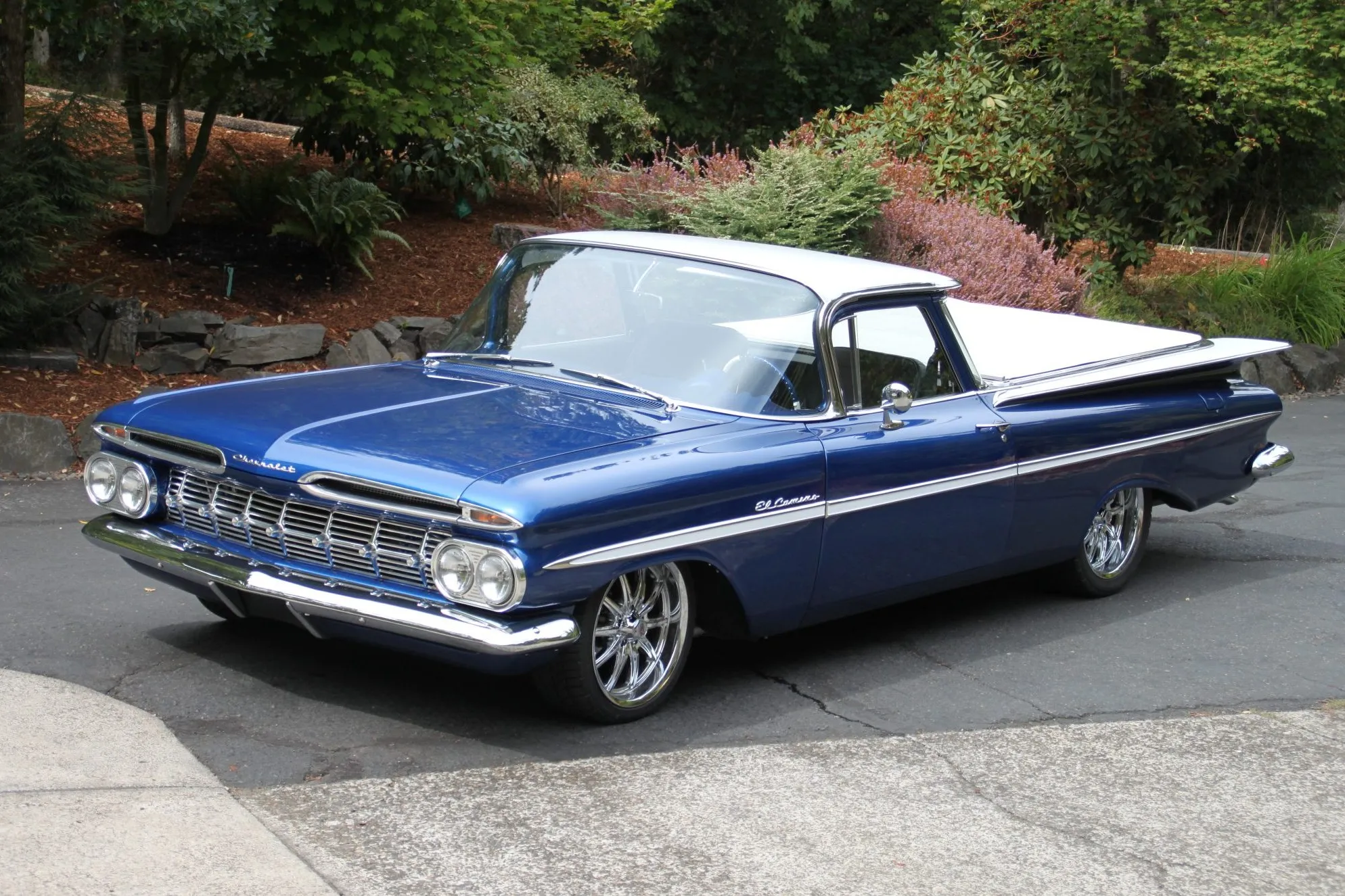
A first-year 1959 Chevrolet El Camino — the body style that introduced Chevrolet’s car-based pickup to America — is drawing serious bidder attention on Bring a Trailer. Bidding has already passed $35,000 with hours remaining, and nearly 900 people are watching the auction unfold. What’s notable isn’t the number. It’s the reason people are paying attention to a fifty-nine El Camino that no longer wears its factory paint, its factory drivetrain, or its factory interior.
This truck has been comprehensively resto-modded: a 6.0-liter LS2 V8, a six-speed automatic, modern suspension and disc brakes, and an interior built around Chevelle seats and digital instrumentation. None of that qualifies it as a numbers-matching collector car in the traditional sense. And that’s exactly why it’s worth examining. The bidding activity on this El Camino says less about this particular truck than it does about where the middle of the collector market is actually heading.
A Short, Strange First Chapter
Chevrolet introduced the El Camino for the 1959 model year as a direct answer to Ford’s Ranchero, which had already spent two seasons proving American buyers wanted something that split the difference between a car and a pickup. GM’s response rode on the full-size Chevrolet platform for what remains one of the most flamboyant model years the division ever produced. The “batwing” tailfins sweeping out from the rear fenders were a one-year-only styling exercise, toned down considerably by 1960. The El Camino nameplate itself lasted only two seasons before Chevrolet shelved it, not reviving the concept until 1964. That brief, oddball first chapter is part of why unmodified 1959 and 1960 El Caminos carry real weight with collectors focused on first-year and transitional body styles, even though this particular example has moved well past preservation territory.
What the Data Plate Still Tells Us
Even heavily built cars carry their factory history in the data plate, and this one is no exception. The style code decodes to a V8-equipped El Camino assembled at Chevrolet’s St. Louis, Missouri plant, originally finished in Cameo Coral over Satin Beige with gray cloth-and-vinyl trim, a warm two-tone combination typical of 1959 Chevrolet passenger cars. None of that survives today. The body now wears a metallic blue-and-white repaint applied during a 2020 build, and the cabin has been re-trimmed in black. The Oregon title is in the current seller’s name, and the truck is being sold by a private party out of Corvallis rather than through a dealer. This is a car whose paperwork tells you what it used to be, not what it is now, and buyers are being asked to value it accordingly.

The Build Is the Argument
The specifics of the build matter more than the fact that a build happened at all. The LS2, a 6.0-liter V8 sourced from a Pontiac, most likely a GTO, pairs with a six-speed automatic and a 3.55:1 limited-slip rear axle, hardly a lazy combination. The chassis received drop springs front and rear, tubular front control arms, and sway bars at both ends, with power-assisted front disc brakes doing the stopping. It rides on 18-inch REV wheels wrapped in BFGoodrich g-Force Comp 2 tires. Inside, the builder reached for Chevelle-sourced bucket seats with integrated heaters, a fabricated wood-trimmed console, Vintage Air climate control, and Dakota Digital instrumentation wired through an American Autowire harness. Roughly 2,000 miles have gone on the digital odometer since the 2020 completion date, according to the seller, suggesting a truck that has been finished, driven sparingly, and kept up rather than left to sit. Component choices like these are the difference between a thoughtful build and a parts-bin special, and collectors evaluating resto-mods increasingly know to look for that difference.

A Market That Rewards Execution, Not Just Originality
Nearly 7,400 people have viewed this listing, and roughly 900 have added it to their watch list, activity that looks more like a blue-chip Ferrari than a modified sixty-five-year-old pickup. That level of engagement on a car with no claim to originality tells us something about where collector attention is actually flowing. We have tracked this same pattern elsewhere: a Buick GNX-inspired El Camino build has drawn similar enthusiasm this year, as has a HEMI-powered Plymouth Cuda resto-mod and a turbocharged Volkswagen Westfalia Syncro that traded factory correctness for six-figure engineering. None of these cars would satisfy a concours judge scoring for originality. All of them are finding real demand.
Why This Matters
Originality still governs the top of the collector market, and it should. The cars that defined their eras deserve to be preserved as they were built. But this El Camino sits in a different tier, where the factory build sheet is a reference point rather than a rulebook, and where the market pays for craftsmanship, drivability, and taste instead. Originality is the currency of the cars that already made history. Execution is becoming the currency of everything else. Serious buyers watching this segment of the market should spend less time asking what a resto-mod used to be and more time asking how well it was built to be something else.
Bidding on this LS2-powered 1959 Chevrolet El Camino continues on Bring a Trailer through September 11. The full listing, photos, and bid history are available here.
The collector car market, every weekday morning.
Auction results, price moves and what’s crossing the block, read in four minutes. Free, from Modern Car Collector.
No spam, unsubscribe in one click. Or read more about the Brief.
Related Posts:
- Record Ferraris, Rare Icons and 15,000 RPM: The Week…

- Today in Collector Car History: Chevrolet Unveils…
- 1959 Chevrolet El Camino: A Pro-Touring Restomod…
- Big-Block 1968 Chevelle SS Convertible With Air Ride…
- The Collector Car Market Paid Up for Certainty This…

- 10 Coolest Chevrolet Chevelles at Mecum Harrisburg 2026
 Shawn Henry
  Kyle Matthews