

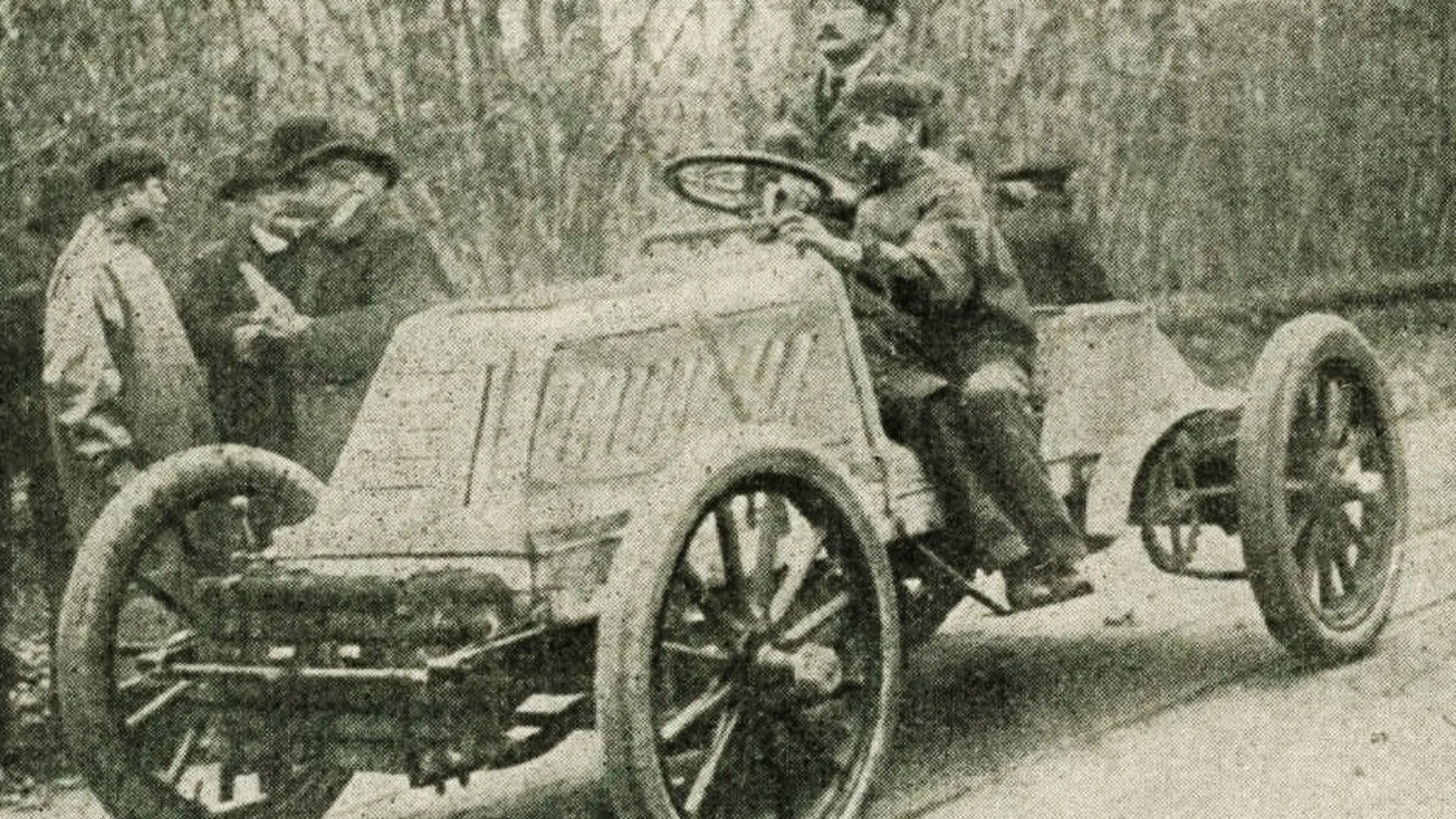
On Nov. 17, 1902, a French driver named Maurice Augières took a Mors racing car down a measured kilometer at Dourdan, southwest of Paris, at 77.13 mph (124.13 km/h) and became the holder of the world land speed record. He beat a mark set by fellow Mors driver Henri Fournier just twelve days earlier, by roughly half a mile an hour. The margin looks tiny now. The Mors land speed record is still worth a closer look, because it shows how a 60-horsepower French racer, and the company behind it, fit into the earliest chapter of collector-car history.
What happened on Nov. 17, 1902
Wikipedia’s list of land speed records gives the date, place and figures: Nov. 17, 1902, Dourdan, France, Maurice Augières, Mors Z Paris-Vienne, 77.13 mph over one kilometer. Greg Wapling’s land speed racing history gives the same date, place and speed. The period magazine La Vie au Grand Air also ran a photograph of Augières at Dourdan in its Nov. 22, 1902 issue. One summary of the date places the run near Chartres, but the record table, the Wapling entry and the photograph’s caption all point to Dourdan, so that is the location used here.
Dourdan was a speed-trial venue, not a race. French sources describe a long straight stretch of road between Dourdan and Saint-Arnoult that hosted record attempts in the autumn of 1902, with cars timed over a flying kilometer. Augières’s run was one of several records set there that season.
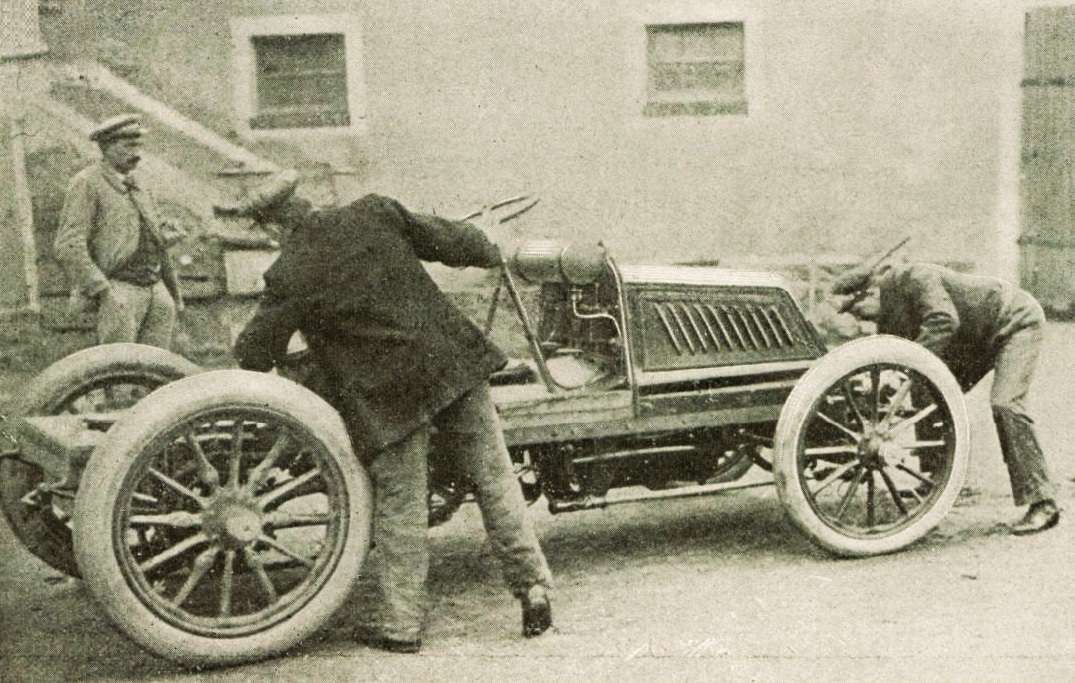
The car: a 60-horsepower Mors Z
The Mors Z Paris-Vienne was built for the 1902 Paris–Vienna race, which also served as that year’s Gordon Bennett Trophy event. According to the Revs Institute, which holds a 1902 Mors Type Z, the car used a 9,236 cc four-cylinder engine rated at 60 horsepower at 1,400 rpm, magneto ignition, a 99-inch wheelbase and a weight of about 2,220 pounds. Rather than chase Panhard on horsepower, Mors fitted pneumatic shock absorbers and a direct-drive top gear. Wikipedia’s Mors entry notes that the shock absorbers were a real advance on the roads of the day.
The Mors land speed record chain: three records in one season
The record Augières took had changed hands quickly. Léon Serpollet’s steam-powered Gardner-Serpollet “Easter Egg” held it at 75.06 mph after a run at Nice on April 13, 1902. On Aug. 5, 1902, American William K. Vanderbilt II drove a Mors Z at Ablis, near Chartres, to about 76 mph, which Wikipedia’s table records as the first internal-combustion land speed record. Fournier raised it again at Dourdan on Nov. 5 to roughly 76.6 mph. Twelve days later Augières pushed it to 77.13 mph. Three Mors drivers, three records, one car design.
Vanderbilt’s name will be familiar to regular readers. The same enthusiast later lent his name to the race we covered in the first Vanderbilt Cup in 1904.
Why a gain of half a mile an hour mattered
In 1902 the contest was as much about marketing as engineering. Wikipedia reports that founder Émile Mors began racing in the 1890s because he believed it had technical and promotional benefits, and that by around 1900 racing was largely a contest between Mors and Panhard et Levassor. A land speed record was a headline a customer could understand. The fact that an internal-combustion car had overtaken a steam car for the top spot also said something about where the industry was heading. For a snapshot of how young that industry still was, see our look at New York’s first great auto show in 1900.
How long the record lasted, and what became of Mors
Not long. On July 17, 1903, Belgian driver Arthur Duray took the record at Ostend in a Gobron-Brillié at 83.46 mph, about eight months after Augières. Duray raised it again at Dourdan on Nov. 5, 1903, to 84.73 mph, and Henry Ford’s 999 racer reached 91.37 mph over a mile on Jan. 12, 1904.
Mors’s competition record was strong while it lasted. Henri Brasier designed the company’s 1899 racers, Fournier won the Paris–Bordeaux and Paris–Berlin races in 1901, and Mors driver Fernand Gabriel won the 1903 Paris–Madrid race, which the French government halted at Bordeaux after numerous fatalities (Bonhams lot notes). Mors ended racing in 1908. André Citroën became chairman that year, bought the company outright in 1925 and used its factory to build Citroën cars. That is the same Citroën name later led by Pierre-Jules Boulanger, whom we profiled in our Nov. 11 piece.
Why the Mors Z matters to collectors today
A record-setting Mors Z is not a car that changes hands often, and I could not find a public sale of one. The best-documented survivor is the museum example mentioned above: the Revs Institute’s 1902 Mors Type Z, chassis Z30003, ran the 1902 Paris–Vienna race under the Baron de Caters and finished in the top ten after three days and 615 miles, according to Revs. Cars like that set the reference point for what the marque’s competition history means.
The market evidence sits with Mors road cars. Bonhams sold a 1904 Mors 24/32-hp Roi des Belges, with two family ownerships from new, for £460,000 in 2014. At an earlier Bonhams sale, a 1903 Mors Model N 18-hp tonneau sold for £161,000 (about $224,800) including premium; the lot page does not give the sale date. Those are the verifiable data points I found, and they are older and sparse, so treat them as context rather than a price guide.
The takeaway for veteran-car buyers is the one we made in our piece on the Somerset hoard of veteran cars: for cars this old, documented history matters more than cosmetics. A Mors with period press, racing links and continuous ownership records carries a story that a bare chassis cannot. On Nov. 17, 1902, Augières added one more line to that story.
Sources: Wikipedia, List of land speed records; Greg Wapling, Mors Z Paris-Vienne (M. Augières); Revs Institute, 1902 Mors Type Z; Wikipedia, Mors (automobile); Wikipédia, Kilomètre de Dourdan; Bonhams lot pages linked above.
The collector car market, every weekday morning.
Auction results, price moves and what’s crossing the block, read in four minutes. Free, from Modern Car Collector.
No spam, unsubscribe in one click. Or read more about the Brief.



 Kyle Matthews