

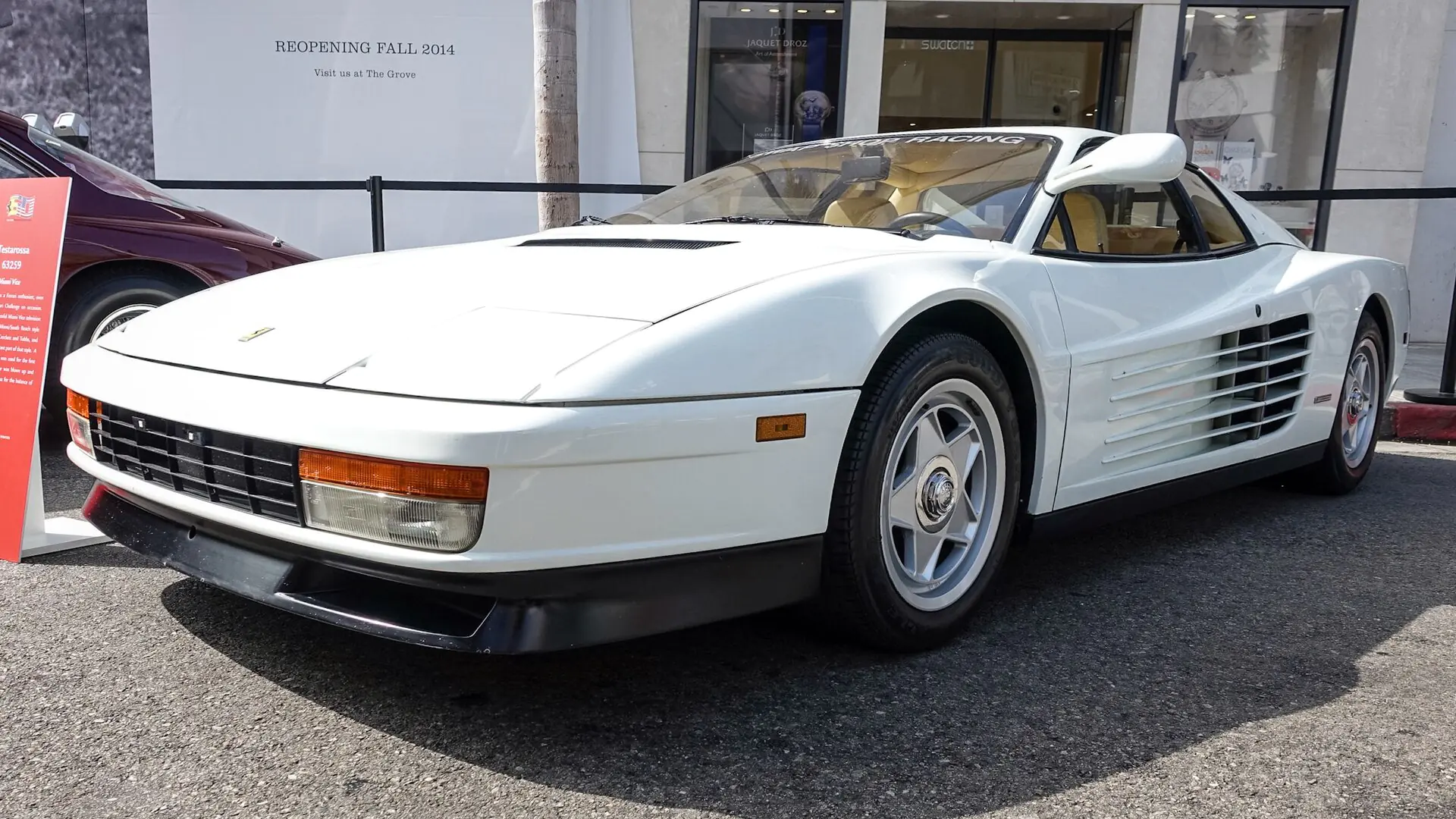
Through November 28, a Ferrari Testarossa sits inside Selfridges on Oxford Street wearing a blue-to-pink fade, gold wheels and a rearing-rabbit badge where the Prancing Horse used to be. It is the Grotti Cheetah, the Vice City supercar from Grand Theft Auto VI, built for real by West Coast Customs on a commission from Rockstar Games. Selfridges is offering it through its Personal Shopping service for £1 million, roughly $1.3 million. The game itself arrives on November 19.
The price will carry the headlines. It should not carry the analysis. A promotional one-off is priced by the campaign that paid for it, and the market reprices it later, usually once the campaign is over. The more useful fact is what sits under the paint. For more than two decades, Rockstar’s thinly disguised Testarossa has been one of the most-driven Ferraris on earth, and the players who first met it on a PlayStation are now the buyers reshaping the collector market. The £1 million Cheetah is not a new kind of collectible. It is a receipt for an influence that has been working on the Testarossa market for years.
What Rockstar and West Coast Customs actually built
The Cheetah is one of six cars the Burbank shop built for the GTA VI launch. The others are the Pegassi Tempesta, Progen Emerus, Invetero Coquette, Albany Buccaneer and Albany Manana, a lineup that runs from Lamborghini, McLaren and Corvette lookalikes to lowriders. All six were filmed on the streets of Miami wearing Leonida plates and frames reading “VI,” “West Coast Customs” and the Rockstar logo. Reported construction mixes metal fabrication, composite panels and CNC-machined parts, finished in paint matched to the game models. The Cheetah was then flown from Miami to London for the Selfridges installation. It is the only one of the six reported to be for sale.
Just as telling is what has not been published. No model year, chassis number or mileage has been disclosed. Nobody has said whether the flat-12 and five-speed transaxle remain stock, or whether the original body panels, badges and interior were kept. The listing copy, as quoted in launch coverage, describes a “4.9L naturally-aspirated V8.” A Testarossa’s 4.9-liter engine is a flat-12, the car’s defining feature and the reason for its name. It reads as a copywriting slip, not a mechanical change. But at this level a car’s description is the first page of its paper trail, and the paper trail is most of what is being sold.
Rockstar has run this experiment before
In 2013, ahead of Grand Theft Auto V, Rockstar and West Coast Customs built a real Bravado Banshee on a 2006 Dodge Viper SRT-10. It got new bodywork and a bespoke interior with Banshee-embroidered seats, and it was given away through a GameStop PowerUp Rewards sweepstakes. The winner listed it on eBay with a $170,000 Buy It Now price. It sold in 2014 for $45,200.
The market had been asked to value the story at well over $100,000, and it declined. It is the same discount we saw when a K.I.T.T. tour car stalled at CHF 200,000 in Zürich: buyers will pay for a famous identity when it was built in from the start, and they hesitate when it was added later. A promotional build trades on its donor car first and its campaign second, and the campaign discount grows every year after launch week.
The Cheetah is a different case for one reason. The Banshee’s donor was a seven-year-old Viper still losing value. The Cheetah’s donor is a Testarossa, a car with a mature and well-documented collector market of its own. That difference cuts both ways.
The donor car is both the problem and the point
Ferrari built about 7,177 Testarossas between 1984 and 1991. By Maranello’s standards that is not rare, and rarity has never explained the car’s value. Culture does: the white car of Miami Vice, the show whose Ferrari history still ends up in court; the arcade cabinets; the bedroom posters; and Rockstar, whose Cheetah has stood in for the Testarossa since GTA III in 2001 and Vice City in 2002. Few collector cars have had a cheaper or more persistent ambassador than a video game played by tens of millions of teenagers.
That audience has grown up and the market shows it. Across 49 tracked auction sales over the past 12 months, the median Testarossa brought about $202,000, with typical results between $159,000 and $273,500. The top end has moved further: in January, a 257-mile 1989 car sold for $687,500 at Mecum Kissimmee. The spread between those numbers is not about horsepower or production year. It is about originality, mileage and documentation. The Testarossa is no longer one market. It is several, and the most original cars sit at the top.
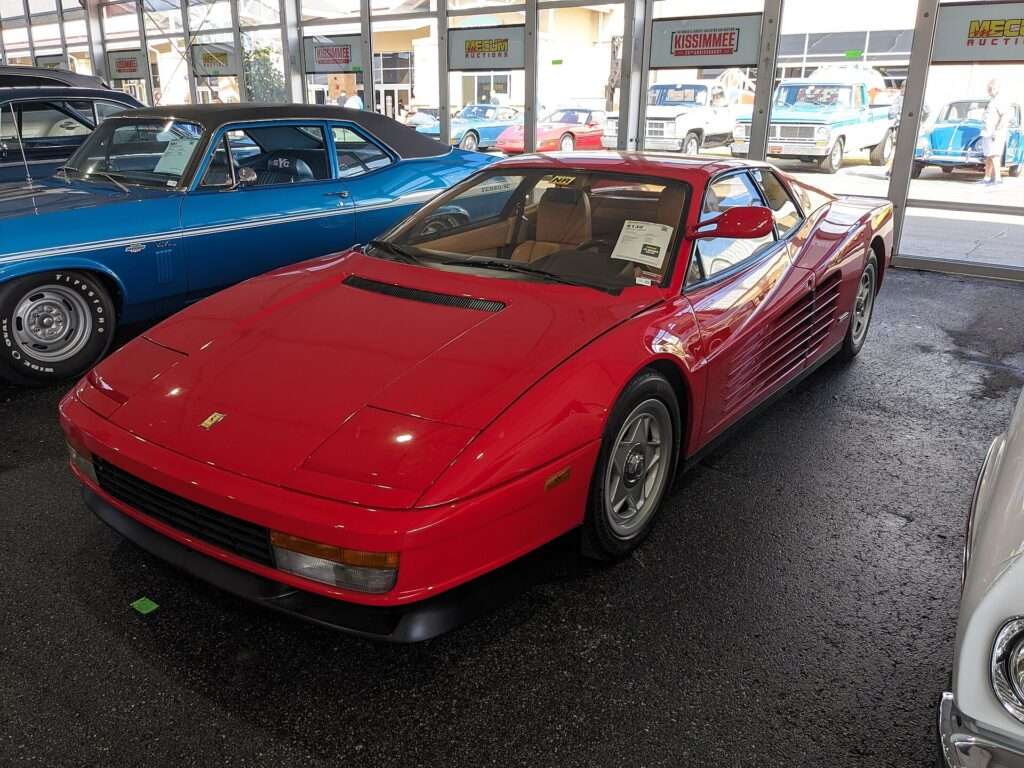
This is the paradox at the center of the Selfridges car. The conversion takes away exactly what the Testarossa market now pays for: factory bodywork, factory badges, original paint and the chance of Ferrari Classiche certification, a program built to confirm conformity with factory specification, not departures from it. A Testarossa’s value increasingly depends on how close it is to the day it left the factory. The Cheetah’s value depends entirely on how far it has moved from it. We saw a similar question with a 412P re-creation built on a wrecked Berlinetta Boxer, where the build file, not the badge, decided the conversation.
What £1 million is actually paying for
Take a strong Testarossa at $200,000 to $300,000 away from the asking price and roughly $1 million is left. That is the price of the story: a first-party commission from the studio behind one of the most anticipated entertainment releases in years, a recognized builder, a Miami photo shoot and a public showing in one of the world’s best-known department stores. That is provenance in its purest form. It is also the most fragile kind. Value generated by a launch peaks during the launch.
Intellectual property adds a further complication. The Grotti name, the Cheetah name and the Vice City livery belong to Rockstar, and recent pop-culture sales have shown how much a rights holder’s terms can shape a car’s value. Warner Bros.’ conditions came with the Batman Returns Batmobile, and the Ninth Circuit’s Eleanor ruling changed what an “official” tribute car can claim. A buyer should know, in writing, what the purchase allows them to do with the car’s identity, from display and loan to resale and commercial use.
Marketing cars are priced at the height of the campaign. Collector cars are priced long after it. The question for the Cheetah is whether GTA VI becomes a cultural landmark big enough that this car is remembered as its physical artifact, not simply as its window display. If it does, the Cheetah has a stronger case than the Banshee ever had. If it does not, the market will do what it did in 2014 and price the Ferrari underneath.
What a serious buyer should ask before the appointment
- Identity. The chassis number, Ferrari build data and engine and transaxle numbers, and whether the drivetrain is matching and unmodified.
- Reversibility. Whether the original body panels, badges, trim and interior were kept and are included. Reversibility is the buyer’s hedge against the campaign premium fading.
- The build file. West Coast Customs’ invoices, materials list and build photography, plus a letter from Rockstar confirming the car’s commission and its status as a one-off.
- Rights. Exactly what use of the Grotti, Cheetah and GTA VI marks passes to the buyer, and what does not.
- Customs and registration. The car came from Miami for a temporary promotion. Confirm its title, its UK import status and the duties and taxes due wherever it will be registered. Selfridges’ tax-free export arrangements remove UK VAT for overseas delivery, but they do not cover the destination country’s charges.
- Mechanical condition. Service history, especially the timing-belt service, which on a Testarossa is a major and often engine-out job. Also confirm how the lowered stance and track-oriented tires affect use on the road.
The verdict
Is the Grotti Cheetah significant? As an object, yes. It is the successor to the Banshee and the most ambitious real-world car Rockstar has commissioned, and it marks the point where a game’s influence on a collector car became visible enough to put on display. As a Ferrari, no. It is a Testarossa whose most valuable qualities have been traded for a story, and the only lasting protection for that story is documentation.
For collectors, the more important lesson is about the Testarossa, not the Cheetah. A video game has spent 25 years building demand for a 1980s Ferrari, and this week Rockstar put a price on that demand. Anyone who wants exposure to that effect has a clearer option: buy the most original, best-documented Testarossa available. Buy the Cheetah only if what you want is the receipt.
Sources: Sale terms and the GTA VI installation are from the Selfridges Grand Theft Auto VI Collection and launch coverage quoting its listing; game details are from Rockstar Games. The six-car program is drawn from Rockstar’s press release as reported by Complex, and the listing copy from RockstarINTEL. Bravado Banshee history is from Game Informer and BangShift. Testarossa market figures are from completed auction results compiled by OldCarsData and Conceptcarz. Images via Wikimedia Commons, credited in captions.
The collector car market, every weekday morning.
Auction results, price moves and what’s crossing the block, read in four minutes. Free, from Modern Car Collector.
No spam, unsubscribe in one click. Or read more about the Brief.
Related Posts:
- On an Alfa Romeo Giulia Sprint GTA, Aluminum Panels…
- Record Ferraris, Rare Icons and 15,000 RPM: The Week…
- Rare 1964 Bill Thomas Cheetah, Chevy's Shelby Cobra…

- Everything Modern Car Collector Covered Last Week
- The Collector Car Market Paid Up for Certainty This…
- Miami Vice ’85 Inherits the Ferrari Daytona Spyder,…
 Shawn Henry