
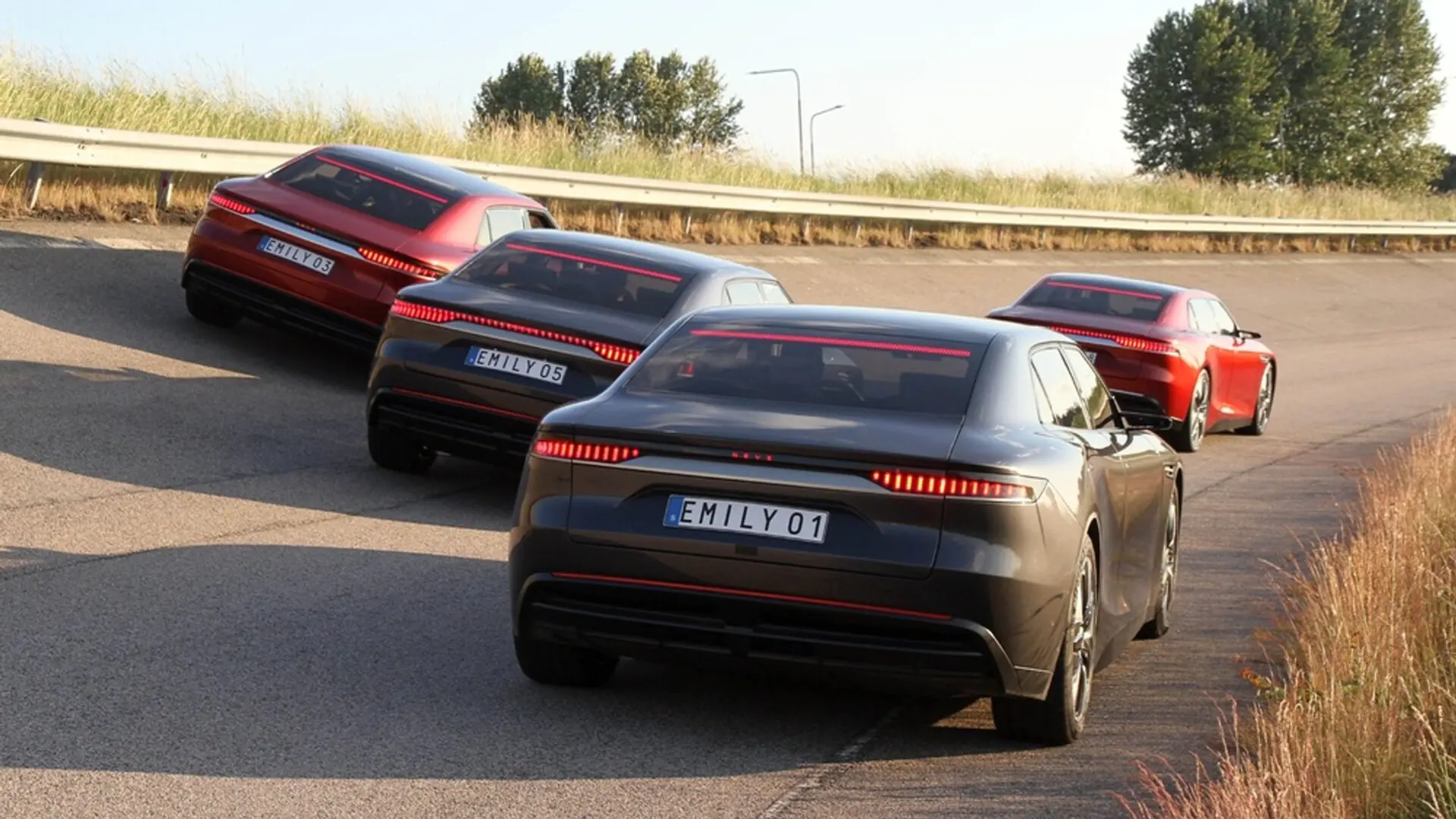
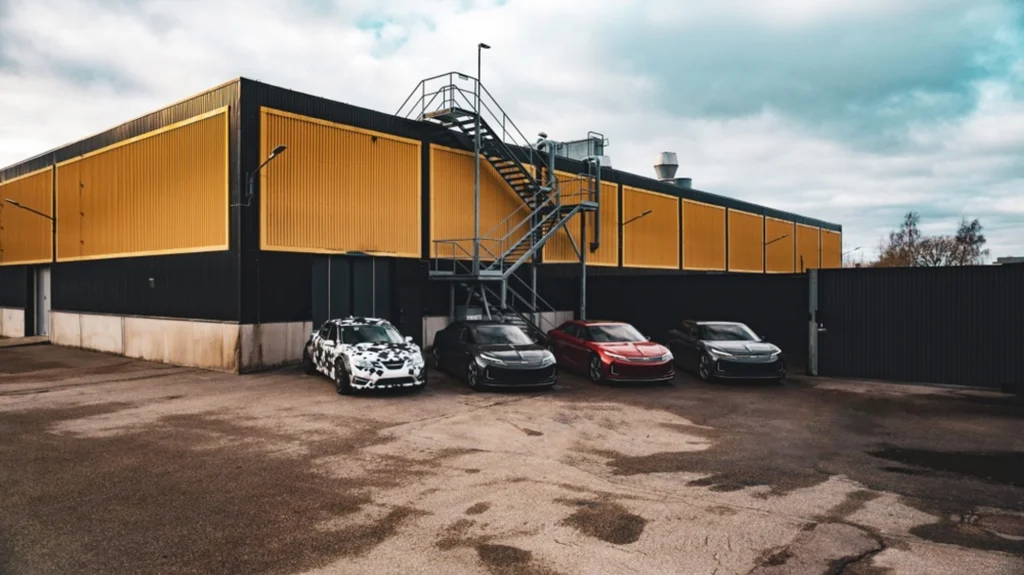
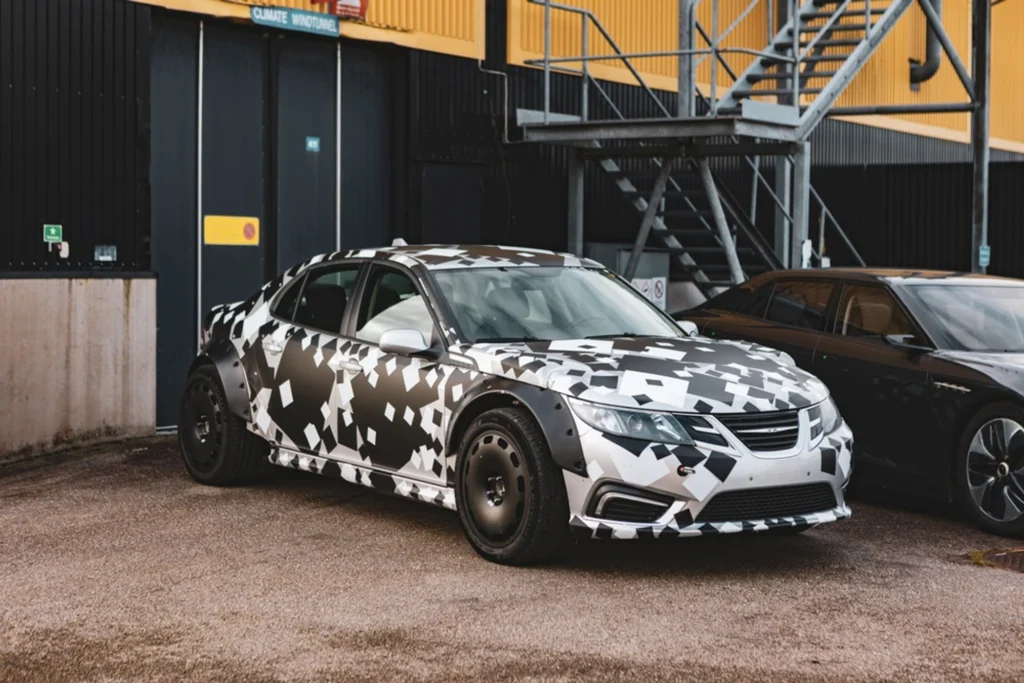
Saab collectors have spent the past fifteen years buying the end of the story one car at a time: a late Aero here, a 9-3 Viggen there, a low-chassis-number pre-production car when one finally leaves Trollhättan. On December 9, Swedish online auction house Klaravik closes bidding on something of a different order. The entire NEVS Emily GT project is being sold as a single lot: four complete prototypes, a Saab 9-3-based development mule, body shells, parts, tools and engineering drawings. In short, everything physical that remains of the last car developed in Trollhättan.
File it under curiosity if you like: an orphaned electric sedan from a company that no longer builds cars. You’d be missing the one condition that matters. Klaravik won’t split the cars from each other or from their paperwork, and that’s what turns four unregistrable prototypes into an archive.
What is actually on the block
Klaravik’s listing describes the Emily GT lot as four complete prototype cars, the only examples that will ever be offered for public sale, plus a mule built on a 9-3 chassis and interior, and a stock of bodies, parts, tools, accessories and drawings from the prototype phase. The cars cannot be bought individually. One bidder takes everything.
A separate auction on the same dates covers Pons, the autonomous urban-mobility program NEVS unveiled in 2020. Its centerpiece is Sango, a robotaxi designed for up to six passengers, and the lot includes the only complete vehicle built for the project.
Both sales open on November 25 and close on December 9. Bidding and viewing are online only; there is no physical inspection day. Klaravik says detailed condition reports and technical specifications will appear in the listings when they go live. International bidders are welcome, but foreign buyers must complete account registration by December 7. No estimate, starting bid or reserve has been published.
Ten months, four motors, one closed door
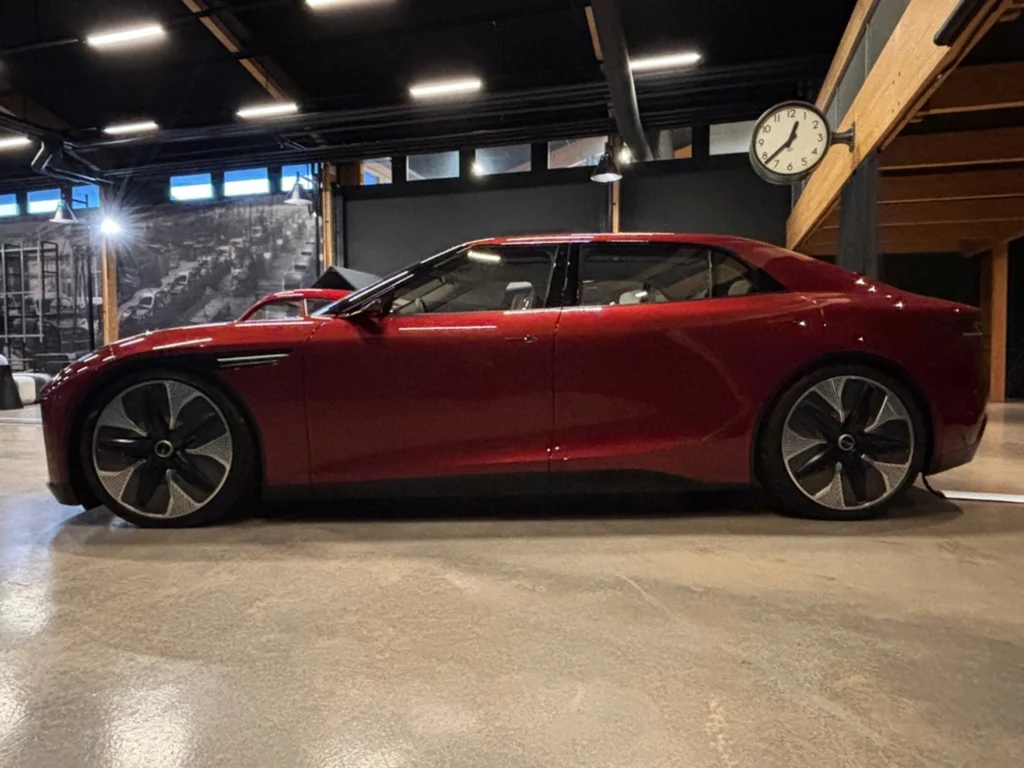
The background explains why this lot exists at all. Saab Automobile collapsed in 2011, and National Electric Vehicle Sweden acquired its core assets in 2012 with the intention of building electric cars in the old factory. In 2019, Chinese property conglomerate Evergrande took a 51 percent stake. Late that year, a small team heavy with former Saab engineers began the Emily GT, and took it from concept to running prototype in roughly ten months. Design was led by Simon Padian, Saab’s former brand design chief, and the debt to the final 9-5 is obvious in the roofline and the kinked C-pillar.
The engineering was genuinely unconventional. Instead of central motors and differentials, the Emily GT places an electric motor in each wheel, roughly 120 hp apiece for a combined output of about 360 kW, or 490 hp, with torque vectoring handled entirely in software. The package was designed around a 175 kWh battery and a claimed range beyond 1,000 km. Christian von Koenigsegg drove a prototype and came away openly impressed, which is a better review than most stillborn programs ever receive.
Timing did the rest. Evergrande’s financial collapse pushed NEVS into what it called hibernation in early 2023, with roughly 95 percent of the workforce let go. Only then, in April 2023, was the Emily GT shown publicly. The car was revealed to the world at the precise moment it could no longer be built. In December 2023, EV Electra announced it had acquired the rights to the Emily GT and Pons projects and intended to put the car into production. That never happened, and the cars stayed in NEVS custody. Earlier this year Klaravik sold the last 9-3s on the Trollhättan site. The Emily GT is what remains.
The detail serious bidders should read twice
Much of the early coverage of this sale has described it as including the project’s intellectual property. Klaravik’s own listing does not say that. It lists drawings and tools. It says nothing about design rights, patents, trademarks or licensing, and the accompanying press release is equally silent. Owning a set of drawings is not the same as owning the right to build from them, and this project’s rights already passed through one announced transaction in 2023.
For a museum or a private custodian, the distinction barely matters. For anyone imagining production, a continuation series or commercial use of the Emily name, it is the entire question. Get a written answer from Klaravik and NEVS on exactly what conveys before placing a bid, not after.
Two further practical points. First, these are prototypes that were never type-approved, and Klaravik says so plainly. Buyers outside Sweden, and particularly outside the EU, should assume they are acquiring display objects and take advice on import classification and any display-only routes before the hammer falls. Second, each car carries a prototype high-voltage pack that has spent most of the period since 2023 in storage. Battery state of health, storage history and the cost of shipping prototype lithium-ion hardware, which is regulated as dangerous goods, belong in the budget from the start. Parts support consists of whatever spares are in the lot. There is no dealer network behind it, and there never will be.
What the May sale already told us
Klaravik has run a version of this experiment before. In May 2026 it sold seven 9-3-based cars left at the factory, every one without reserve. The highest price, 252,000 kronor, went to a NEVS 9-3 electric car. The best of the 2014 Saab 9-3 Aero pre-production cars made 177,000 kronor. The camouflaged range-extender prototype, arguably the most technically interesting car in the sale, brought just 62,000 kronor.
Two lessons follow. The Saab community turned up in force, and Klaravik reported enthusiasts travelling to Trollhättan for the closing day. But it bid like a community of enthusiasts, not speculators. And the cheapest lot was the strangest one, a reminder that collectors pay for usability and narrative clarity long before they pay for engineering curiosity.
Apply that to the Emily GT and the logic is clear. Offered one at a time, these prototypes would hit the same ceiling: unregistrable, unsupported and not even legally Saabs, since NEVS lost the right to the Saab name years before Emily was conceived. Offered together, they are something the market almost never sees: a complete, documented development program, with its mule, its spares and its drawings, from the factory that built Saabs for more than seven decades.
Why the whole matters more than the parts
Prototype provenance usually arrives in fragments. A development car surfaces at auction while its paperwork sits somewhere else and its siblings have been scrapped or scattered. Owners of significant one-offs, from a Bizzarrini prototype to a factory test car, often spend years reconstructing a story that was never written down in one place. Here the story is intact on day one.
A prototype is only half an object. The other half is the evidence that explains it, and this lot sells both halves together.
The market has already shown how much that second half is worth. Documentation can carry a car well beyond its mechanical merit, as the sale of JFK Jr.’s Saab 900 SE demonstrated. The Emily GT applies the same principle at the scale of an entire program. It also sidesteps the unresolved debate over how collectors should value electric cars, a question raised by projects such as Porsche’s Mission S. Nobody will collect the Emily GT as a usable EV. They will collect it as an artifact.
Who Should Buy It
Is this significant, or simply unusual? Significant, within clear limits. This is not a blue-chip investment and should not be bid as one. The cars cannot be registered, their rights position is unconfirmed, their batteries are an unknown and their support network is a pallet of spares. Its value is custodial. The ideal buyer is an institution or a collector able to keep four prototypes, a mule and a set of drawings together, properly stored and accessible to the people who care about how the Trollhättan story ended. The worst outcome would be a buyer who breaks the lot up and sells it off piece by piece.
Since 2011, Saab’s history has left Trollhättan one car at a time. Bidding closes December 9. Who should end up with this lot: a museum, or one very committed collector? Saab club members, if you have a better answer, we’re listening.
Sources
Auction details and lot descriptions: Klaravik, Nevs auction listing. Press release: Klaravik, “Emily GT goes under the hammer,” November 19, 2026. May 2026 results: Klaravik newsroom, final Saab auction results.
The collector car market, every weekday morning.
Auction results, price moves and what’s crossing the block, read in four minutes. Free, from Modern Car Collector.
No spam, unsubscribe in one click. Or read more about the Brief.


 Eve Nowell
 Shawn Henry
 John Lloyd