

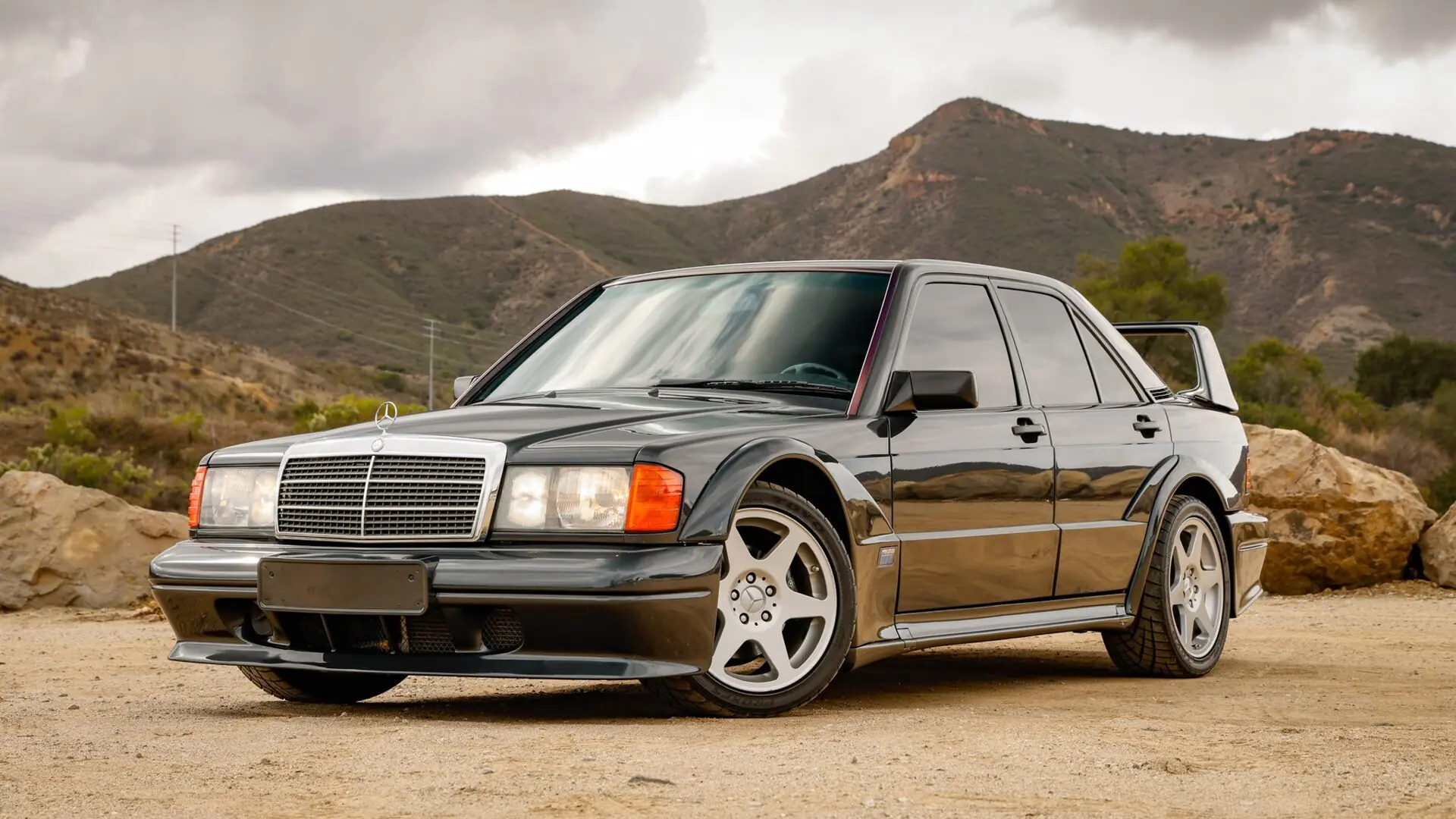
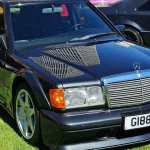
The bid on car No. 84 stands at $225,000 with five days left, and that number is the least interesting thing about the listing. What matters is what this particular 1990 Mercedes-Benz 190E 2.5-16 Evolution II, with about 72,000 miles, a Montana title and a repaired engine bay, is about to tell us about how the market prices an Evolution II that is no longer a time capsule.
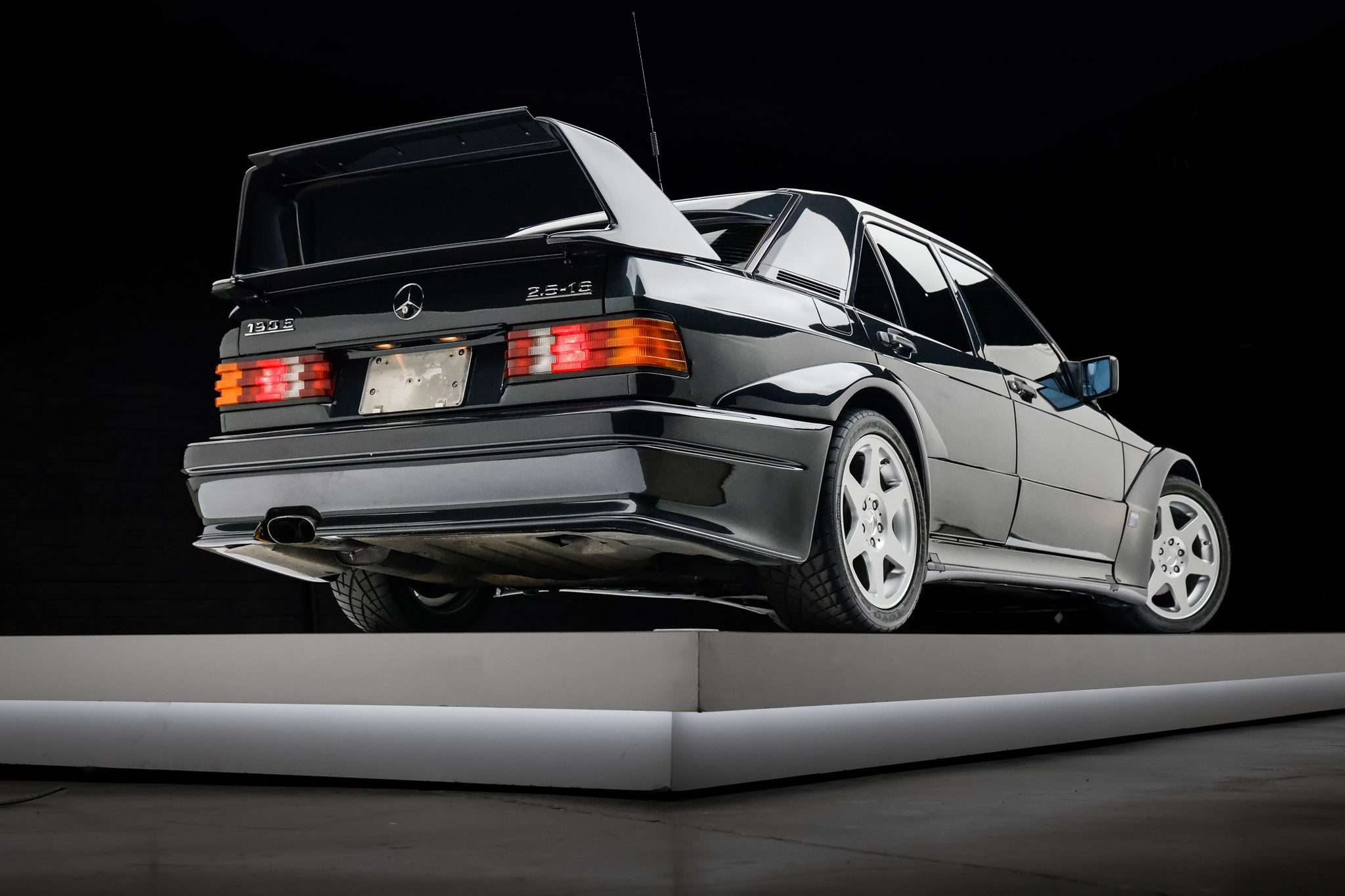
The Bring a Trailer listing, which closes November 17, shows six bids and more than 1,200 watchers. It is not designated No Reserve, so the current figure is a bid, not a price. The car is plated No. 84 of 502, was first ordered by a Mercedes-Benz company employee, spent time in Germany, and was imported to the United States in June 2023. It shows 116,000 kilometers, roughly 72,000 miles, about 300 of them added by the current owner.
Rarity Is a Constant. Condition Is the Variable.
Every Evolution II is one of 502, which makes the production figure the least useful number for comparing them. It is identical for all of them. What separates one car from the next is mileage, originality, and what has been done to it, and the 2026 results show the market is still working out how much each is worth.
In August, No. 448, a Japanese-market import showing about 31,000 miles, sold on BaT for $310,000. In September, No. 401, also imported from Japan and showing about 36,000 miles, sold for $420,000. Both were Blue Black Metallic, both within about 5,000 miles of each other, and they finished $110,000 apart, about five weeks apart. Mileage does not explain that gap. Presentation, momentum and the dynamics of a single auction do, which is another way of saying there is no settled price curve for these cars yet.
The High-Mileage Record
Cars with real use behind them have a thinner and more cautious record. No. 140, with about 82,000 miles, sold for $280,000 in May 2025. In late 2023 a 70,000-mile car was bid to $245,000 without selling, and a 116,000-mile car stalled at $170,000.
A third no-sale from that period is the interesting one for this story, because it was No. 84. It closed on September 3, 2023 with a high bid of $231,000 and did not sell, and the current owner acquired it later that year. Three years on, the same car, with nearly the same mileage, is back at $225,000 with five days to run. The result will show how much of the market’s appreciation since 2023 attaches to a car that has been driven, rather than preserved.
What the Listing Discloses
The seller, a California dealer and BaT Local Partner, is candid about the car’s compromises, and a serious bidder should read them as line items. The car carries a clean Montana title, is located in California, has not been inspected by the state’s Bureau of Automotive Repair, and has not passed a California smog test. A Montana title is common on imported cars and is not a defect, but it converts a bid into a compliance project with its own cost and timeline. The data plate lists option code 620, a catalytic converter, which helps the car’s case without settling it.
Two other details deserve more than a skim. A 2009 invoice in the earlier listing’s gallery records rust repair in the engine bay. A documented repair beats an undocumented one, but the question for a car whose value rests on originality is where the repair was made and how well it was done, and a pre-purchase inspection exists for exactly that. A bolt-in roll cage has also been removed. That returns the cabin to road trim, but it suggests a chapter of harder use that the paperwork does not describe.
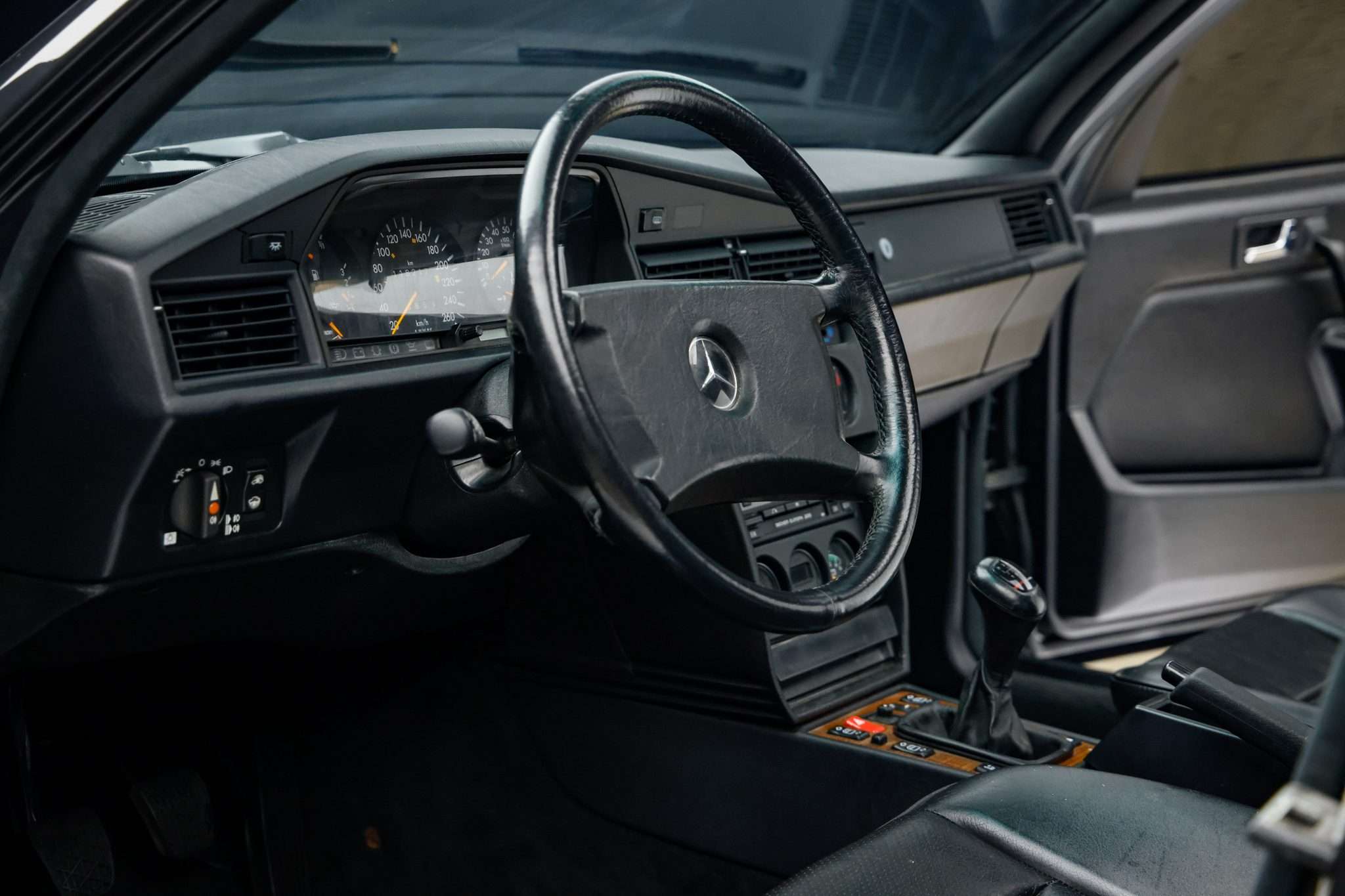
Against that, the car has the credentials that matter: a German-delivered first owner, a data plate that decodes to Blue Black Metallic (199) over black leather (271) with power sunroof, ABS, self-leveling suspension and air conditioning, a clean Carfax, and very little use under the current owner. The 2.5-liter M102, developed with Cosworth, carries the AMG PowerPack that took the Evolution II to a factory-rated 232 horsepower, through a Getrag dogleg five-speed and a limited-slip differential.
Why the Evolution II Still Sets the Standard
Mercedes-Benz introduced the Evolution to answer BMW’s M3 Sport Evolution, and the Evolution II added power, deeper aerodynamic bodywork and an adjustable rear wing. That motorsport lineage is why it holds its place: Klaus Ludwig won the 1992 DTM title in an Evolution II, and the road car’s wings and flared arches are homologation paperwork you can see from across a parking lot. Our comparison of the Evo II, Sierra RS500 and M3 Sport Evolution sets out why the three touring-car specials trade in such different markets.
The principle is the same one we apply when we check a modern classic for originality or walk through what to look for in a 500E: for a car the factory built to a purpose, the badge is the beginning of the valuation, and the condition decides where it ends.
What to Watch on November 17
Collectors should watch where this car finishes relative to two figures: the $280,000 paid for an 82,000-mile car in 2025, and the $310,000 paid for a 31,000-mile car this August. A result near the first suggests the market is pricing use and paperwork carefully. A result near the second suggests the badge is carrying more weight than the odometer, and that the recent run of strong prices has begun to lift cars that were once the market’s value tier.
In a run of 502, rarity is a constant. Condition is the only variable, and the market is finally starting to price it.
The collector car market, every weekday morning.
Auction results, price moves and what’s crossing the block, read in four minutes. Free, from Modern Car Collector.
No spam, unsubscribe in one click. Or read more about the Brief.



 John Lloyd
 Shawn Henry