

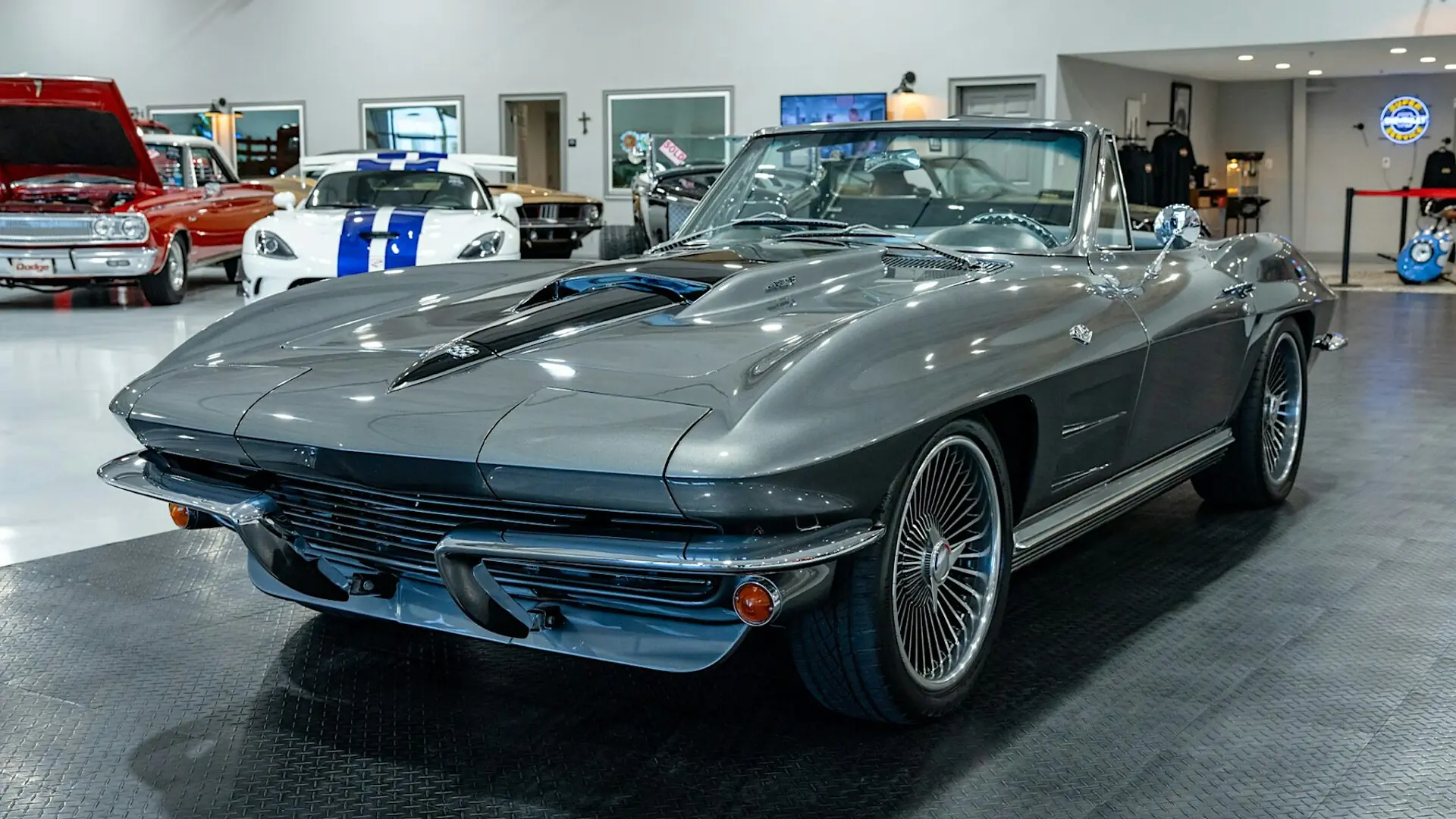
For its first three days on Hagerty Marketplace, the ex-John Travolta Corvette behaved the way most celebrity-linked restomods do. Bidding climbed, the comments filled with questions, and nobody seemed in a hurry. Then, on the afternoon of Wednesday, November 18, the seller attached the build invoices to the listing. By that night the high bid on the 1964 convertible had gone from $55,000 to $100,000.
Travolta’s name had been in the listing headline since day one. What changed that afternoon was the paperwork. The car is a useful lesson in how the market prices a modernized midyear. As we laid out in our guide to what the C2 Corvette reveals about factory intent, collectors pay for Sting Rays that show how Chevrolet built them. A restomod has deliberately given most of that up, so it has to prove its worth some other way. The proof here was a stack of repair orders.
What Is Actually Being Sold
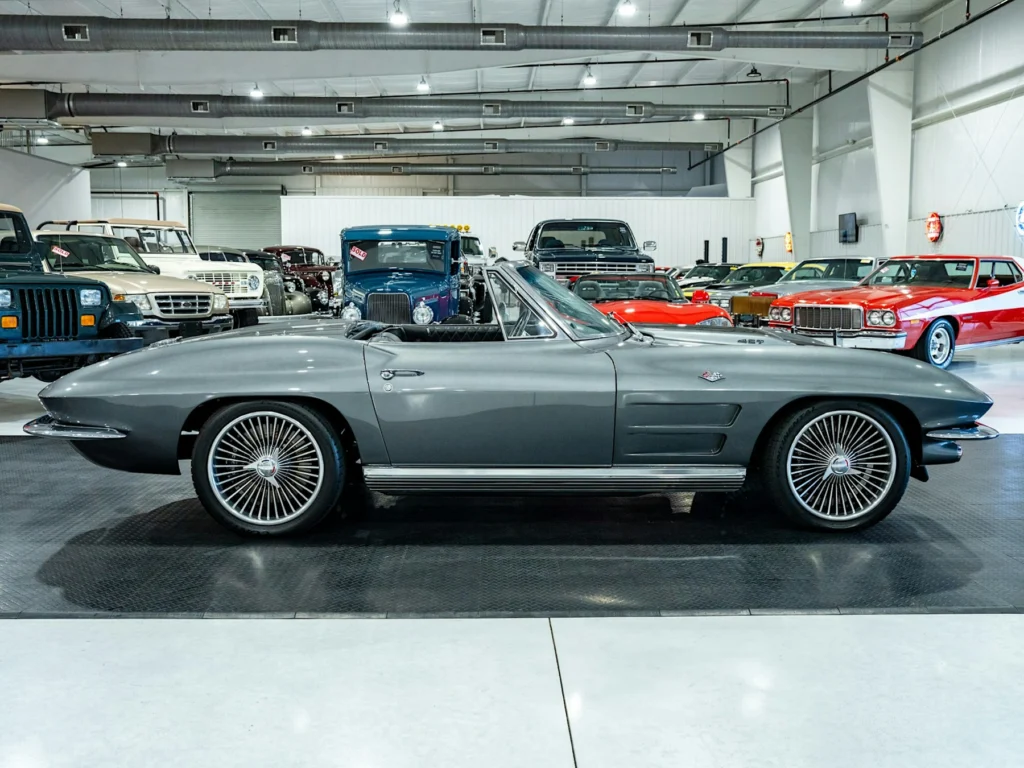
The car is a gray 1964 Corvette convertible with black stripes, a black top and black diamond-stitch leather. It is offered on dealer consignment by Burnyzz of Ocala, Florida, with a clean Florida title, and a Broad Arrow Auctions specialist is acting as agent for the owner. The auction closes Monday, November 30, at 2:40 p.m. Eastern.
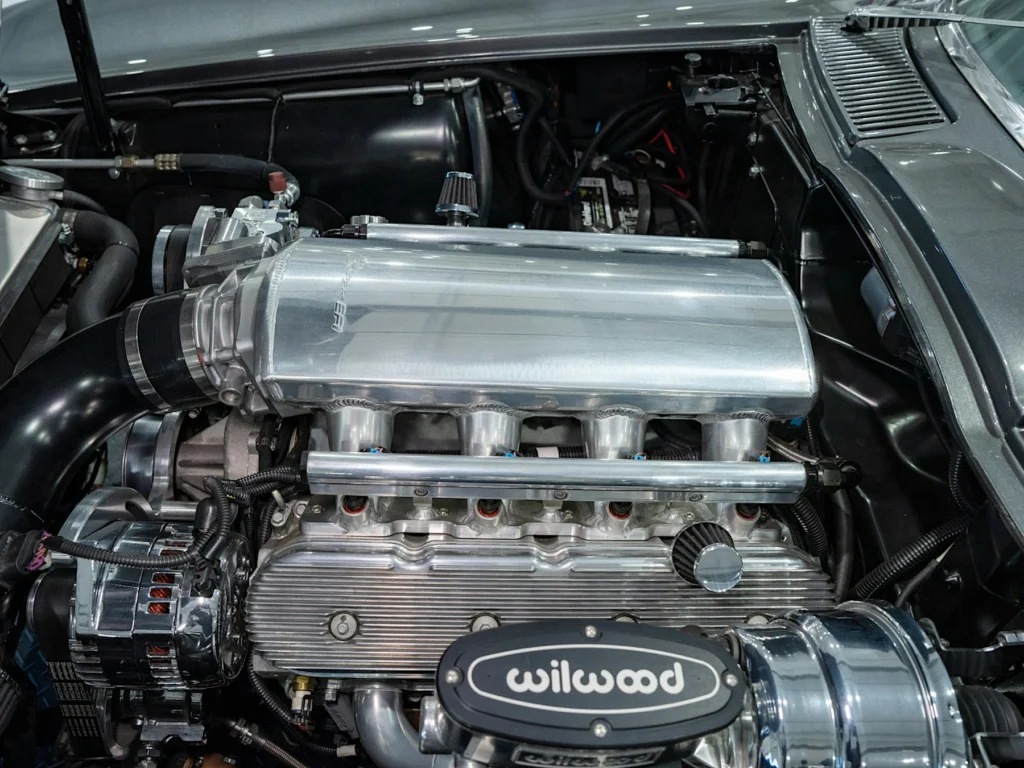
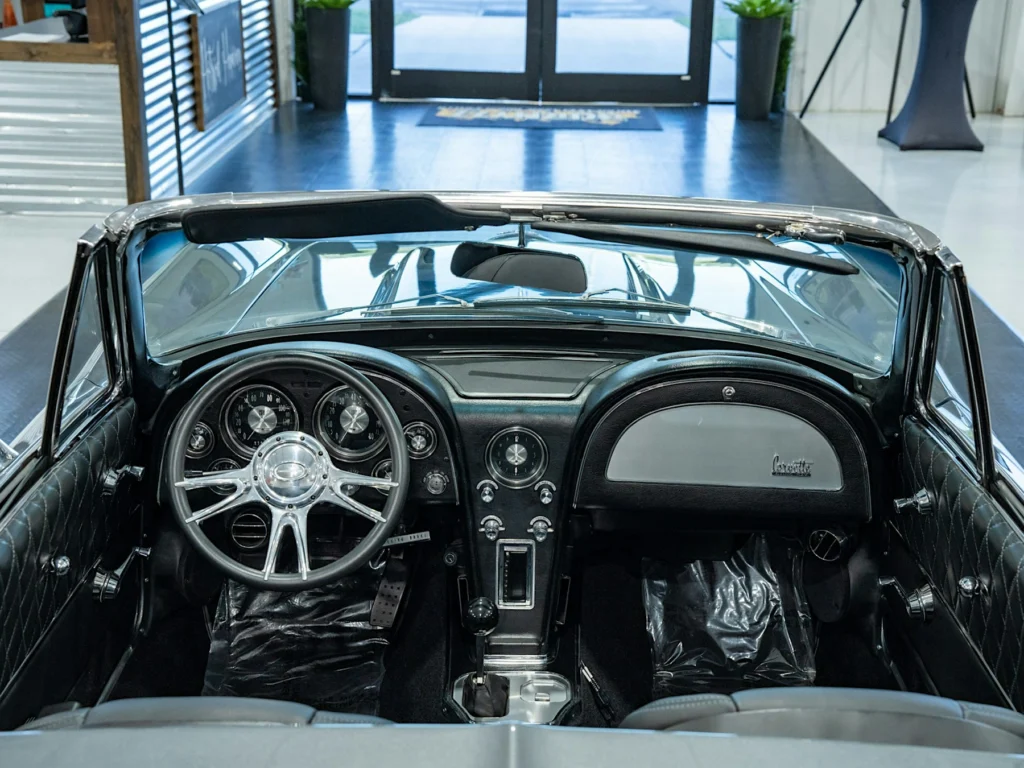
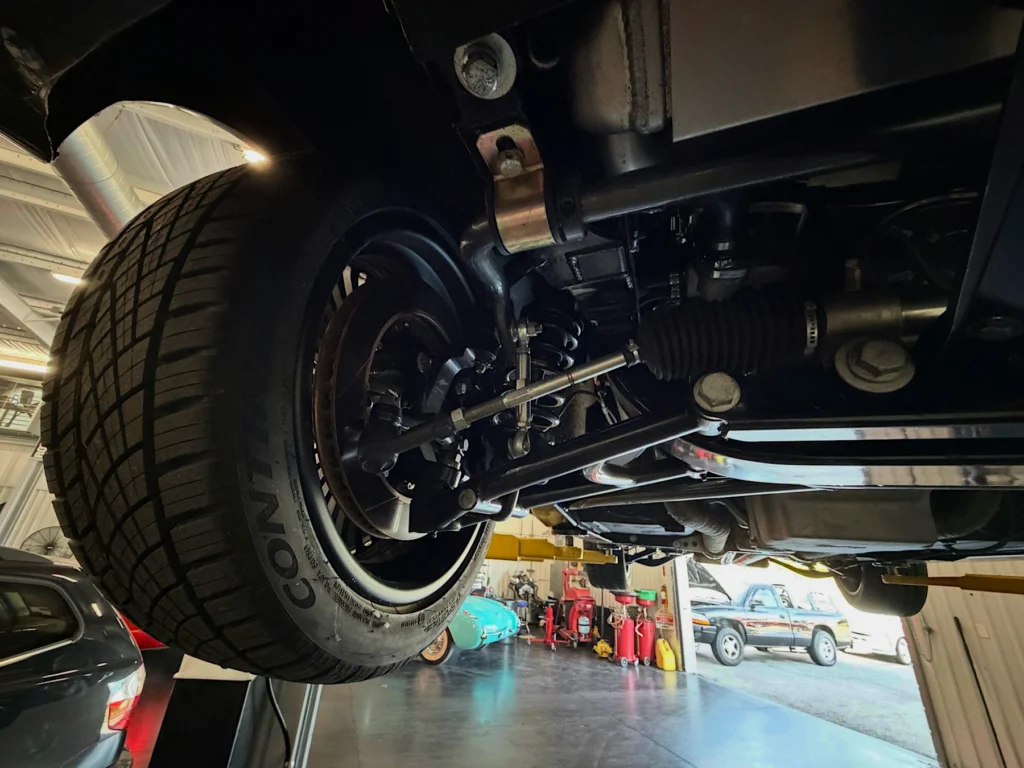
Underneath, very little is from 1964. The car sits on an Art Morrison performance chassis with tubular suspension, coil-over shocks and Wilwood power disc brakes (six-piston calipers in front, four-piston at the rear). Power comes from a GM LS7, the 7.0-liter, 427-cubic-inch V8 from the C6 Corvette Z06. It runs a Holley Sniper EFI intake and is reported to make 540 horsepower. Behind it are a Silver Sport Tremec five-speed and a Strange rear end with 3.55 gears. The cabin has Classic Instruments gauges in the factory cluster, an Ididit tilt column with a Billet Specialties wheel, a Hurst shifter, aftermarket air conditioning, and a 600-watt audio system driving six JL Audio speakers.
Mixing periods like this is normal for a restomod, and here it is done on purpose. Chevrolet offered no 427 in a Corvette until 1966, and the stinger hood is a 1967 big-block feature. The fuel injection does have a 1964 ancestor. That year’s top engine was the fuel-injected L84 327, rated at 375 horsepower and fitted to 1,325 of the 22,229 Corvettes built. Read that way, the LS7 is a modern answer to a 1964 idea. This is a builder’s car, not a restoration, and it is being sold as one.
The Bidding Tells the Story
The bid history is public and has clear stages. The car opened on November 15 at $500. By the evening of November 16 it had moved from $14,250 to $45,000, then crept to $55,000 by late morning on November 18. Just after that bid, a commenter asked for proof of the Travolta connection. The seller pointed to a gallery photo showing the title still in Travolta’s name, with his personal details blacked out. Another bidder asked who built the car and when, and whether receipts existed.
The seller’s reply is the most useful line in the listing. Burnyzz says it built the car in-house, with work starting in 2020 and finishing in 2022. The car came back in 2023 for different wheels and interior changes. The repair orders were added under the listing’s Additional Documents at 1:52 p.m. Over the next eight and a half hours, the high bid went through $70,000, $75,000, $77,777, $97,000 and $97,501 before settling at $100,000. As of this writing it has 20 bids and more than 8,600 views.
Bidders don’t explain themselves, and a bid timeline can’t prove why people bid. Even so, the order of events is hard to dismiss. The famous name was there from the start. The jump came once the name was tied to a dated build by a named shop, with invoices anyone could read. A car that comes back to the same shop a year after completion for revisions also looks like a customer car, not a spec build. Whether the invoices themselves name Travolta as the customer is the next question bidders should ask.
On a Restomod, the Invoices Are the Matching Numbers
Judging a stock 1964 convertible starts with the factory record. The VIN on this car, 40867S118623, decodes as a 1964 convertible built in St. Louis, and that much still holds. A collector would then look at the trim tag, the engine pad stamping, date codes and correct components. Almost all of that is gone here, by design. The original frame has been replaced and the original 327 has been removed. The gauges are new too, which is why the 1,550 miles on the odometer are listed as true mileage unknown.
What is left from 1964 is the body, the VIN and the car’s legal identity. Everything else dates from 2020 to 2023, so the value of those years depends on what went into them: which parts, how many labor hours, and who did the work. Factory paperwork answers those questions for a survivor. For a restomod, the build invoices do the same job. A restomod without its invoices is like a numbers-matching car without its engine stamping. You can still admire it, but you can’t verify it.
This is the same argument we made about a 650-horsepower 1972 Camaro where the builder is the provenance, and about a one-owner split-window custom that brought $425,000 because the paperwork did the heavy lifting. Celebrity ownership doesn’t replace a build record. It only adds value once the build record is in place.
Where $100,000 Sits Among LS-Powered Midyears
Recent sales of LS-swapped C2s give a clear price range. In May 2026, Burnyzz offered its own LS7-powered 1966 Corvette coupe on Hagerty Marketplace: Marina Blue, also in Ocala, with fuel injection and a high-end performance chassis. It was bid to $76,000 and did not sell. In July, a 20-years-owned, LS3-powered 1962 sold at no reserve on the same platform for $111,280, and that car came with a logbook of its modifications.
The most instructive comparison is an LS3-powered 1964 convertible with a five-speed, VIN 40867S117248. It sold on Hagerty Marketplace for $68,480 in a post-auction deal in December 2025. ACC Auctions then reported the same VIN sold for $122,500, including fees, in February 2026. The same car brought nearly twice as much eleven weeks later. That shows how much restomod prices depend on venue, presentation and how the build is documented. It also shows why a buyer should judge a restomod by its build quality and documentation, not by the last price someone paid.
Against those results, the Travolta car is already $24,000 above what Burnyzz’s own LS7 coupe failed to reach, with ten days left. The body styles differ and the specifications are not identical, so that gap is not a clean measure of the celebrity premium. But it shows that the name, backed by paperwork, has lifted this car above an otherwise similar build from the same shop.
What Serious Bidders Should Check
The listing has one contradiction that needs settling before anyone bids. Its seller disclaimer says the seller did not build or restore the vehicle. In the comments, the seller says the car was built at Burnyzz. The answer matters, because it decides who stands behind the work and whose invoices bidders are reading. A buyer should get that confirmed in writing.
The title needs the same attention. The seller has shown a title still in Travolta’s name, and the car is described as having a clean Florida title on dealer consignment. Bidders should confirm how title will pass from the named owner to the buyer before the auction ends, not after. They should also check whether the invoices name the customer. A title proves Travolta owned the car. Invoices made out to him would show the car was built for him, and that is worth more. The listing says pre-purchase inspections are welcome, and with a car built mostly of aftermarket components, a specialist’s inspection is worth paying for.
The comment thread also shows bidders checking details. One commenter noticed the gauges had been misidentified as Dakota Digital units. The seller corrected the listing to Classic Instruments within a day. Small errors like that are common in dealer listings, and they are one more reason to rely on the invoices rather than the description.
The Verdict
This is not a blue-chip Corvette, and nobody is presenting it as one. It is a professionally built, modern-driving C2 convertible with a famous former owner. That has a real market, and the market here is clearly working. Travolta’s name has no film role or racing history attached to this car. Its value comes only from documented ownership, and documented ownership is worth only as much as the documents. When Robert Downey Jr.’s electric Corvette returned to Hagerty Marketplace, we argued the car would have to do the selling. The Travolta Corvette shows the other half of that point. A celebrity name brings bidders to a restomod. The invoices are what convince them to raise their bids.
Where it finishes on November 30 will show how much the name is worth once the build has been accounted for. On the evidence so far, the most important thing in this listing is the folder of repair orders.
Sources
Specification, ownership claims, seller statements, documentation and bid history come from the Hagerty Marketplace listing for the ex-John Travolta LS7-powered 1964 Chevrolet Corvette restomod. Comparable results come from Hagerty Marketplace listings for the LS7-powered 1966 Corvette coupe, the LS3-powered 1964 Corvette convertible and the 20-years-owned LS3-powered 1962 Corvette, and from the ACC Auctions result for the 1964 Corvette LS3 convertible. 1964 production figures come from Corvette Action Center’s 1964 production data and the CorvSport 1964 RPO breakdown.
The collector car market, every weekday morning.
Auction results, price moves and what’s crossing the block, read in four minutes. Free, from Modern Car Collector.
No spam, unsubscribe in one click. Or read more about the Brief.
Related Posts:
- BMW Z3 M Coupe vs. Lotus Elise: Two Offbeat Driver’s…
- The RADwood Collection Gives Three Modified Builds…

- The Thoroughbred Motorsports Collection Cleared 99…
- Scout II vs. K5 Blazer vs. Bronco: Three 1970s 4x4…

- Austin-Healey 3000 vs Sunbeam Tiger vs Triumph TR6:…
- A 1969 Corvette L88 Convertible Is at $160,000. The…
 Shawn Henry