

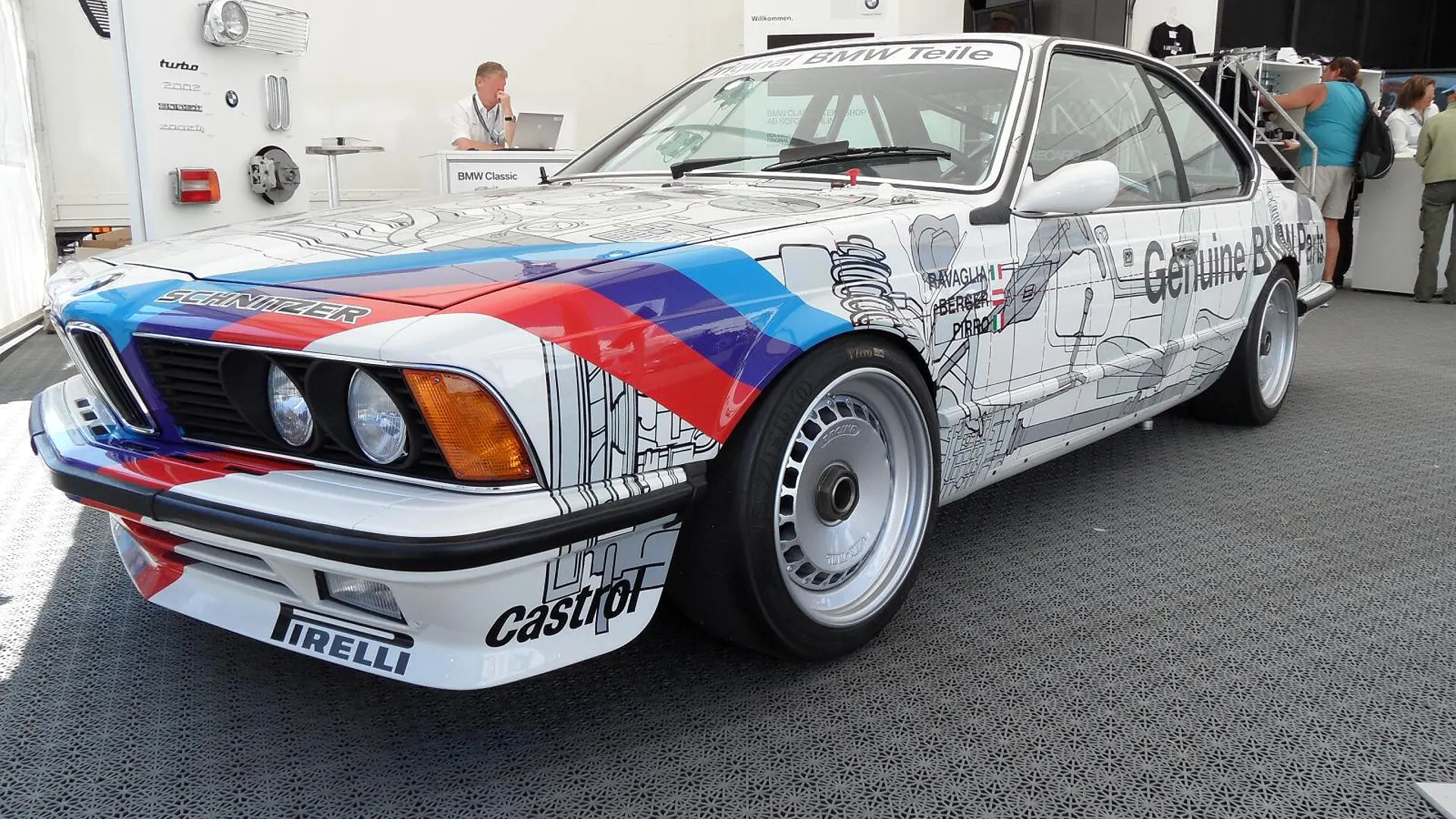
RM Sotheby’s Munich sale at Motorworld on 20 November puts a question in front of the room that the collector market has been quietly answering for a decade. What is a car that actually won worth, set against a road car that was built so that other people could race?
The estimates answer it plainly. The 1986 BMW 635 CSi Group A that Schnitzer Motorsport took to victory in the 24 Hours of Spa-Francorchamps carries an estimate of €500,000 to €700,000. A Speed Yellow 964 Carrera RS 3.8 with more than 185,000 kilometres on its odometer carries €1.1 million to €1.3 million. A 964 Turbo S Lightweight sits between them at €800,000 to €1 million.
Those numbers are not an error, and they are not a slight on the BMW. They are an accurate reading of how today’s buyers spend, and they make Munich a useful test of something we raised when a one-owner RS 3.8 went to RM’s London sale last month: the market pays most readily for what it can register, drive, insure and resell. The Spa winner is the most historically important car in the catalogue. The estimate treats it as the hardest one to own.
The car that did the winning
Chassis E24 RA2-79 is, by RM’s account, one of roughly ten Works 635 CSi coupés built and entered by Schnitzer, out of about 80 cars prepared for Group A. Its 1986 season is laid out race by race in the catalogue, and it reads like a roll call of the era. Roberto Ravaglia and Emanuele Pirro retired it at Monza with a wheel failure in March. Ravaglia and Gerhard Berger took it to second at Donington two weeks later. Dieter Quester and Otto Rensing finished second at Hockenheim, and Quester and Ravaglia brought it home third at Zeltweg in June, the same season Ravaglia went on to win the European Touring Car Championship.
Then came Spa, on 3 and 4 August. Quester, Altfrid Heger and Thierry Tassin started ninth and beat the Ford, Volvo and Rover entries over 24 hours. It was the third and final Spa victory for the 635 CSi, and it arrived months before the E30 M3 took over as BMW’s touring car. The big coupé’s last Works outing was the Bathurst 1000 Kilometres in September, where it did not finish.
That timing is the car’s historical value. The 635 CSi was the heavyweight that kept BMW winning Group A’s endurance classics while the M3 was still being readied, and this chassis carries the last of those wins. The turbocharged Volvos it raced against had more power. The BMW won on durability, consistency and Schnitzer’s preparation, which is what endurance racing in Group A was really about.
Why it is estimated below two 911s
Collectors should read the catalogue’s fine print as carefully as the race record, because it explains the estimate. After Bathurst the car went to privateer Yvan Tapy. The consignor bought it in June 2017, and Graber Sportgarage in Toffen, Switzerland, restored, maintained and race-prepared it from 2017 to 2024. Pastrolli Classic Cars in Maranello rebuilt the engine and fitted a new clutch in late 2025. A correct-type replacement engine now powers the car, and the original engine comes with it. RM offers it on a bill of sale only, and its FIA Historic Technical Passport is valid to the end of 2026.
None of that undermines the car. A Group A racer that has spent four decades being raced, rebuilt and raced again will rarely carry its 1986 engine, and the fact that the original block survives and comes with the car counts in its favour. But every one of those details narrows the pool of buyers. A race car comes with ongoing costs: a crew, a transporter, a passport renewal and a rebuild schedule. It cannot be driven to dinner. The buyers who want what it offers, a competitive entry on the best historic touring car grids (it has recently run at the Spa Classic and the Monza Revival), are a far smaller group than the buyers for a road-registered 911.
The archive is the asset
The strongest single item in the file is not the trophy. It is the Schnitzer Motorsport archive material: period timing sheets, engineering notes and setup pages tied to this chassis. Among roughly 80 Group A 635s, many of which have been re-shelled, rebuilt and re-liveried over the years, a team archive is what turns a well-told story into a verifiable one. Add the more than €250,000 of recent invoiced work, and a buyer is paying for a proven Works car that is ready to race.
Our view: measured by significance per euro, this is the most compelling lot in Munich. The estimate does not measure the car’s history. It is a discount for how hard the car is to resell.
The 911 that tests the air-cooled market
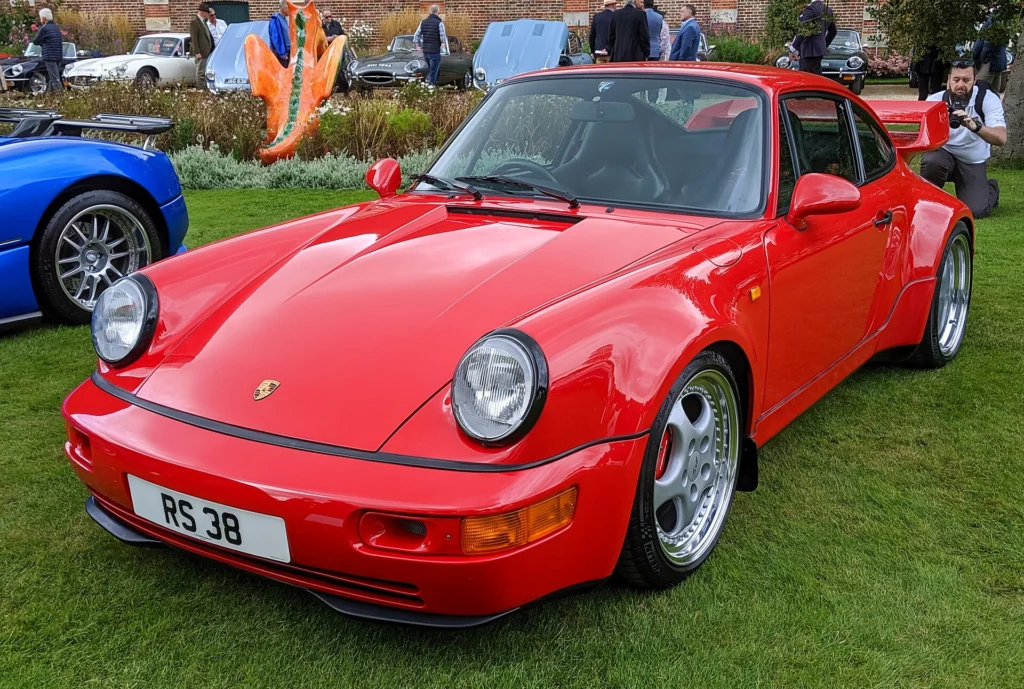
Porsche built 55 examples of the 964 Carrera RS 3.8 to homologate the Carrera RSR 3.8 for GT racing. Many regard it as the definitive road-going air-cooled RS. The Munich car is not a typical example, and that is exactly why it is worth watching.
The owner ordered it through Jürgen Barth, then Porsche’s customer racing manager, with the invoice issued via Porsche Centre Nuremberg on 12 December 1993. Its single German owner collected it at Weissach on 9 March 1994, and its papers record it as a 1994 model year. At the owner’s request, Porsche reinstalled the rear seats, with three-point belts, in the otherwise stripped cabin, which by RM’s account makes it the only RS 3.8 that seats four.
The owner had the engine rebuilt through Porsche Centre Fürth-Erlangen in 1998 after a material defect. Helmut Pietsch, head of engine technology at Porsche’s Werk 1, oversaw a second overhaul around 2005, and a later dyno run recorded 324 PS against the factory’s 300. The service book shows nine visits to Porsche for inspection up to October 2006. Kurt Ecke Motorsport has looked after the car since 2008, most recently in July 2025. The odometer reads 185,440 kilometres.
How the comparisons stack up
Now look at the comparisons. RM sold a 16,652-kilometre RS 3.8 in London in 2016 for £716,800, and a right-hand-drive car with under 20,000 kilometres there in 2018 for £933,125. At the end of October, the one-owner, 10,210-kilometre Zermatt Silver car cleared the top of its £800,000–£1,000,000 estimate in London. Munich’s €1.1–1.3 million range works out at roughly £950,000 to £1.12 million, about the same money for a car that has covered around 18 times the distance.
If bidders meet that estimate, it tells us something specific about the top of the air-cooled market. It would mean the RS 3.8 now trades as a scarce model rather than as a condition-graded used car. Every one of the 55 chassis is known and catalogued, and buyers will accept a well-used example with a continuous factory story rather than wait for the next car that has barely been driven. The four seats will divide purists, but they were specified at the factory and are documented in the Barth, Franz and Weber registry. Collectors have always paid for a documented factory one-off.
The broader lesson is worth stating plainly. At this level, mileage stops being a deduction and becomes a biography, provided every kilometre is written down. A 185,000-kilometre RS 3.8 with a gap in its records would be a very different proposition. This one has spent three decades in the hands of the factory and one specialist, and that continuity is what is being sold.
The Lightweight is the steady benchmark
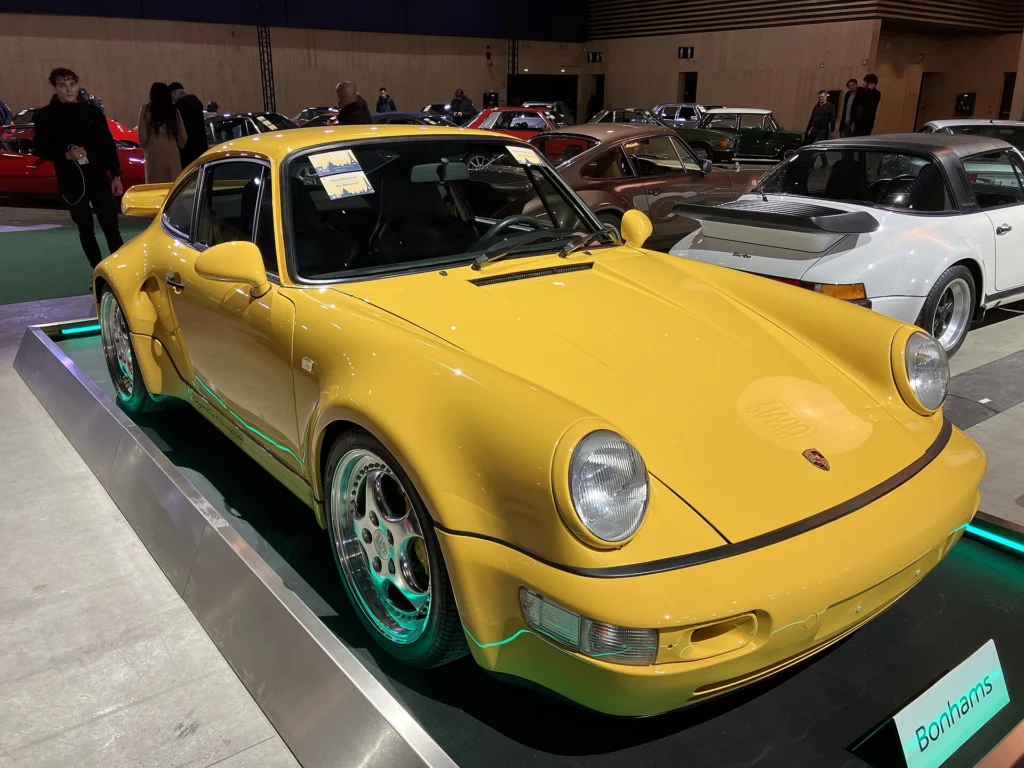
The 964 Turbo S Lightweight was Rolf Sprenger’s project. It is generally credited as the first model developed and built entirely within Porsche’s Exclusive department, and it was conceived as a road-going counterpart to the 964 Turbo that won the 1991 IMSA Supercar Championship. Porsche built 86, each more than 180 kilograms lighter than a standard Turbo S.
The Munich car was ordered by a Porsche VIP client, completed in September 1992 and delivered to Germany that December. It was registered in Spain in 1993 and has stayed with one family since. It is finished in paint-to-sample Speed Yellow, shows about 30,933 kilometres, and in October 2026 the Porsche Classic Center Gelderland confirmed its matching-numbers engine and gearbox.
RM’s own results show how settled this model’s market has become. A Lightweight brought $962,000 in Arizona in 2023. One with fewer than 130 kilometres made $923,500 at Monterey in 2024, and a right-hand-drive car sold for £770,000 in London the same year. Another failed to sell against an $800,000–$1,000,000 estimate in 2025. That is a market that has held close to $1 million for three years without either collapsing or overheating. Munich’s €800,000–€1 million estimate sits squarely within that range.
The comparison inside this sale is the more revealing one. Two Speed Yellow 964s, both from long single ownership. RM has placed the more powerful, lower-mileage car below the RS 3.8 with six times its mileage. The RS 3.8 is the rarer car, at 55 against 86, and its naturally aspirated engine and direct link to the RSR give it a standing in Porsche collecting that the Turbo has never quite matched.
Two M1s and one question about authenticity
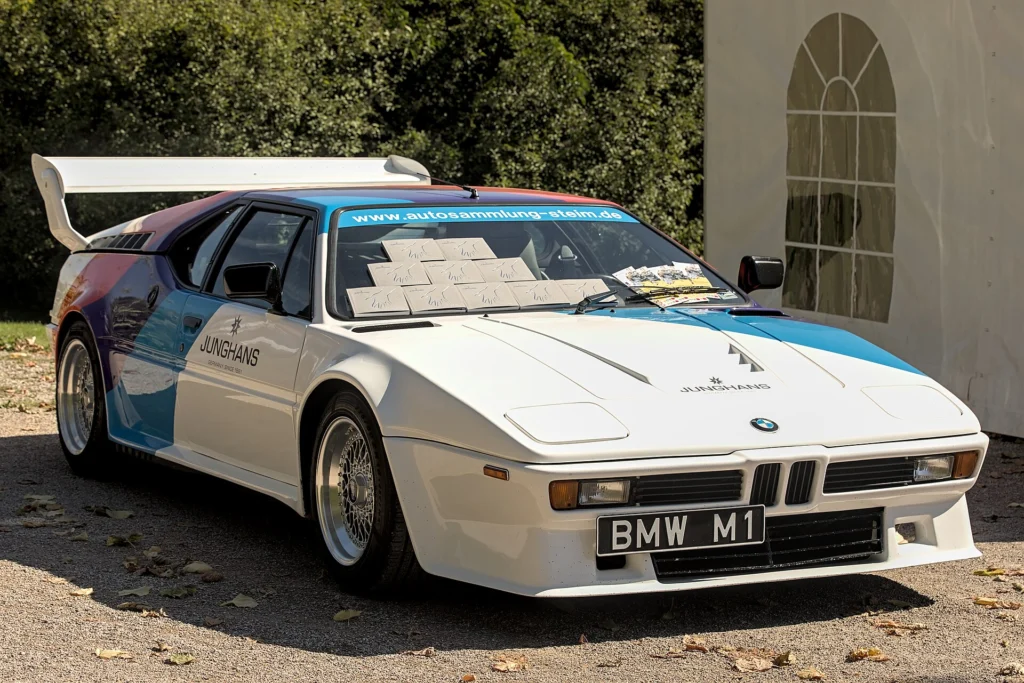
The most instructive lot in Munich may be one offered without reserve. After the Procar series ended and M1 production stopped, Peter Gartemann, president and owner of the BMW dealer AHG, created the AHG Studie: a package that turned a road-going M1 into a Procar-style street car, with bespoke bodywork, adjustable racing suspension, three-piece 16-inch BBS wheels and an engine uprated to 350 horsepower. RM believes AHG made no more than ten, each one different, and that the Munich car was Gartemann’s own, the car AHG used to promote the programme. It carries the “altmiks lackdesign” signature of the paint shop that finished each car.
There is one detail collectors need to understand. The car’s 17-digit VIN ends in 01461, outside BMW’s M1 sequence, which closed with chassis 01460 in February 1981. RM attributes its production to AHG, not BMW. The estimate is €400,000 to €500,000.
A no-reserve test of authenticity
The sale also includes a conventional 1980 M1: the 55th built according to the BMW M1 Register, still in its factory Blue over Black, German-owned from new and showing 45,135 kilometres. RM sold an M1 for €567,500 at this same venue last year, and sold a different AHG Studie for $648,500 in 2022. With no reserve, the AHG car will give an honest price for a question the market rarely gets to test directly. Do collectors value a rare, period, dealer-built interpretation of a legend more than a factory car that sits within the official sequence? The VIN could work either way. For some bidders it confirms the car is a separate, documented creation. For others it will be a reason to stay with a car that BMW itself recorded.
The supporting cast
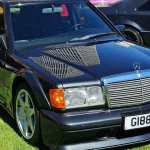
The rest of the catalogue supports the theme. A 1990 BMW M3 Sport Evolution, one of 600 and the final E30 M3, was delivered through BMW AG on 6 April 1990 before going to Austria, and it is still in its correct Black II over Anthracite cloth. RM sold one at Motorworld last year for €325,625. A Mercedes-Benz 190 E 2.5-16 Evolution II joins it. RM sold an Evo II for €308,750 in Monaco in April. We compared these two DTM homologation specials with the Sierra RS500 in our three-way market comparison, and our E30 M3 spec sheet covers how to verify a genuine car.
For contrast, there is a Maserati Ghibli Spyder 4.7, one of only about 80 of the 125 Spyders built with the 4.7-litre V8. Chassis 1233 left the factory in US specification. RM states that its full history is not known, that a later owner had it refinished in black, and that it has a replacement manual gearbox. It is a reminder that rarity alone sets a ceiling, and documentation is what raises it.
What serious buyers should watch
- The RS 3.8 against its estimate. A result at or above €1.1 million for a 185,000-kilometre car would confirm that documented history now outweighs mileage at the top of the air-cooled market.
- Where the 635 CSi lands in its range. A strong result would suggest that buyers of historic racing cars with Works provenance are coming back to Group A. A weak one would show that the resale discount on race cars is still wide.
- The no-reserve M1 AHG Studie. It is the purest price signal in the sale for period, non-factory rarity, especially with a factory M1 offered on the same night.
Homologation was meant to be the paperwork that allowed a car to race. Thirty-five years on, the market often values that paperwork more highly than the racing itself. Munich will show whether that still holds when the race car in question won Spa, and anyone who would rather own the moment than the specification knows which car to look at first.
Sources
- RM Sotheby’s, The Munich Auction 2026: sale details
- RM Sotheby’s lot page: 1986 BMW 635CSi Group A
- RM Sotheby’s London 2016: 1993 Porsche 911 Carrera RS 3.8 result
- RM Sotheby’s London 2018: 1993 Porsche 911 Carrera RS 3.8 result
- RM Sotheby’s Arizona 2023: 1993 Porsche Turbo S Lightweight result
- RM Sotheby’s Monterey 2024: 1993 Porsche 911 Turbo S Lightweight result
- RM Sotheby’s London 2024: 1993 Porsche 911 Turbo S Lightweight result
- RM Sotheby’s 2022: 1980 BMW M1 AHG Studie result
- RM Sotheby’s Munich 2025 results release
- RM Sotheby’s Monaco 2026: 1990 Mercedes-Benz 190 E 2.5-16 Evolution II result
The collector car market, every weekday morning.
Auction results, price moves and what’s crossing the block, read in four minutes. Free, from Modern Car Collector.
No spam, unsubscribe in one click. Or read more about the Brief.
Related Posts:
- A €5.2M LaFerrari, a Valkyrie With a Haircut, and…
- A €5.2M LaFerrari, a Valkyrie With a Haircut, and…
- The Porsche Carrera GT Doubled in 2026. The $6.7…
- A One-Owner 1993 Porsche 911 Carrera RS 3.8 Heads to…
- The Collector Car Market Paid Up for Certainty This…
- 190E Evo II vs. Sierra RS500 vs. M3 Sport Evolution:…
 Shawn Henry
 Eve Nowell