

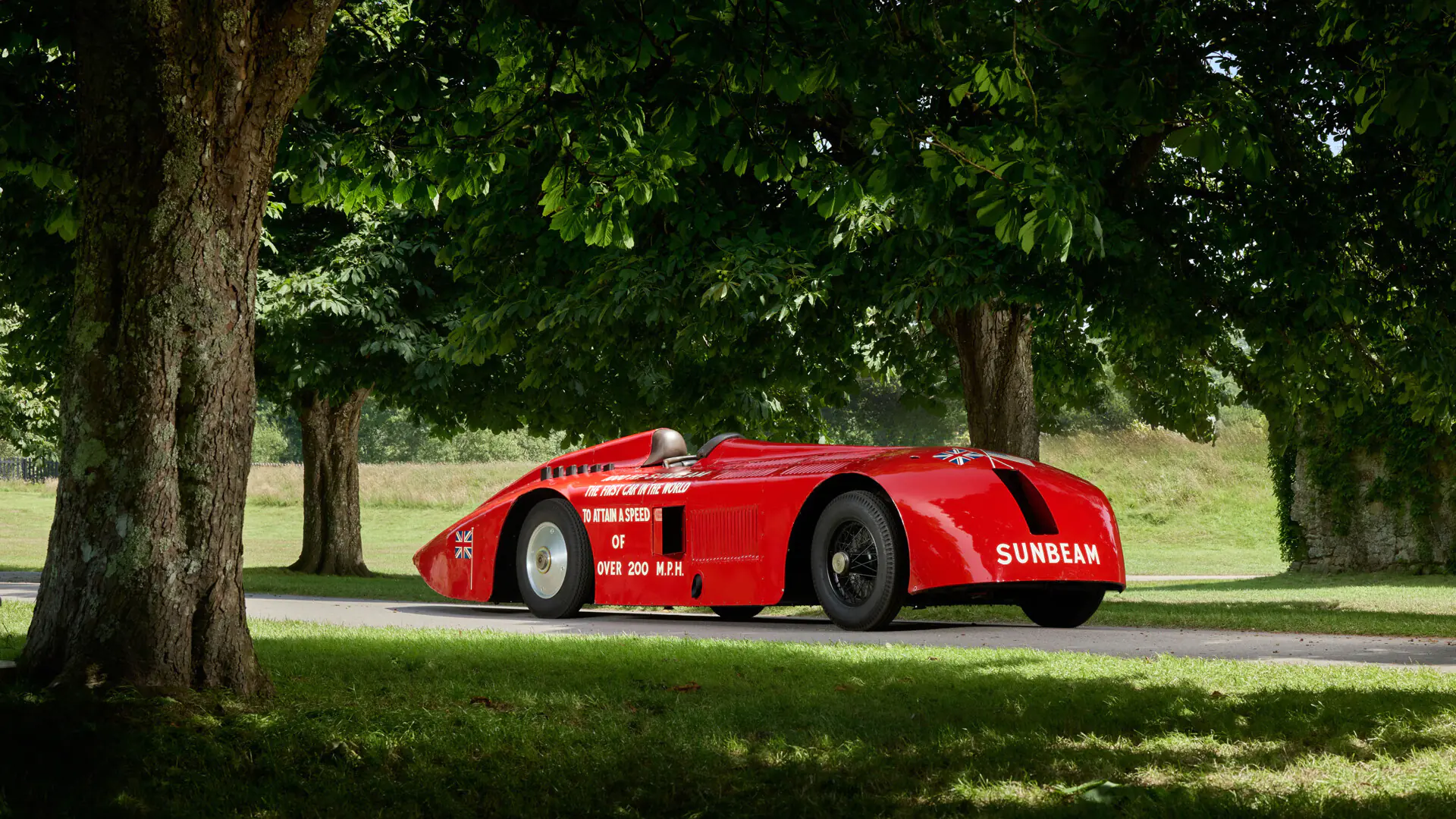
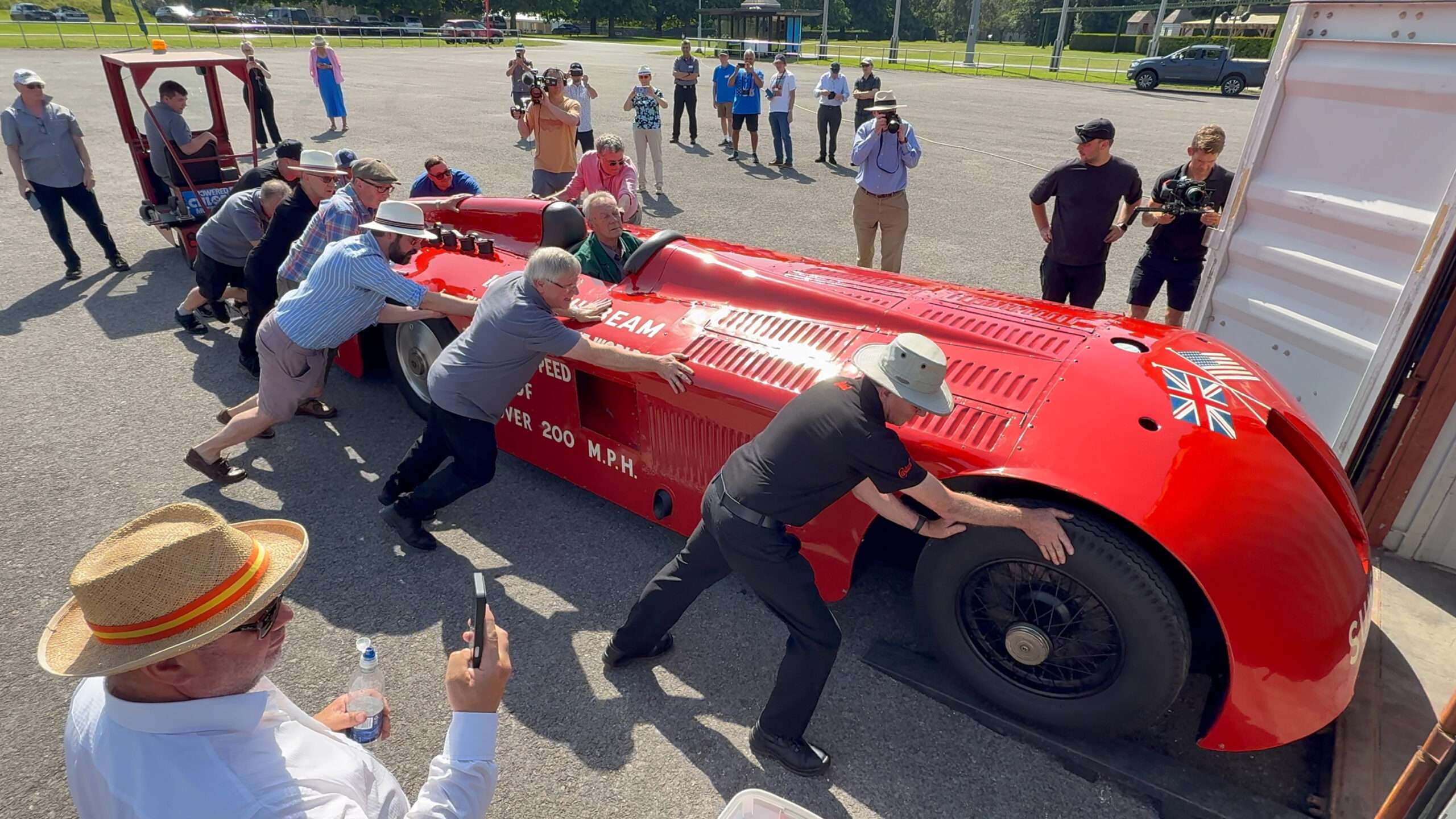
The land speed record has always been told in numbers, from the 77 mph Maurice Augières coaxed out of a Mors in 1902 to the 203.792 mph that Henry Segrave averaged over the measured mile at Daytona Beach on March 29, 1927. Segrave’s car, the Sunbeam 1000hp, was the first to go faster than 200 mph. On March 29, 2027, a century to the day, it is scheduled to return to the same sand.
This time the important number is the one it will not reach. The National Motor Museum at Beaulieu, which owns the car, has said plainly that the centenary run will be a low-speed re-enactment and that no one will try to repeat 203 mph. That is how it should be. The achievement worth celebrating in 2027 is not speed. It is that a twin-engined experiment, assembled in a few months around a pair of salvaged aero engines and silent for most of a century, can once again move under its own power.
For collectors, that is the real story. The Sunbeam will never cross an auction block, so its importance cannot be expressed as a price. What it offers instead is something more useful: a fully documented answer to the question every owner of a significant mechanical object eventually faces. Do you preserve it as found, or do you make it work again?
A record car built from leftovers
The name was always more ambition than measurement. The car is powered by two Sunbeam Matabele V12 aero engines of 22.5 liters each, rated at 435 bhp apiece. That is roughly 870 bhp combined, a remarkable figure for 1927 but not the four-figure number painted into the legend. The engines themselves were secondhand. Built in 1918 and surplus after the First World War, they raced a hydroplane off the Isle of Wight in 1920, and in 1921 went to Detroit, where the boat’s hull failed and it sank. Sunbeam recovered the waterlogged engines and stored them at its Moorfield works in Wolverhampton until Louis Coatalen, the company’s chief engineer and managing director, and Segrave saw what they might do in a car. A dunking does not have to end a significant machine’s story, as a seawater-ruined Delahaye 165 that now wins concours has shown. These engines went on to make history.
Coatalen’s concept put one engine ahead of the driver and one behind, with a three-speed gearbox and chain final drive, all wrapped in a body shaped like an upturned boat. Captain Jack Irving turned the idea into hardware, combining a frame from John Thompson Motor Pressings, Vickers steel forgings, specially built Hartford shock absorbers and a Dewandre vacuum-servo braking system. Construction started on Nov. 11, 1926. Wind-tunnel testing was finished on March 2, 1927, and the car sailed for New York aboard Cunard’s Berengaria with 18 crates of spares. Its nicknames, “Mystery” and “The Slug,” the latter postwar slang for a bullet, came with it.
It belongs to a short, extraordinary era when record breakers simply took aircraft power and found a way to put it on the ground. Ernest Eldridge’s Fiat Mephistopheles came from the same school of thought. The Sunbeam took the idea further than anyone, with two engines instead of one, and became the first car to prove that 200 mph was possible.
The morning of March 29, 1927
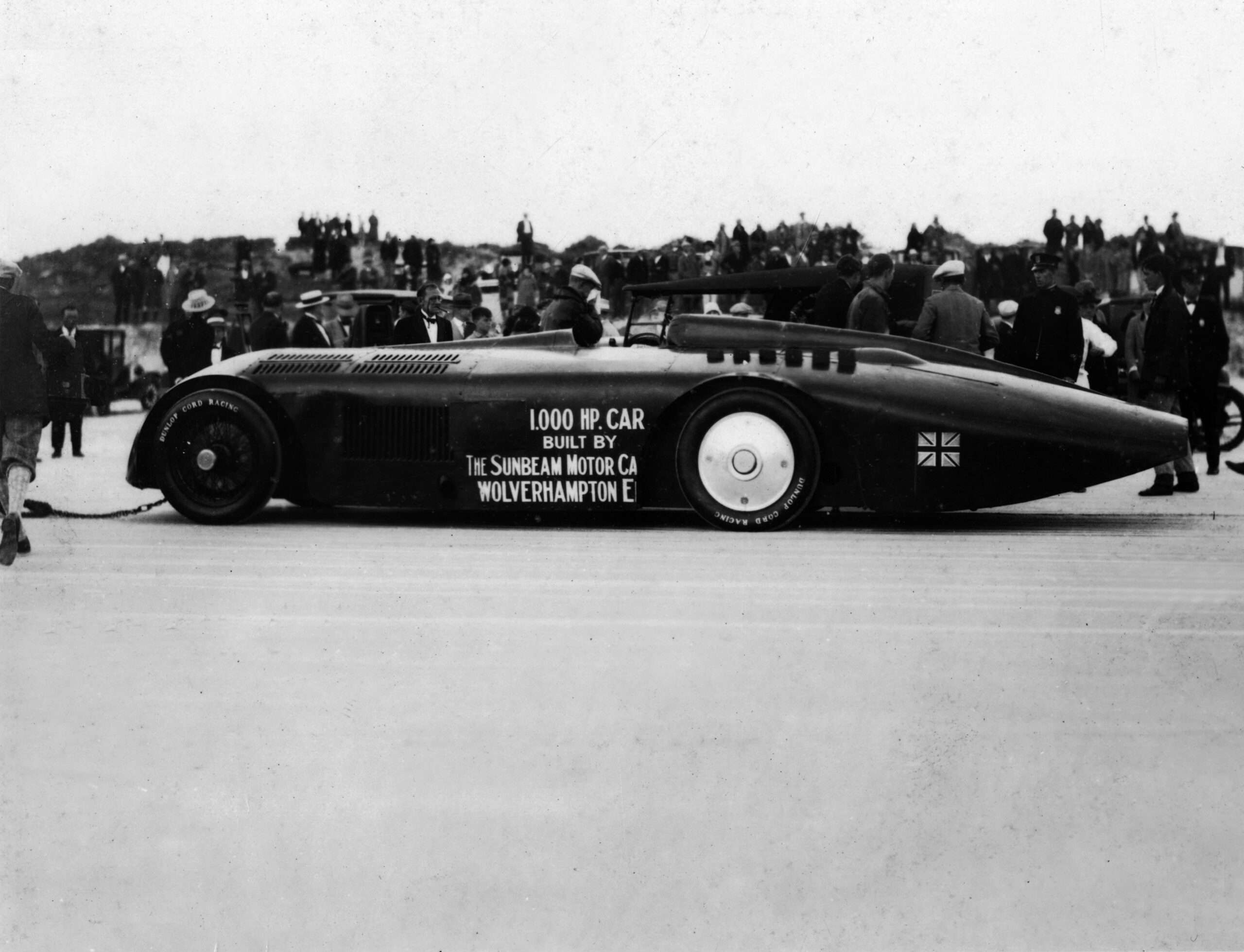
The Sunbeam’s first test run on Daytona Beach, on March 21, drew an estimated 10,000 spectators. The record came eight days later, at about 9:30 in the morning. According to the museum’s account, Segrave was pushed off line on the measured mile and fought the car back under control. As the usable beach ran out his brakes failed, and he steered into the shallows to scrub off speed. Fresh tires went on for the return run. The two-way average was 203.792 mph.
The record itself did not last. Malcolm Campbell’s Blue Bird raised it on the same beach less than a year later. That is the point worth remembering: speed records are always broken, but firsts can only be kept. Collectors rarely pay a premium for a number that someone else has since beaten. They pay for the moment a barrier fell, and the Sunbeam is the only car that can claim the moment 200 mph did.
A provenance with almost no gaps
After Daytona, the Sunbeam was displayed in the window of Selfridges in London and made demonstration runs at Brooklands and Montlhéry before returning to Wolverhampton. Castrol and Dunlop used it in their advertising, and toy versions followed. In 1958 the Rootes Group, by then Sunbeam’s parent, lent it to the Montagu Motor Museum at Beaulieu. In 1970, as the National Motor Museum was being formed, Lord Montagu bought it at auction with Rootes’ help. It was on display when the new museum opened in 1972, alongside the Sunbeam 350hp, Golden Arrow and Bluebird CN7.
For a car of this importance, that is an unusually clean chain of custody: the factory, the factory’s successor, then a museum that has held it continuously since 1958. There was no private-ownership interlude and no succession of owners each leaving a mark. That matters more than it might seem. Private collections, however well kept, have a way of ending up at auction. A national icon held by a charitable trust does not, which is exactly why its restoration choices could be made for the long term rather than for the market.
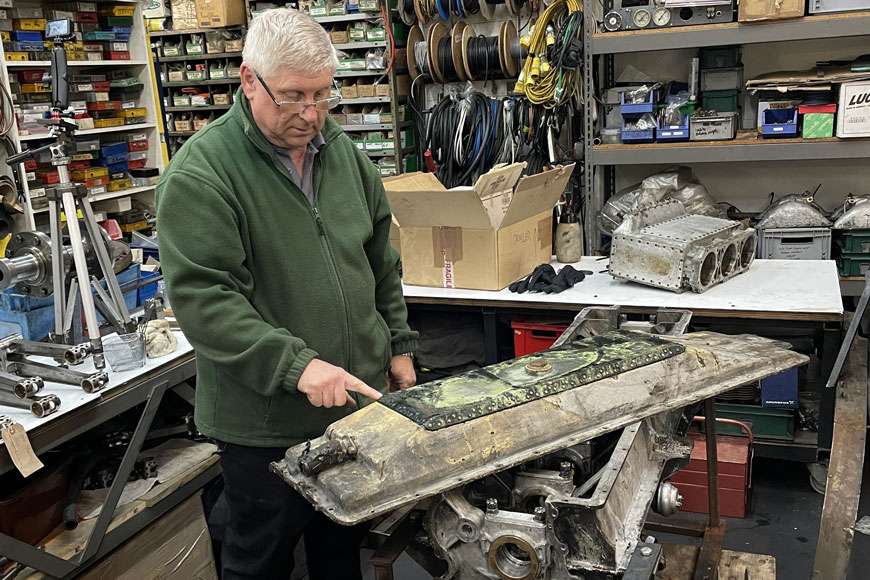
Clean provenance is not the same as an untouched car, however. The restoration found that the front engine had been dropped at some point and repaired before it reached Beaulieu, and that water left in the cooling system had frozen and cracked all four of its cylinder blocks. Ian Stanfield, the senior engineer who led the work, summed it up simply: the engine had “had a hard life.”
Restoring without a manual
There were no manuals and no factory documentation to work from, and the two engines are not identical. They turn in opposite directions, so lessons from the first rebuild only partly applied to the second. The museum spent about 18 months simply stripping the rear engine, during which a crack in the crankcase was repaired by laser welding. That engine ran again in September 2025 at the Beaulieu International Autojumble, its first start in roughly 90 years.
The front engine proved worse. Its camshafts were glued in place by old Castrol R and had to be soaked in a hot detergent tank for a carefully timed period so the solution would not attack the aluminum. Rusted cylinder bores were machined out and fitted with steel liners. Formhalls Engine Services, part of Marcos Motor Company, handled off-site work, including the white-metal bearings on the first engine. A compressed-air starter was recreated, and parts that were missing or worn beyond saving were remade. In June 2026 the second engine went back into the chassis, both engines were tested, the original bodywork was refitted and new tires were mounted. The museum puts the restoration at more than three years, after many more years of preparation. Work on the first engine began around the record’s 90th anniversary in 2017.
What collectors should notice is the approach. The museum describes extensive work, on site and off, to repair original parts, including those of the frost-damaged front engine, and the original bodywork went back on the car. New parts were made where originals were missing or too worn to save. The work was also carried out in view of museum visitors and recorded on film and in published updates throughout. That record now travels with the car. With any significant restoration, the documentation is part of the asset, and it is often the part buyers find hardest to replace.
Why run it at all?
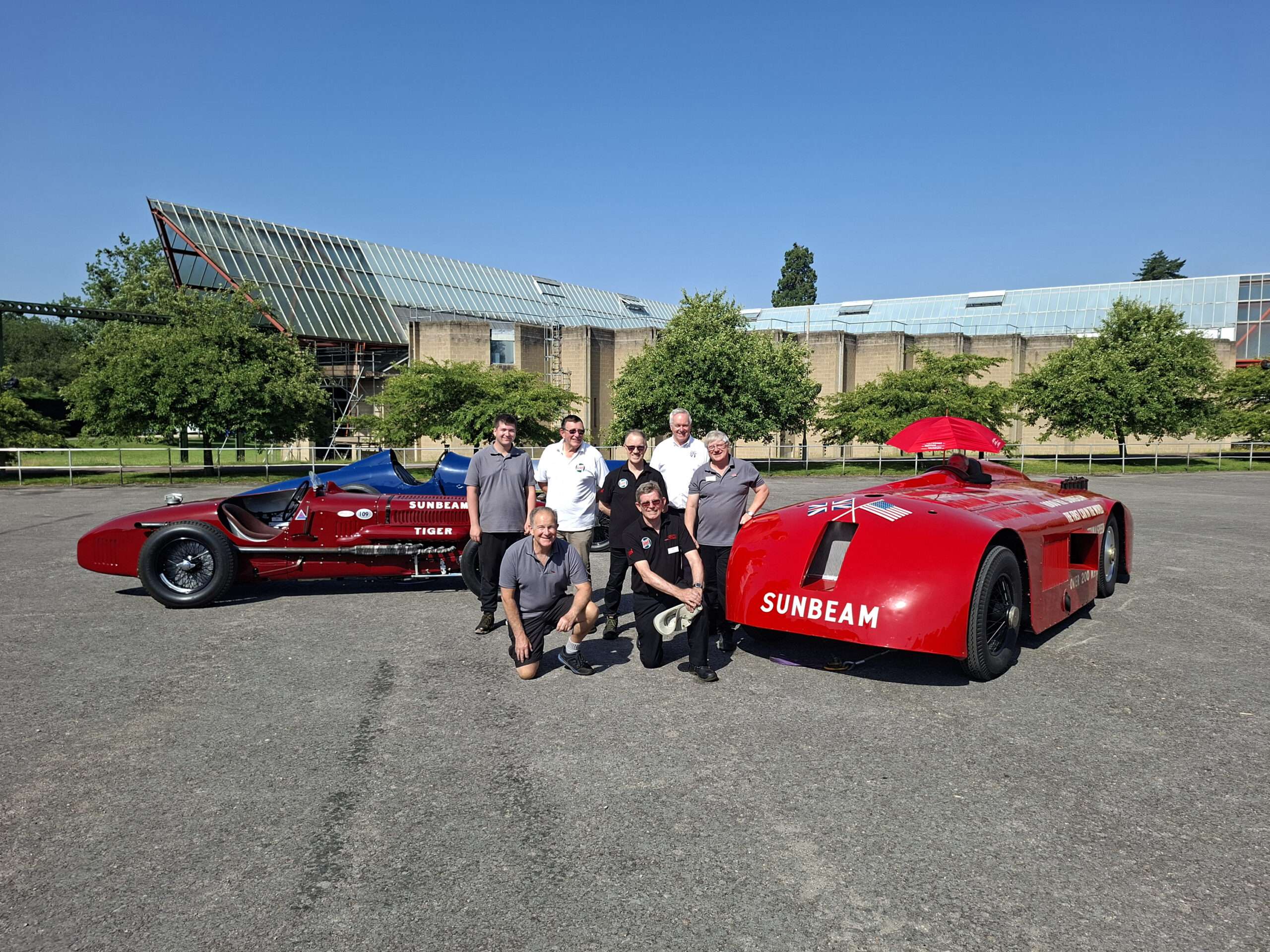
There is a respectable argument for leaving a one-off like this alone. Every start carries risk, and an engine that does not run cannot be damaged by running. The museum’s answer, which we find persuasive, is that the Sunbeam was built to run, and the understanding of how these engines actually work survives only in the people who have rebuilt them. A young apprentice, Aaron Burton, worked on the second engine. Knowledge kept in hands lasts longer than knowledge kept in an archive. Beaulieu has done this before: its workshop returned the Sunbeam 350hp to running order for the 90th anniversary of that car’s record at Pendine Sands in 2015.
The American tour also shows why a running icon matters to the wider hobby. In August the Sunbeam headlined a special curated class at the 75th Pebble Beach Concours d’Elegance. It is on view at the Petersen Automotive Museum in Los Angeles through Jan. 3, its first time in the United States since 1927. A static car in a hall draws respect. A car that moves draws a crowd, and some of that crowd will go on to become collectors.
The 2027 schedule
The museum and its Florida partners have published the following plan:
- Jan. 16 to April 18: On display at the Motorsports Hall of Fame of America at Daytona International Speedway.
- March 25: Evening presentation on the car at the Hall of Fame.
- March 26: A chance to meet the National Motor Museum team at Ormond Garage in Ormond Beach.
- March 26 to 28: Display at the Spring Daytona Turkey Run in the Speedway infield.
- March 27: Tours of The Casements in Ormond Beach, John D. Rockefeller’s former winter home, where Segrave and his team were received after the 1927 runs.
- March 29: The centenary re-enactment on Daytona Beach in the morning, a display at the Daytona Beach Bandshell in the afternoon and an evening celebration at The Shores Resort & Spa.
- April: A return to the Hall of Fame before the car goes home to Britain.
Exact times, the location of the run and arrangements for public viewing have not yet been announced. The museum says those details will follow. Anyone planning to travel should wait for them before making firm plans. The Turkey Run booking stands out. It is a long-running car show and swap meet built around owner-driven cars, and putting a museum icon among them is a smart choice. It puts the Sunbeam in front of the people who keep old cars running for the love of it.
The real significance
Segrave’s record lasted less than a year. His car has lasted a century, and it now runs again because a museum decided that keeping an object and keeping it alive are two different jobs. The run on March 29 will be slow, and that is fine. The car has already done the hard part, which was coming back. For anyone who owns a car that matters, the lesson from Beaulieu is that original fabric, honest repair and a complete record are what carry a car’s significance into its second century. Speed was never going to do that.
Sources: National Motor Museum, Sunbeam 1000hp History; Sunbeam 1000hp Returns to the USA; Sunbeam 1000hp World Land Speed Record Breaker Restored; Restoration race is on as engineers discover damage in second engine; Engineers rebuild second engine; Sunbeam 1000hp starts journey to America; How to participate in the centenary celebrations; Sunbeam 1,000hp, vehicle collection.
The collector car market, every weekday morning.
Auction results, price moves and what’s crossing the block, read in four minutes. Free, from Modern Car Collector.
No spam, unsubscribe in one click. Or read more about the Brief.
 Kyle Matthews
 Eve Nowell