

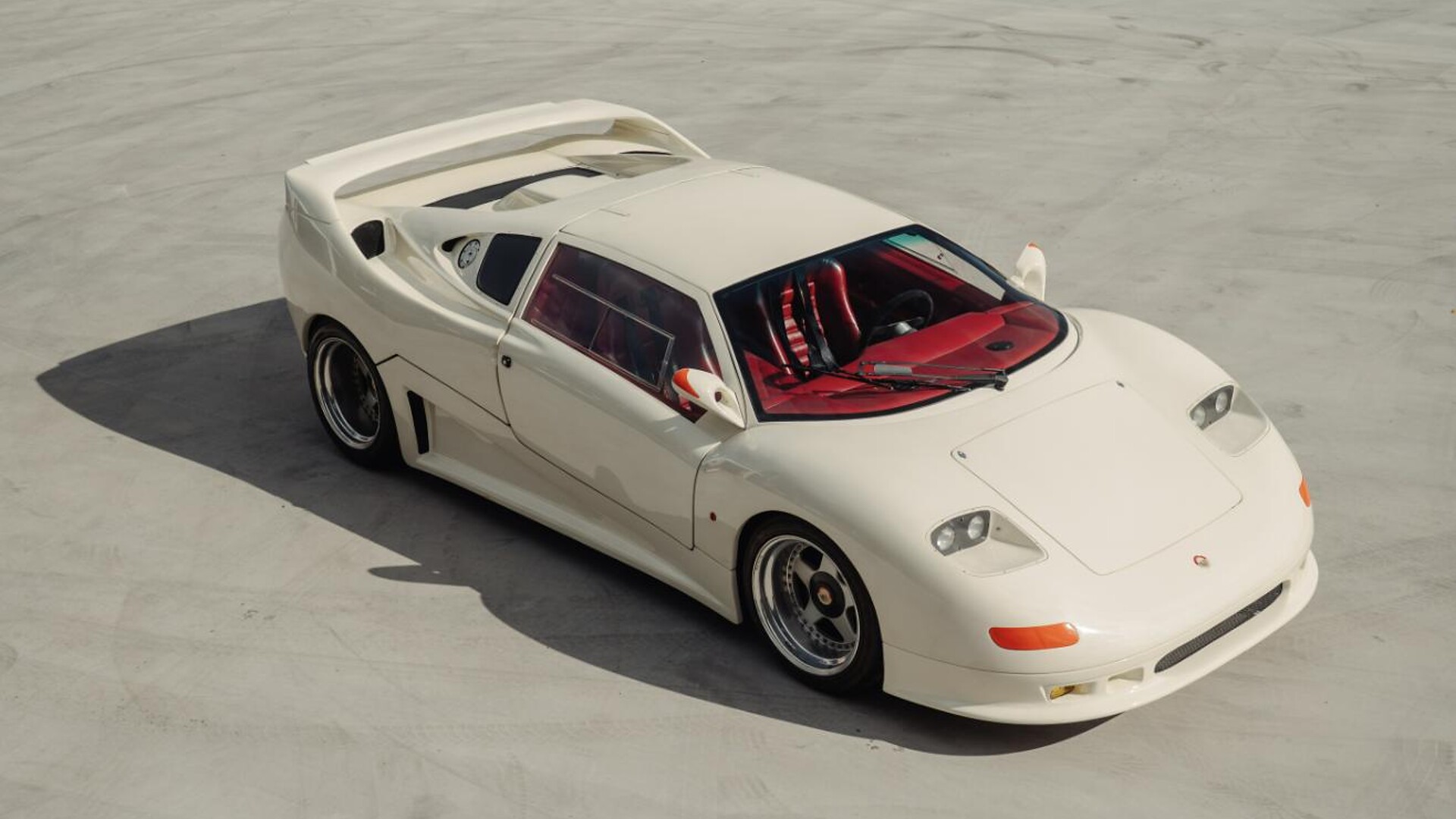
On October 9, 2026, Broad Arrow Auctions will bring the first-ever MCA Centenaire to the block at its second annual Zoute Concours Auction in Knokke-Heist, Belgium, carrying a presale estimate of €900,000 to €1,200,000 (roughly $967,000 to $1,290,000). It is an easy car to undersell: a carbon-fiber supercar built in a principality with no car industry to speak of, powered by a borrowed Lamborghini V12, one of only five ever made. But the estimate is not the story. The real story is a correction to automotive history that most of the collector world has never heard — and this particular chassis, the one that started the whole project, is the car to prove it with.
Monaco’s Only Car Company
Monte Carlo Automobile was never going to be a volume manufacturer. Founded in 1983 by Fulvio-Maria Ballabio, a former Formula 2 and IndyCar driver based in the Principality, the company assembled a small but serious roster: technical director Carlo Chiti, the engineer behind engines for Scuderia Ferrari and Autodelta, and Pierluigi Corbari, formerly Alfa Romeo’s sporting director. Their brief was to build the first automobile ever manufactured under a Monégasque flag, timed to the 1990 centenary of the Automobile Club de Monaco and significant enough to be presented personally to Prince Albert II.
They called it the Centenaire. Power came from a Lamborghini 5.2-liter V12, the same unit fitted to the Countach 5000 QV, sent through a ZF six-speed manual to the rear wheels. Only five were built between 1990 and 1992, and two development cars were later clocked at roughly 220 mph on the Mulsanne Straight during Le Mans testing — a speed that would have embarrassed some purpose-built prototypes of the era.
The Claim That Predates the McLaren F1
Here is the detail that should matter more to collectors than the Lamborghini badge on the engine cover: the Centenaire’s carbon-fiber monocoque chassis and body predate the car usually credited with pioneering that construction method for road cars. The McLaren F1, unveiled in Monaco in May 1992 and still widely cited as the first production car built around a full carbon-fiber monocoque, arrived roughly two years after the Centenaire was already running. Monte Carlo Automobile’s chassis was not a technology demonstrator or a one-off concept; it was the production specification of a five-car series, built by a company with none of McLaren’s Formula 1 engineering budget.
That is not a knock on the F1, which remains the car that proved carbon-fiber construction could be scaled, refined, and sold — deservedly the more important car in the arc of automotive engineering. But it does mean the Centenaire’s real value to collectors is not nostalgia for a forgotten supercar. It is documentation of a “first” that the market has largely priced as a footnote. Cars rarely get reappraised this late in their lives; documented firsts tend to compound in value once the record catches up to them.
From Sant’Agata to the Auction Block
This particular Centenaire is chassis No. 1, the development and presentation car, which explains why its history reads more like a factory archive than a used-car file. After its test and show duties were finished, Lamborghini kept the car at its Sant’Agata Bolognese factory for roughly a decade before gifting it back to Ballabio in the early 2000s. It resurfaced in 2007 at Rétromobile, repainted blue, parked beside the one-off Lamborghini Pregunta concept from the same collection. A bodywork restoration around 2016 returned it to its original Ivory White over red leather, a palette chosen deliberately to echo Monaco’s own flag, while the red interior, untouched by that restoration, remains original.
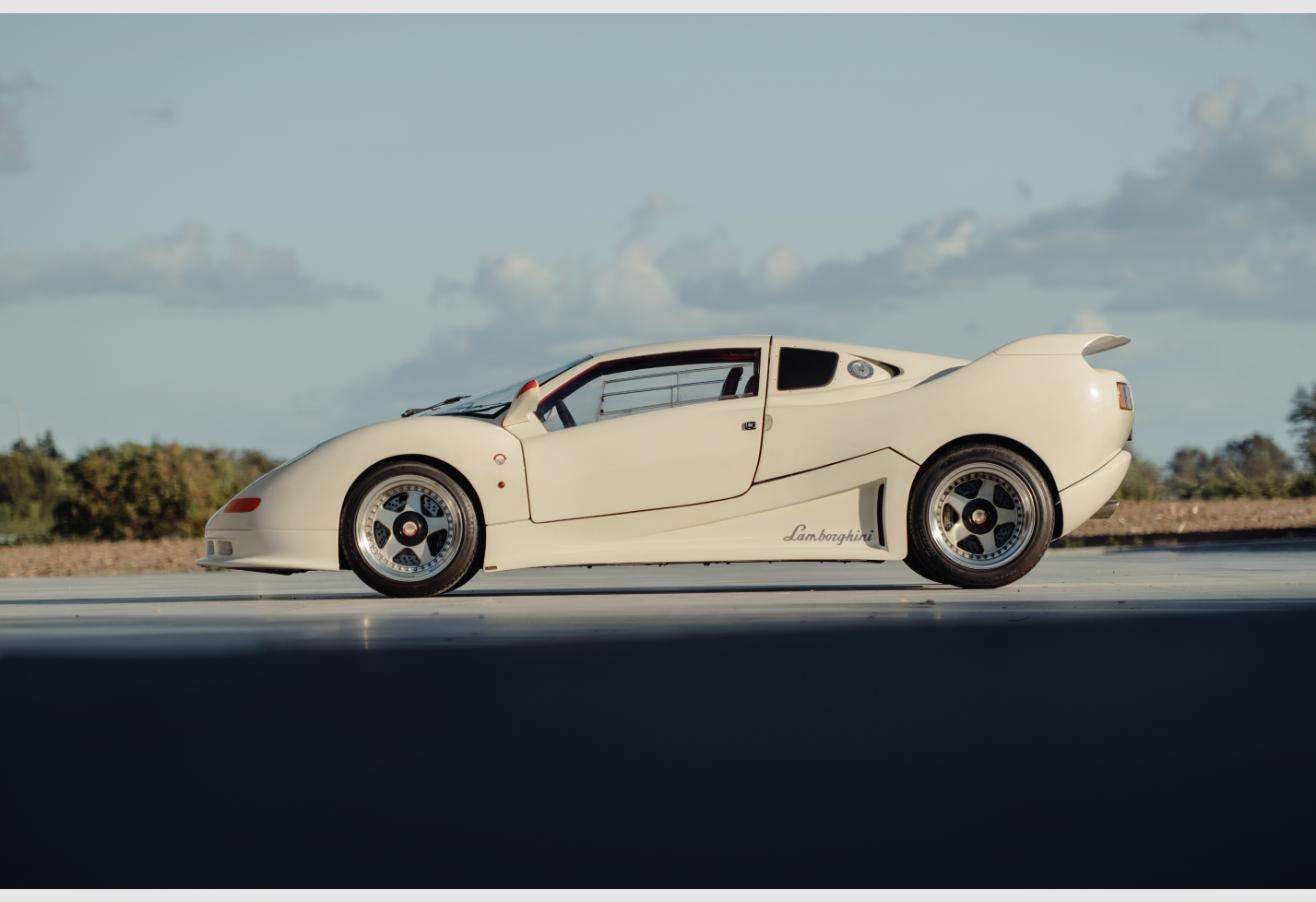
A French collector acquired the car in 2014 and has consigned it for this sale. What travels with it matters as much as the car itself: a documented history file including the original supply contract between Automobili Lamborghini and Ballabio for the V12 engines, period photography from the Sant’Agata factory, and paperwork from its Rétromobile appearance. Broad Arrow consignment consultant Jean-Louis Baldanza called it “an honour to present this piece of French supercar history” in the auction house’s announcement of the sale. It is a modest way to describe a car that may deserve a more significant place in the record than either the consignor or the auction house is claiming.
What Serious Buyers Should Weigh
Rarity alone has never been the reason to pay for a car, and five built is not automatically five reasons to bid. What should move this sale is a combination of factors that rarely travels together: factory-level documentation, an unbroken and traceable ownership chain back to Lamborghini itself, a restoration that preserved rather than replaced original material, and a legitimate, underexplored claim to engineering significance. Buyers should also weigh what the Centenaire is not. It is not a car with a competition record to lean on, and Monte Carlo Automobile’s later history, including a mid-1990s acquisition by the Aixam Mega group and a pivot toward alternative-fuel prototypes, never built the kind of brand equity that keeps prices climbing on name recognition alone. This is a collector car that has to be bought on the file, not the badge.
For context, boutique, carbon-bodied V12 machinery from this era has proven it can hold serious value once the story is told correctly. The Lamborghini Centenario traded on exactly that formula a generation later, pairing extreme rarity with a carbon-fiber structure and a name that, coincidentally, echoes the Centenaire’s own. Collectors chasing that same intersection of rarity and engineering substance, rather than horsepower or nought-to-sixty numbers, are the ones who will understand what is actually being offered at Zoute this October.
The headline number on October 9 will likely be whatever hammer price the Centenaire pulls in Knokke-Heist. Ignore it. The real transaction here is a correction to the record: the first carbon-fiber road car most people can name is not actually the first one built. Collectors who understand that a documented first is worth more than a famous one — and who get there before the wider market does — are the ones who will look prescient a decade from now.
The collector car market, every weekday morning.
Auction results, price moves and what’s crossing the block, read in four minutes. Free, from Modern Car Collector.
No spam, unsubscribe in one click. Or read more about the Brief.
Related Posts:
- Five Built, Three That Count: How to Read the MCA…

- Collector Car Market Brief: Sampras's BMW Z8, Two…

- Record Ferraris, Rare Icons and 15,000 RPM: The Week…

- The Collector Car Market Paid Up for Certainty This…

- McLaren Senna in Fina Colours: A Rare Commission…

- Two T.50s Have Sold at Auction, $2.4 Million Apart.…

 Shawn Henry
  Eve Nowell