

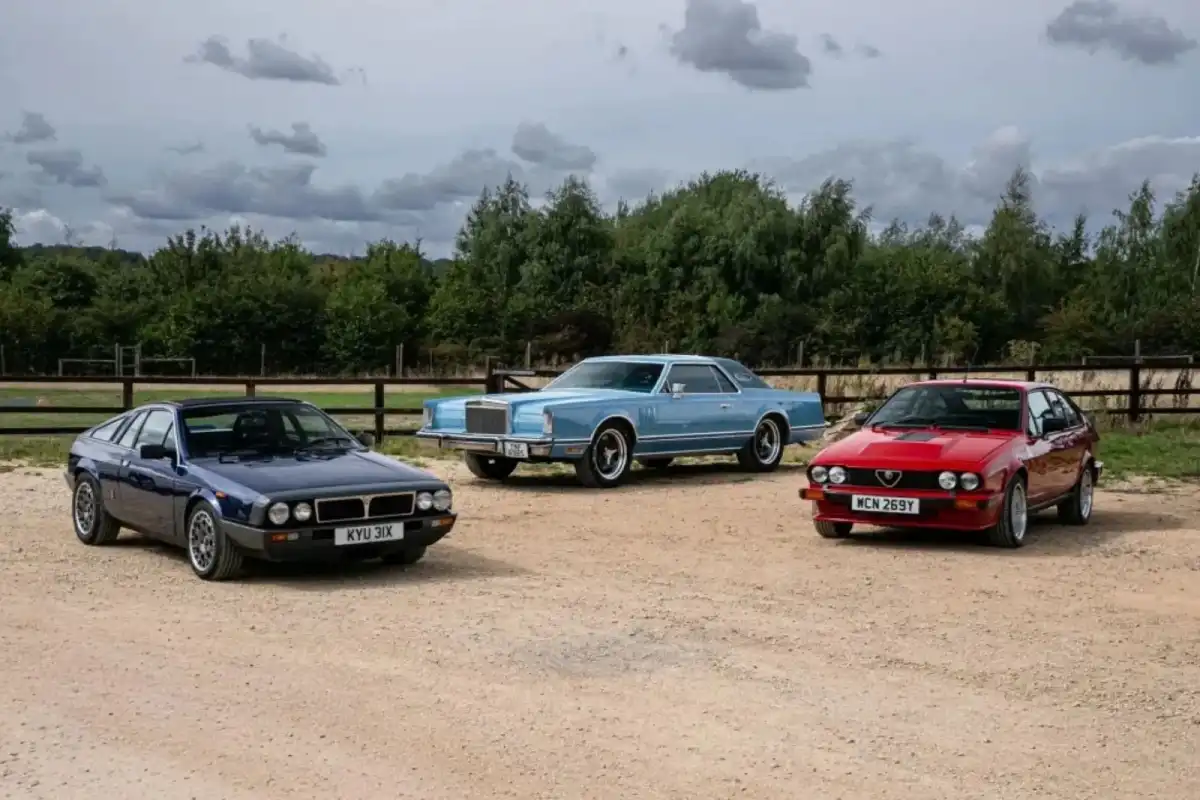
Three cars from Jeremy Clarkson’s personal collection will cross the block without reserve at Iconic Auctioneers’ Iconic Sale, held during the NEC Classic Motor Show in Birmingham on November 14, 2026: a 1982 Lancia Montecarlo Spider, a 1983 Alfa Romeo GTV6, and a 1978 Lincoln Continental Mark V. All three appeared in The Grand Tour. None of them, on paper, is a car serious collectors fight over. That is precisely what makes this sale worth watching.
Strip away the cameras and the three lots read like a 1995 classifieds page: a rust-prone Italian coupe worth low five figures, a better-engineered Alfa with a genuinely good engine, and a soft American land yacht nobody has taken seriously as an investment since the Carter administration. What changes the equation is provenance of a very specific, very modern kind — not matching numbers or a factory competition history, but twenty-two years of television. Only one of the three cars earns real weight on its own engineering and history. The other two are riding on its coattails, and knowing which is which matters more than the hammer prices will.
Three lots, one collection, no floor
Iconic Auctioneers is offering all three cars “directly from” Clarkson’s own collection, each without reserve — no floor price protecting any of them, no walking away if the room goes quiet. Clarkson’s own explanation is characteristically understated: he rarely gets the chance to drive or enjoy the cars anymore, so “it’s probably for the best if they end up with someone who can.” Iconic has also teased that the fuller story behind the sale will surface in a forthcoming season of Clarkson’s Farm, which is the kind of promotional breadcrumb worth noting and nothing more until it airs.
The timing carries its own weight regardless of what that story turns out to be. The Grand Tour ended its run with Clarkson, Richard Hammond and James May in September 2024, closing out a partnership that stretched back through Top Gear to 2003. Amazon has since handed the franchise to a new cast for its most recent series. A no-reserve strategy is also a specific market tool, not just an emotional gesture — it’s the same mechanism sellers use when they want genuine price discovery rather than a number protected by an estimate. Offered this way, all three Clarkson cars will tell the market exactly what television history is worth today, with nothing propping up the result.
The Lancia Montecarlo: the car that got to say goodbye
Of the three, the 1982 Lancia Montecarlo Spider is the one worth a serious collector’s attention, and not only because of what it did on camera. It was the last car Clarkson drove in One for the Road, the finale that ended the original trio’s run together, filmed across Zimbabwe and Botswana. Clarkson liked it enough to buy it out of the production fleet afterward and keep it in his own collection — which is a meaningfully different kind of provenance than simply being borrowed for a shoot. The car also closed a loop few viewers would have caught: during that final special, Clarkson was reunited with the Lancia Beta Coupé he’d driven in the 2007 Top Gear Botswana special, tying the closing episode of the Amazon era back to one of the defining episodes of the BBC one.
Finished in Lotus Blue and fettled for the cameras with Ferrari 308-style rear lights, quad tailpipes, and Lancia Delta Integrale wheels, headlights and grille, this Montecarlo is not concours-original — it is a car that was deliberately, visibly modified to read well on screen, right down to the cloth Recaro seats and Alcantara-wrapped wheel. Recently serviced by marque specialist Max500 Ltd, with an MOT running to September 2027, it is described as starting, running and driving well. None of that will satisfy a numbers-matching purist, and it isn’t meant to.
What the Montecarlo has that the other two lots don’t is a genuine engineering story underneath the paint. Designed by Pininfarina’s Paolo Martin and launched in 1975, it was Pininfarina’s first car developed and built entirely in-house — a mid-engined, rear-drive coupe built to sit above Fiat’s X1/9 at a moment when a major manufacturer putting a proper mid-engine layout into series production was still a statement. Only 7,798 were built across two series between 1975 and 1981, output that included 220 examples of the homologation-special competition version. The race-bred Lancia Beta Montecarlo Turbo won the 1979 World Championship for Makes in its class and the outright titles in 1980 and 1981, and its technical lineage runs directly into the Lancia 037 — the last rear-wheel-drive car to win a World Rally Championship manufacturers’ title, in 1983. The production Montecarlo inherited period-typical weaknesses, notably rust and a troublesome rear brake system that dogged early cars, which is exactly why collectors have historically undervalued it relative to what it actually represents in Lancia’s history.
That undervaluation is starting to correct on its own, television aside. Tracked sales over the past year have clustered between roughly $23,000 and $25,000, against a broader market benchmark near $20,000 and a clear upward trend — solid but not spectacular money for a car with a genuine mid-engine pedigree and motorsport lineage running through to a World Rally Championship winner. A screen-used example with this specific a story — the last car of the last episode, bought back by the man who drove it — sits in rarer territory than the model’s market data alone would suggest, and that is the case for paying a real premium here rather than just an emotional one.
The Alfa Romeo GTV6: a real collector car that happens to have a screen credit
The 1983 GTV6, finished in Rosso Alfa and driven around Scotland’s North Coast 500 for the 2019 special Well Aged Scotch alongside Hammond’s Fiat X1/9 and May’s Lancia Gamma Coupé, is the more conventional classic-car proposition of the three — and the one that would still be a legitimate buy with no television history attached. Right-hand drive, manual, and showing 28,315 miles, it is offered as original and highly original, a genuine Clarkson-owned car rather than a set-dressed prop.
The GTV6’s real credential is its engine. Giuseppe Busso’s 2.5-litre V6 is widely regarded as one of the best-sounding, best-balanced engines Alfa Romeo ever built, and the GTV6 that carried it is frequently described as the last Alfa engineered before Fiat’s ownership began flattening the marque’s individuality. Alfa Romeos have been building real momentum at auction on their own terms as buyers rediscover what the Busso V6 era actually represents, separate from any celebrity attached to a given car. Current market data puts the GTV6 at a median price around £15,500, with top examples reaching into the £60,000s and roughly three-quarters of cars offered finding a buyer — figures that reflect a genuinely collectible model, not a curiosity riding on borrowed fame.
Its filming history is a minor footnote by comparison, if a fitting one: the GTV6 suffered a propshaft failure during production, and its temperamental gear change became part of the episode’s own storyline — a small, honest reminder that these were never treated as museum pieces, on screen or off it.
The Lincoln Continental Mark V: nostalgia, not investment
Then there is the wildcard. Clarkson’s 1978 Lincoln Continental Mark V, chosen for the pandemic-era special The Grand Tour Presents: Lochdown and filmed in Scotland, is 5.5 metres of left-hand-drive, automatic, 6.6-litre American excess, complete with the nitrous injection system fitted for the show and, tucked inside, the bagpipes and the dashboard’s Cartier-signed clock that caught Clarkson’s attention on camera. He said at the time he wanted it in his life, and then he bought it. Now, with 68,000 miles on the clock, somebody else gets a turn.
The Mark V generation sold in extraordinary numbers for a personal luxury coupe — nearly a quarter of a million units across three model years — and its top designer-edition variants, developed with Bill Blass, Cartier, Givenchy and Emilio Pucci, once commanded significant premiums over a standard car. Those premiums have compressed sharply since; a genuinely pristine Diamond Jubilee edition might bring around $49,500 against roughly $36,000 for a comparable standard example, and a good #2-condition Mark V generally still trades under $20,000. This is not a car anyone should buy expecting appreciation. It is a car to buy because shag carpet, opera windows and a Cartier clock in a coupe the length of a small yacht is a specific, unrepeatable kind of American confidence, and because Clarkson driving one across Scotland for nitrous-fuelled comic effect is exactly the sort of detail that turns a forgotten Malaise-era Lincoln into a story worth telling at a concours lawn rather than just another car in a field.
What without-reserve actually measures
Selling all three without reserve is, functionally, a controlled experiment in what screen provenance is worth once nothing else props up the number. Celebrity ownership has always been its own category of provenance, distinct from matching numbers or documented factory history, and it prices unpredictably precisely because it depends on story rather than specification. A no-reserve sale strips away the safety net that lets a seller quietly walk away from a disappointing number, which means the hammer prices on November 14 will say something real about how much of a premium buyers will actually pay for a car that was on their television screen, as opposed to one that merely could have been.
That distinction is worth sitting with, because the headline number from a sale like this is rarely the actual story. If the Lancia brings a genuine premium over its recent market range while the Alfa and the Lincoln trade closer to what they’d fetch with no television history at all, that tells you screen provenance is being priced the way serious collectors price everything else: by the strength and specificity of the story, not by mere association. A car that was simply present for a season is worth a modest bump. A car that closed out twenty-two years of television, and that its own former owner cared enough to buy back for himself, is worth quite a bit more than that.
The real lot number
None of these three cars would be newsworthy if Jeremy Clarkson had never owned them. That is obvious and beside the point. The more useful question is which of them would still be worth owning if he hadn’t — and by that measure, the Lancia Montecarlo is the only one doing double duty, carrying real engineering and motorsport substance underneath a genuinely rare piece of television history. The GTV6 would be a smart buy in an empty room. The Mark V is a love letter to a design era that will never come back, sold as exactly that. Collectors chasing all three for the same reason are missing the point of owning any of them. The rarest thing on offer at the NEC in November isn’t a car at all. It’s the ending of something, sold in three parts, only one of which actually needed the show to matter.
The collector car market, every weekday morning.
Auction results, price moves and what’s crossing the block, read in four minutes. Free, from Modern Car Collector.
No spam, unsubscribe in one click. Or read more about the Brief.
Related Posts:
- Record Ferraris, Rare Icons and 15,000 RPM: The Week…

- You Won’t Want to Miss These Two Without-Reserve Collections
- Everything Modern Car Collector Covered Last Week
- The Collector Car Market Paid Up for Certainty This…
- Throttle Auctions: Classic 1961 Lincoln Continental…
- A Split-Window Corvette Stalled $148,000 Below One…
 Shawn Henry
  Eve Nowell