
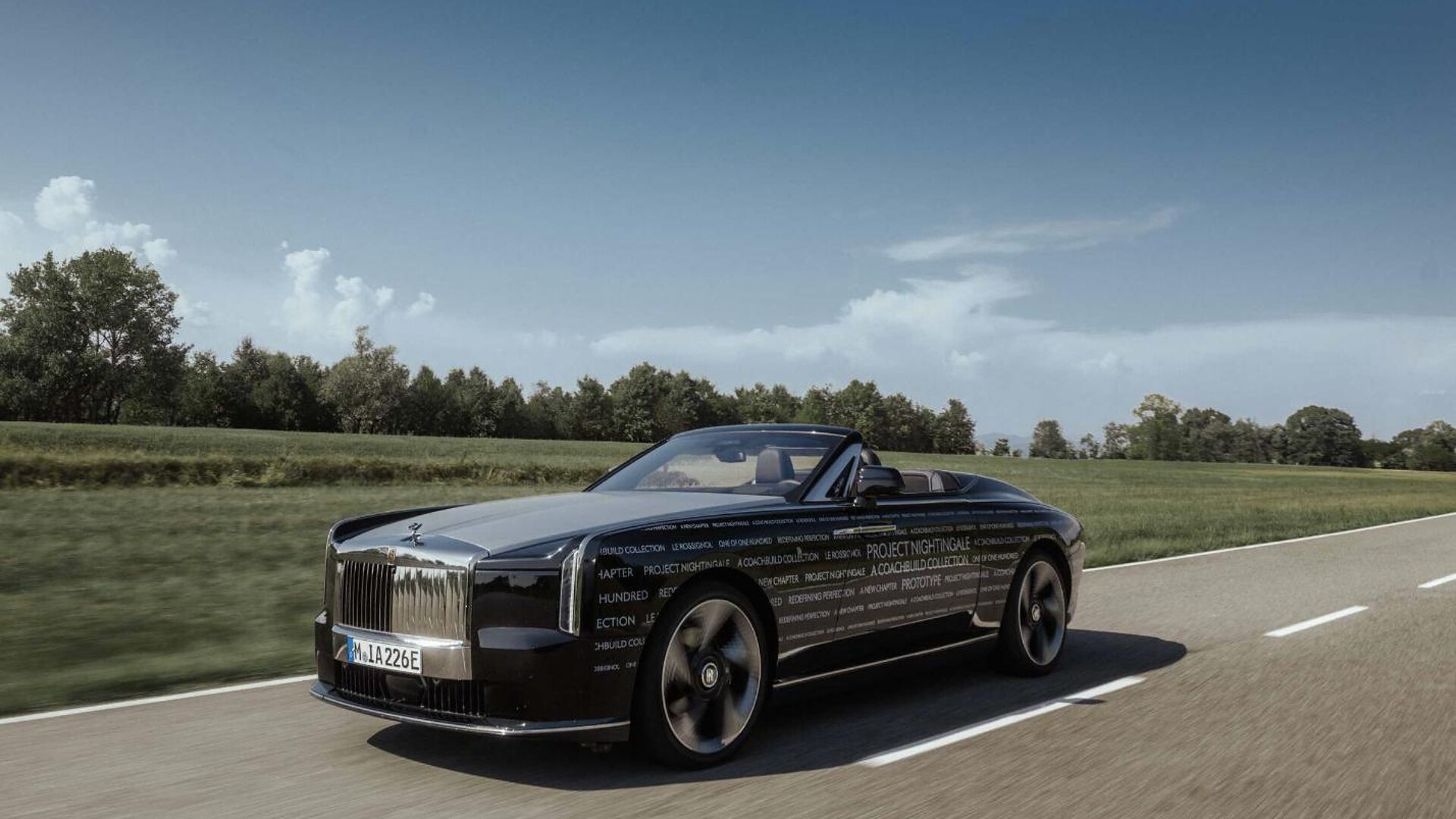
Rolls-Royce announced Project Nightingale in April with the kind of language the marque reserves for its most consequential work: an open-top, two-seat “Coachbuild Collection” of 100 cars, hand-built at Goodwood, powered entirely by electricity. It was a striking reveal. But the news that actually tells collectors something is the one that arrived this month, five months later, with far less fanfare: Rolls-Royce has put Project Nightingale into a testing programme, and the programme itself is the story.
Three hundred and fifty collective weeks of testing. Southern Europe first, then every climate a client might plausibly drive in. Fourteen hundred and thirty hours of aerodynamic modelling and wind-tunnel work. Fifteen thousand open-and-close cycles for the “Piano Boot” alone, just to certify how it sounds when it shuts. This is not the testing regimen of a show car, and it is not how the coachbuild segment has historically treated its most exclusive commissions. It is how Rolls-Royce validates a car meant to rack up real miles, in real weather, for decades. That distinction — not the electric powertrain, not the styling, not even the heritage story Rolls-Royce is telling around it — is what should interest serious collectors first.
What Project Nightingale actually is
Strip away the poetry and Project Nightingale is a specific, disciplined proposition. It is built on Rolls-Royce’s Architecture of Luxury aluminium spaceframe — the same all-electric platform that underpins the production Spectre — reworked as an open two-seater rather than a four-seat coupé. At 5.76 metres long, it is essentially the same length as Phantom, the marque’s flagship saloon, with all of that mass and presence devoted to two occupants instead of four or five. Only 100 will be built, each one coachbuilt by hand, offered strictly by invitation to clients Rolls-Royce describes as having “a deep affinity” for its design language. Deliveries begin in 2028.
The name comes from Le Rossignol — French for nightingale — the house near Henry Royce’s winter estate on the Côte d’Azur where his designers and engineers once worked. The aesthetic draws on Streamline Moderne, the late Art Deco language of unbroken volumes and disciplined surfacing, and more specifically on two cars: 16EX and 17EX, the experimental “red badge” Phantoms Royce’s engineers built in 1928 to chase 90 mph on lightweight aluminium bodies. Those two prototypes are among the rarest and most historically significant cars Rolls-Royce has ever produced, and Project Nightingale borrows their proportions — long bonnet, shallow screen, a cabin set low and well aft — almost directly.
That lineage matters more than it might first appear. Rolls-Royce’s factory coachbuilding tradition effectively ended with Phantom VI, and everything since — Sweptail, Boat Tail, and now Nightingale — has been a revival rather than a continuation. Reviving a tradition convincingly requires more than a badge and a press release; it requires the marque to reach into its own archive for real precedent. Pulling 16EX and 17EX out of the vault, rather than inventing a generic “heritage” story, is the kind of detail that separates an authentic design exercise from a marketing one.
Why the testing programme is the real news
Every modern coachbuilt Rolls-Royce before this one has effectively been a static object. Sweptail, the solitary 2017 commission, is a car most of the world has only ever seen parked. The three Boat Tails, unveiled in 2021 and delivered through 2023 at a reported price near $30 million each, surface occasionally at events like Dubai’s supercar meets — always still, always photographed, rarely in motion. That is not a criticism of their owners. It reflects what those cars were: bespoke sculpture, commissioned to be admired.
Rolls-Royce’s own language around Nightingale signals a different intent. The release notes that “from the moment the project was presented, commissioning clients were emphatic: these motor cars would be driven and enjoyed around the world.” Chief Executive Chris Brownridge frames the testing programme the same way, describing a car “tested with the same rigour with which it was imagined,” refined down to how a boot lid sounds after fifteen thousand cycles. That is not the language, or the engineering investment, that goes into an object destined for a climate-controlled garage.
For collectors, that has real consequences. A car engineered and validated for genuine use across decades and climates is a fundamentally different long-term proposition than one that was never expected to leave a showroom floor. Usability protects value in ways rarity alone cannot: it means parts get exercised rather than seizing, it means the factory has already solved problems an idle car would only discover in year fifteen, and it means an eventual owner isn’t buying a car that has to be babied to remain intact. Mechanical fragility has suppressed the market for more than one exotic before — early hybrid hypercars and several low-volume specials come to mind — and Rolls-Royce appears to be trying to engineer that risk out of Nightingale before a single client car leaves Goodwood.
The electric question no one is asking loudly enough
Project Nightingale is the first Rolls-Royce Coachbuild Collection built on an electric platform, sharing its underpinnings with the production Spectre. That is a meaningful departure, and not only aesthetically — it removes the need for the large cooling intakes an internal-combustion car would demand, which is precisely why designers were able to give Nightingale the uninterrupted, “sheer, monolithic” front end that defines its look. Mechanically, though, it introduces the one genuine unknown in this whole exercise.
Sixteen-EX and 17EX are still running today, nearly a century on, because a well-maintained pre-war chassis and engine are mechanically simple and endlessly rebuildable. No one yet knows what a coachbuilt Rolls-Royce battery pack looks like in year sixty, or even year twenty, and no one has a long enough track record with ultra-low-volume EVs to say with confidence how well factory support will hold up across generations of ownership. Rolls-Royce’s parent, BMW Group, has the resources and the institutional incentive to guarantee long-term parts and service support the way it already does for pre-war Phantoms — but that is a promise, not yet a proven pattern. Any collector evaluating Nightingale as a long-term hold, rather than a five- or ten-year proposition, should be asking Rolls-Royce directly what battery and drivetrain support looks like in 2050, not just in 2028.
What a hundred cars actually means
One hundred is a strange number in the context of Rolls-Royce’s coachbuild programme specifically, and useful precisely because of that. It is dramatically more exclusive than any series-production Rolls-Royce — the marque builds roughly six thousand cars a year across its entire lineup — but it is also thirty-three times the size of the Boat Tail run and a hundred times the size of Sweptail. That is a deliberate recalibration. A true one-off never really trades; there is no comparable sale to price it against, and its owner effectively sets the market by declining to sell. A run of 100, even one restricted to invited clients, behaves differently. It creates enough examples for genuine comparables to eventually emerge, enough separation between original owners and future estates and heirs that some cars will inevitably change hands, and enough of a defined population that collectors can actually study depreciation, or appreciation, as a pattern rather than a single data point.
In other words, Rolls-Royce isn’t just building another halo car. It is building the first coachbuild “collection” in the modern sense of the word — a defined edition with its own future secondary market, rather than a single priceless icon that exists outside normal market mechanics. That is worth watching independent of Nightingale itself, because it is a template. If it works — if invitation-only clients treat their build slots as long-term holds, if the eventual handful of resales command strong prices — expect Rolls-Royce to lean further into numbered coachbuild “collections” rather than one-offs. If it doesn’t, expect a retreat back toward Sweptail-style singular commissions, which insulate the factory from having to manage a secondary market at all.
What serious buyers should watch from here
Pricing has not been disclosed, and given the invitation-only structure, it may never be published in any official sense — a pattern consistent with how Rolls-Royce has handled every coachbuild commission since Sweptail, and one worth keeping in mind next to broader context like our list of the most expensive cars ever built by launch price. What collectors can watch in the meantime is concrete: whether the 350-week testing programme actually concludes on schedule ahead of 2028 deliveries, whether Rolls-Royce publishes any further detail on drivetrain longevity and factory support commitments, and how the broader modern coachbuild market behaves as Boat Tail owners age into the point where estate sales and quiet private transactions become more likely. Every data point from that segment — including how bespoke, lower-volume commissions like the Rolls-Royce Arcadia are ultimately received — will inform how Nightingale is priced and perceived once it starts reaching driveways in 2028.
None of that diminishes what Rolls-Royce has done here. A coachbuilt Rolls-Royce has always been built to be looked at. Project Nightingale, subjected to 350 weeks of testing across every climate its owners might choose to drive it in, is the first one built to be used up — and that, far more than the electric powertrain or the Art Deco styling, is the detail that should make collectors pay attention.
The collector car market, every weekday morning.
Auction results, price moves and what’s crossing the block, read in four minutes. Free, from Modern Car Collector.
No spam, unsubscribe in one click. Or read more about the Brief.


 Kyle Matthews
  Eve Nowell