

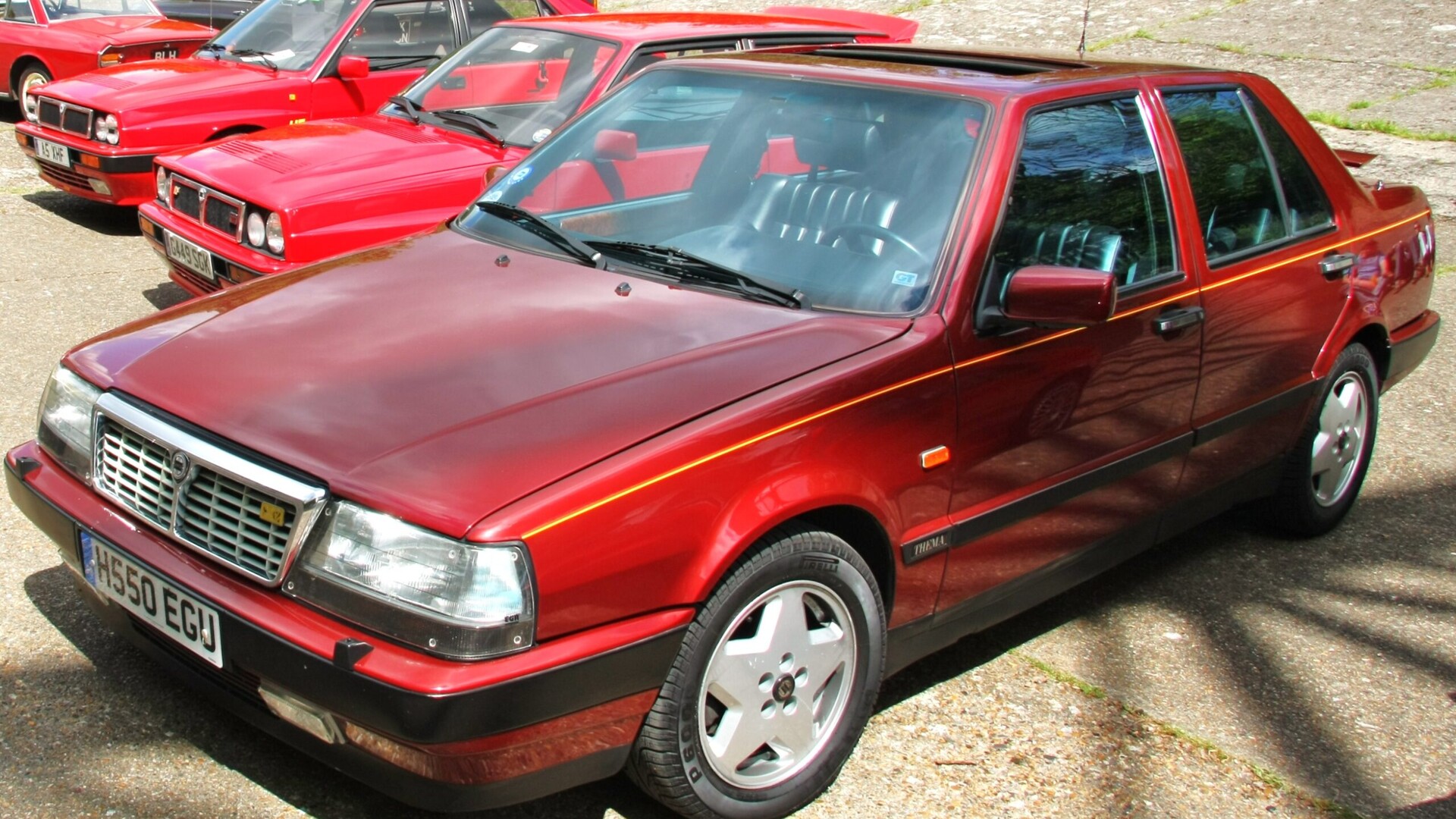
The Lancia Thema 8.32 is a Ferrari-engined car in which the engine is established and the car around it is not. That is the thesis of this evaluation. Collectors have understood the V8 for decades; the front-drive executive sedan that carries it has been priced, in the sales we could verify, like a well-regarded curiosity. Not a blue-chip. The case for the Thema 8.32 as a future collector car lives in the gap between those two ideas, and so do its risks.
Lancia showed the car at the 1986 Turin show as the top of the Giugiaro-styled Thema range, with the 32-valve V8 from the Ferrari 308 and Mondial Quattrovalvole under the hood. The “8.32” is simply eight cylinders, 32 valves. Production ran through 1992, and Wikipedia’s Lancia Thema entry gives the build as 2,370 Series 1 cars and 1,601 Series 2 cars, all left-hand drive.
Why the Lancia Thema 8.32 matters
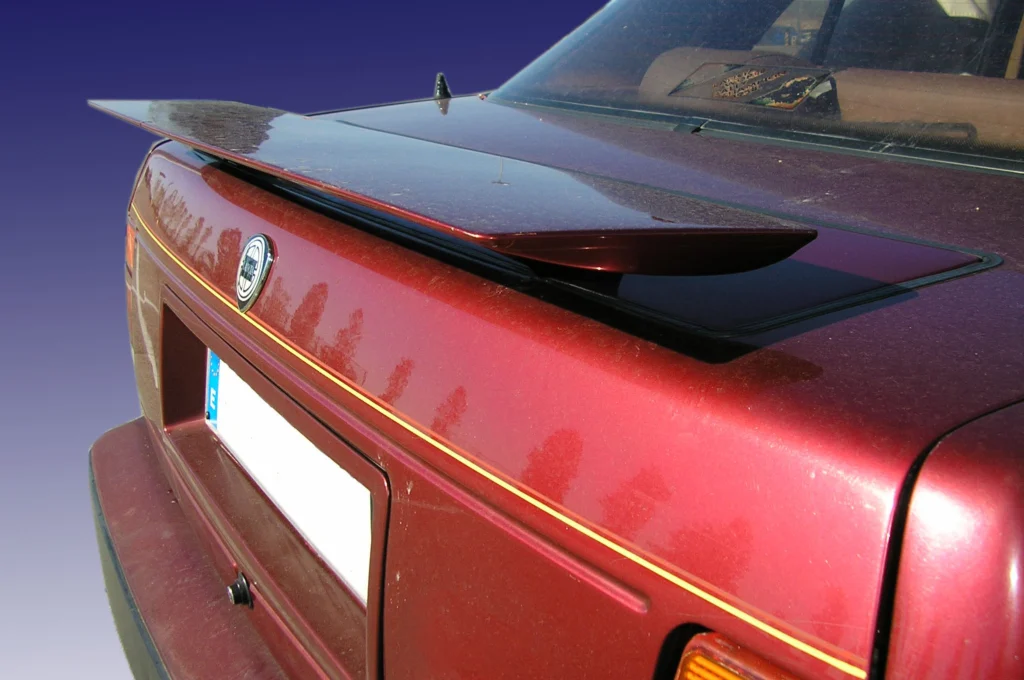
Most Ferrari-engined road cars are exotic by design. The Thema 8.32 is a Q-car by design: apart from yellow 8·32 badges, an eggcrate grille, twin exhaust outlets and a rear spoiler that rises on command, it looks like a standard executive Thema. Lancia hid the pedigree in a cabin of burr wood and Alcantara, with Poltrona Frau leather optional, which makes the car one of the more unusual propositions of 1980s Italian engineering: a four-door for buyers who wanted a Ferrari engine without the Ferrari. Wikipedia’s account of the car also reports that Enzo Ferrari used one as personal transport late in his life, a detail that counts as colour, not provenance.
The Thema also shares its front-drive platform with the Saab 9000, Alfa Romeo 164 and Fiat Croma, according to Zwischengas’s 2014 “classic pearls of the future” profile. The V8 is bespoke. Most of what surrounds it came off the shelf of an ordinary executive sedan.
Production numbers
The widely cited total is 3,971 cars: 2,370 Series 1 (1986–1988) and 1,601 Series 2 (1989–1992). Octane’s buying note uses the same split. Other figures circulate. The Zwischengas profile gives 3,284 units, and a 2022 auction listing for a 1990 car cited 3,537 built. We use 3,971 because it is the most frequently repeated and splits cleanly by series, but any single number should be treated as approximate until a Lancia factory registry settles it.
Every car was left-hand drive, which limited British sales; Autocar reports that fewer than ten were officially sold in the UK, and a 2018 Iconic Auctioneers catalogue put the UK population at fewer than 20. Wikipedia notes a single right-hand-drive conversion, done in South Africa in 1987.
Engine and drivetrain
The engine is the Ferrari Tipo F105 L, a 2,927 cc V8 derived from the 308 GTB and Mondial Quattrovalvole unit. Fuel injection is Bosch KE3 Jetronic, according to the Lancia Motor Club. The car is front-wheel drive with a five-speed manual. Wikipedia says no automatic was offered; one dealer-archive listing mentions an automatic in later series, which we could not corroborate, so we treat the manual as the only verified gearbox.
| Item | Series 1 (non-catalysed) | Series 2 (catalysed) |
|---|---|---|
| Engine | 2,927 cc Ferrari F105 L V8, 32 valves | Same |
| Power | 215 PS at 6,750 rpm | 205 PS at 6,750 rpm |
| Torque | 285 N·m at 4,500 rpm | 263 N·m at 5,000 rpm |
| 0–100 km/h | 6.8 sec | 7.2 sec |
| Top speed | 240 km/h | 235 km/h |
| Gearbox | Five-speed manual | Five-speed manual |
| Brakes | 294 mm vented front, 251 mm rear, ABS | Same |
| Steering | ZF Servotronic speed-sensitive rack | Same |
| Wheels and tyres | 6J×15 five-spoke alloys, 205/55 VR15 Goodyear | Same |
Figures are from Wikipedia’s Lancia Thema entry; period tests differ at the margins (Zwischengas lists 7.6 seconds for the catalysed car), so treat the performance numbers as approximate.
Mechanical uniqueness: what Lancia actually changed
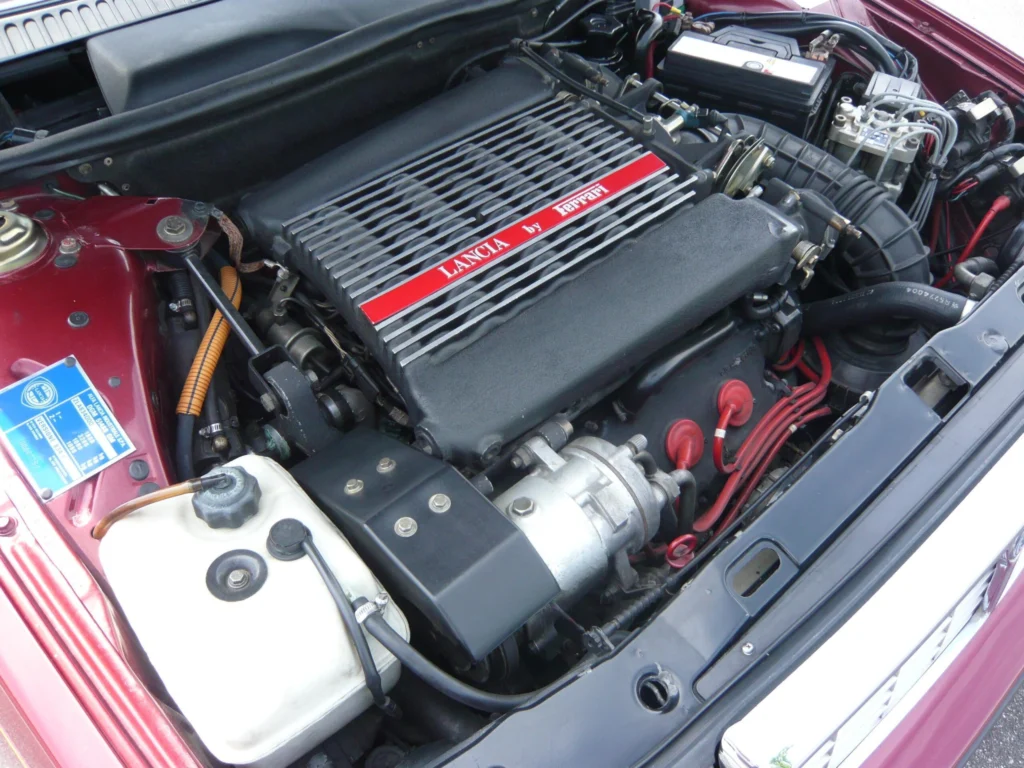
Lancia did not simply drop a Ferrari engine into a Thema. According to Wikipedia, the V8 uses a cross-plane crankshaft instead of the flat-plane crank associated with Ferrari’s V8s, along with smaller valves and a different firing order, tuned for a luxury sedan and not a mid-engine coupe. The same entry says Ducati assembled some components from castings made at Maranello. The car also carries electronically controlled dampers, which RM Sotheby’s lot copy for a 1991 example describes as adjusting to driving conditions.
How it drove is part of the story. Autocar’s retrospective says torque steer was not a major problem but that the car understeered heavily when pushed hard; Zwischengas describes an engine that revs strongly past 7,000 rpm. A comfortable chassis, not a sharp one, wrapped around an engine that sings. Collectors forgive that.
Factory options, colors and identifying details
Five metallic colors were offered: Blizzard Blue, Winner Red, Quartz Grey, Reflex Green and Black, with a double hand-painted pinstripe. Standard seats were beige or date-brown Alcantara, with black or brown leather optional; Poltrona Frau trim also appears on cars from the period. Listed extras included automatic climate control, an electric sunroof, car-phone provision and individual power rear seats. Iconic’s 2018 catalogue noted that its Series 1 car had a velour interior and called it desirable relative to leather, so even taste in trim is unsettled.
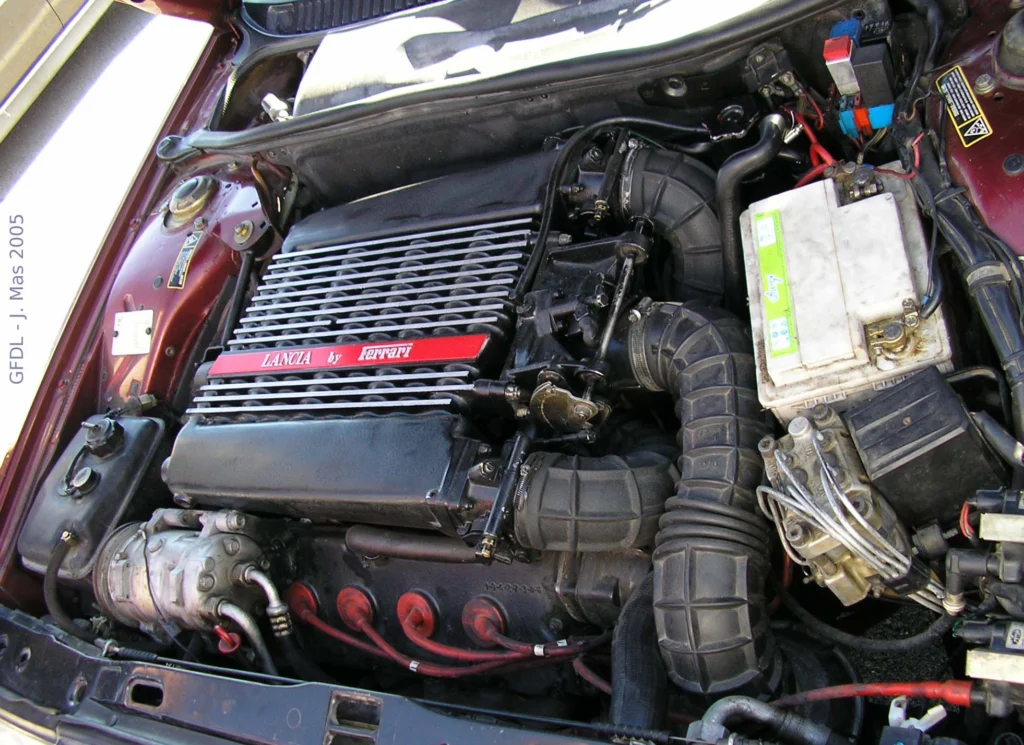
Visual identifiers are the yellow 8·32 badges, the silver eggcrate grille, twin exhausts, five-spoke 15-inch wheels and the driver-controlled spoiler, worked by a rotary switch on the right stalk. Under the hood, the cam covers read “Lancia by Ferrari.” Series 2 cars (introduced in 1988, per Wikipedia) have revised lights, a smaller grille badge and body-side rubbing strips. Be careful with labels: auction houses are not consistent, and Iconic listed a 1989 car as Series 1.
One caution on chassis numbers. The numbers shown on the auction listings we reviewed all begin ZLA834, which appears to be the Thema type code and not an 8.32-only marker. The distinguishing check is the engine: the Lancia-specific F105 L unit, its serial number and its fitment to the car. Ask for engine photos and, ideally, specialist confirmation before paying a premium for a car sold as an 8.32.
Market values and comparable sales
Documented results sit in a narrow band. The table lists sales we could verify from auction-house or valuation pages; currencies are as reported and are not converted.
| Date | Car | Venue | Result |
|---|---|---|---|
| Feb 24, 2018 | 1989 “Series 1,” about 20,000 miles, ex-Rowan Atkinson, no reserve | Iconic Auctioneers | £29,813 |
| Aug 26, 2022 | 1990, about 139,800 km, barn-stored 15 years, belt due, no records | The Market | €15,000 (estimate €15,000–25,000) |
| Nov 21, 2022 | 1988 Quartz Grey, about 107,000 km, belt last done 2018, no reserve | The Market | €17,750 after 69 bids |
| Dec 2023 | 1990 Series 2, 218,700 km, black with Poltrona Frau trim | Collecting Cars via Hagerty | $17,533 |
| Not stated on lot page | 1991, under 88,000 km, new clutch and belt in 2017 | RM Sotheby’s | €17,600 |
The pattern is the story. Setting aside the Atkinson car, the four later results we verified fall between €15,000 and €17,750, or $17,533, for cars with under 88,000 to 218,700 km. The Zwischengas profile quoted €15,000 to €17,000 for a condition-2 example more than a decade ago, and Octane’s 2017 note put a car with good history at about £13,000 and said dealers could ask above £20,000 for top-condition, low-mileage cars. Within the limits of a small sample, headline values appear roughly flat, and the market seems to be paying for mileage and documentation. The 8.32 name earns less.
Asking prices are looser. On Car & Classic’s Thema 8.32 page when we checked on October 23, 2026, 14 adverts ranged from €11,000 for a 124,000 km Italian car to £34,995 for a 62,000-mile UK example, with a 67,087 km Dutch car at €32,950. Asking prices are not sales, and the spread suggests sellers of low-mileage cars are testing a market that has not yet clearly confirmed them.
Ownership costs and known weaknesses
The summary from the sources we found is that the engine is reliable with regular specialist maintenance and expensive when it is not. Octane advises that rebuilds are costly, that the water pump differs from the 308’s, that rough running can point to the Magneti Marelli ignition, and that parts unique to the 8.32 can be hard or expensive to replace. Autocar warned of potentially crushing maintenance bills. We could not find a reliable published cost schedule, so get a specialist quote for the belt service and the electronic dampers before buying. Generalizations will not pay the bill.
Listings add specifics worth reading as buyer prompts. The seller of one Australian auction car disclosed that it runs without its original electronically controlled rear dampers and typically needs several cranks to start, with fuel injection reconditioned in 2023 and a timing belt replaced in 2024. The barn-stored 1990 car above was sold with its belt change due. Rust is a smaller concern than on many contemporaries: Octane notes the Thema was galvanized from new, so serious corrosion is mainly a risk for cars used through salted winters.
Originality considerations
For an 8.32 the originality questions are practical. Is the engine the Lancia-specific F105 L, and does its number match the documentation? Do the electronic dampers still work, or has the car been converted to conventional shocks? Does the spoiler deploy on command? Are the wheels, trim, paint color and pinstripe as delivered? Cars with documented dealership service, original handbooks and service booklets, which the 1991 RM Sotheby’s car and the 2018 Iconic car both emphasized, are easier to underwrite.
Competing vehicles
Wikipedia lists the Audi 100 Quattro, BMW M535i, Ford Sierra RS Cosworth, Saab 9000 2.3 Turbo S and Vauxhall Lotus Carlton (Opel Lotus Omega) as period rivals; Zwischengas adds the Mercedes-Benz 190E 2.3-16. We have not verified current comps for those cars here. In character terms, the nearest relatives on our own pages are other overlooked performance sedans and wagons such as the Volvo 850 T-5R and the Saab 9-3 Viggen. Our Delta Integrale versus Escort Cosworth versus Celica GT-Four comparison shows how differently the market treats a competition-bred Lancia, and our Ferrari 308 GTB originality check covers the car the Thema’s engine came from.
What separates exceptional examples from average ones
Mileage and history do the heavy lifting. The 2018 Iconic car combined about 20,000 miles, a celebrity owner, a no-reserve sale and close to £20,000 of documented bills, and it sold for a considerably higher price than the 2022 and 2023 results, albeit four years earlier. An exceptional 8.32 has low verified mileage, a belt and water-pump service done recently by a specialist, dampers and spoiler that work, and a paper trail without gaps. An average one has 100,000 to 220,000 km, patchy history, a belt coming due, and a seller who wants to be paid for the Ferrari engine’s reputation.
Established value versus speculative potential
What is established: a European cult following, a price band of roughly €15,000 to €18,000 for usable cars in the sales we verified, sales across the UK, Netherlands, Belgium and online platforms, and a premium for low mileage and provenance. What is speculative: any claim that prices will rise. Left-hand drive limits the UK market, 8.32-specific spares are thin, and the evidence we found shows the market has not moved much. All 1986 to 1992 cars are now past the 25-year mark that typically matters for U.S. import eligibility, but buyers should confirm federal and state requirements, and we found no U.S. price benchmark.
What could strengthen or weaken its desirability
Strength would come from a specialist network that keeps the V8 and its dampers serviceable, and from more low-mileage, documented cars crossing major auction blocks. A younger buyer who grew up on 1980s Italian executive cars would help too. Weakness is easier to picture. Spares are thin. Cars with dead dampers and skipped belt services keep piling up, left-hand drive caps demand, and mainstream collectors may never see it as more than a curiosity.
The bottom line
The Lancia Thema 8.32 has a real engineering story, a small build and a cult following. The market still prices it like a good used car. Buy the best-documented, lowest-mileage example you can find, budget for a specialist, and treat appreciation as a possibility and not a plan. If values move, expect the paperwork to get paid first.
Sourcing note: production figures vary by source (3,971, 3,537 and 3,284 all appear), several comps come from auction listing pages with limited detail, and we did not find a published price guide from a major valuation firm. This article is analysis, not investment advice.
The collector car market, every weekday morning.
Auction results, price moves and what’s crossing the block, read in four minutes. Free, from Modern Car Collector.
No spam, unsubscribe in one click. Or read more about the Brief.
Related Posts:
- Lot of the Day: A Factory-Converted 1983 Lancia 037…
- Delta Integrale vs. Escort Cosworth vs. Celica…
- The Collector Car Market Paid Up for Certainty This…

- Record Ferraris, Rare Icons and 15,000 RPM: The Week…

- A One-Off Bizzarrini Prototype Is Estimated Below a…
- Is the Volvo 850 T-5R a Future Collector Car? The…
 Eve Nowell
 Kyle Matthews
 EL Puckett