

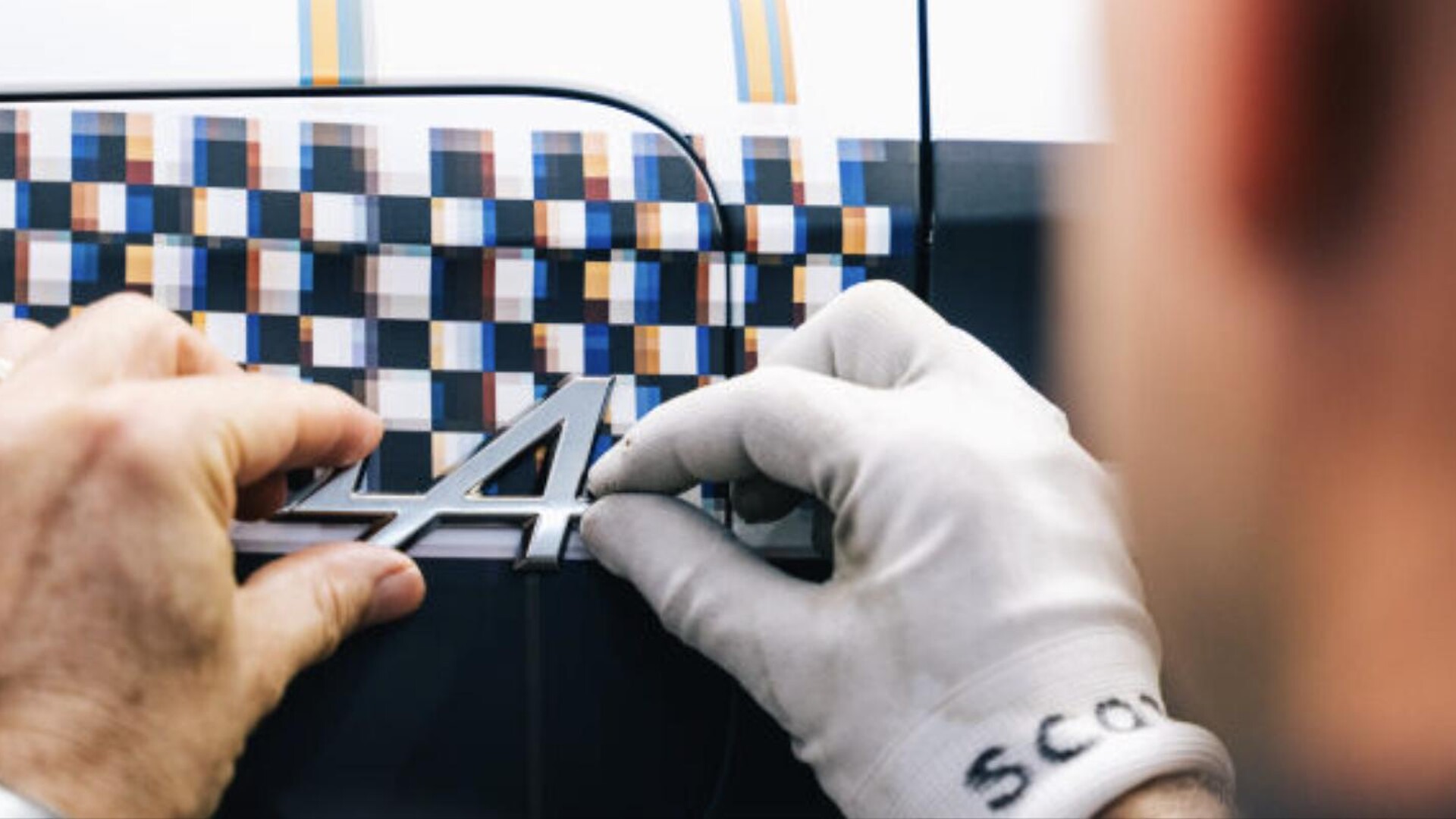
This weekend at Goodwood Revival, Alpine will pull the cover off a car unlike anything else on its stand: a one-off A390 reimagined by London multidisciplinary artist Trevor Jackson, its bodywork turned into what Alpine calls “an abstract visual exploration of form, function, performance and style.” It will draw crowds. It will fill Instagram feeds. It is, by any measure, the most photographed car Alpine brings to West Sussex this year.
It is also, for collectors, almost certainly beside the point.
Parked next to it will be a car with a far quieter story and a far more consequential one: the current-generation Alpine A110, whose production run at Alpine’s historic Dieppe factory concluded in July. What remains is a “limited number” of cars moving through the UK retail network before the model is gone. One car is designed to be looked at. The other is running out.
A Design Surface, Not a New Alpine
The commission itself is straightforward. Alpine invited Jackson — a creative director, designer and music producer whose work spans three decades across art, fashion and visual culture — to treat the A390’s exterior as a canvas, working alongside Alpine Design Director Antony Villain. Jackson described the brief as finding “a balance where the car’s unique personality and my own could sit harmoniously together without compromise.” Villain called it an invitation to bring “a fresh cultural perspective to Alpine design.”
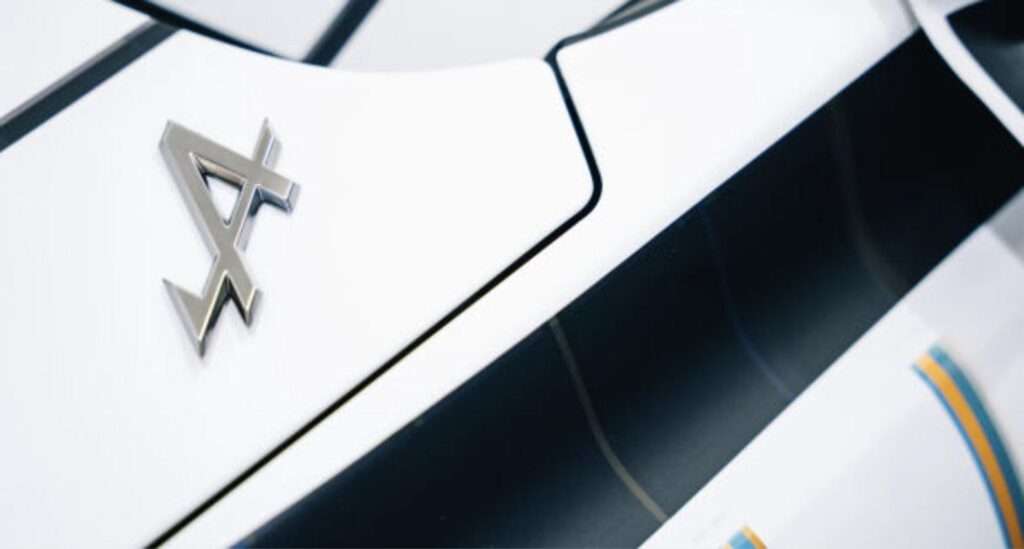
What it is not, by Alpine’s own account, is a new mechanical derivative. The underlying car is the production A390 — Alpine’s first five-seat sport fastback and the second all-electric model in its “Dream Garage” lineup, following the A290 hot hatch. The production version already made its Goodwood Revival debut in 2025. What changes this year is the surface, not the substance.
That distinction matters more than it might seem, because it determines what kind of object this actually is.
What Makes an Art Car a Collector Object
Manufacturer art cars have a real pedigree, and it is worth being precise about what earns a car that status. BMW’s Art Car Collection, running continuously since 1975, set the template: Alexander Calder painted a 3.0 CSL that then raced at Le Mans, tying the artwork permanently to a competition result. Frank Stella, Roy Lichtenstein, Andy Warhol — who famously hand-painted his M1 himself in roughly 23 minutes rather than handing it to technicians — and later Jeff Koons all worked directly on cars that went on to independent significance of their own, whether on track or in period. Most of those cars have never been sold. They live in BMW’s own museum collection precisely because their value was never meant to be liquid; it was meant to be institutional, tied permanently to the brand’s own history. BMW’s most recent addition to that lineage debuted at Villa d’Este, continuing a program collectors have tracked for half a century.
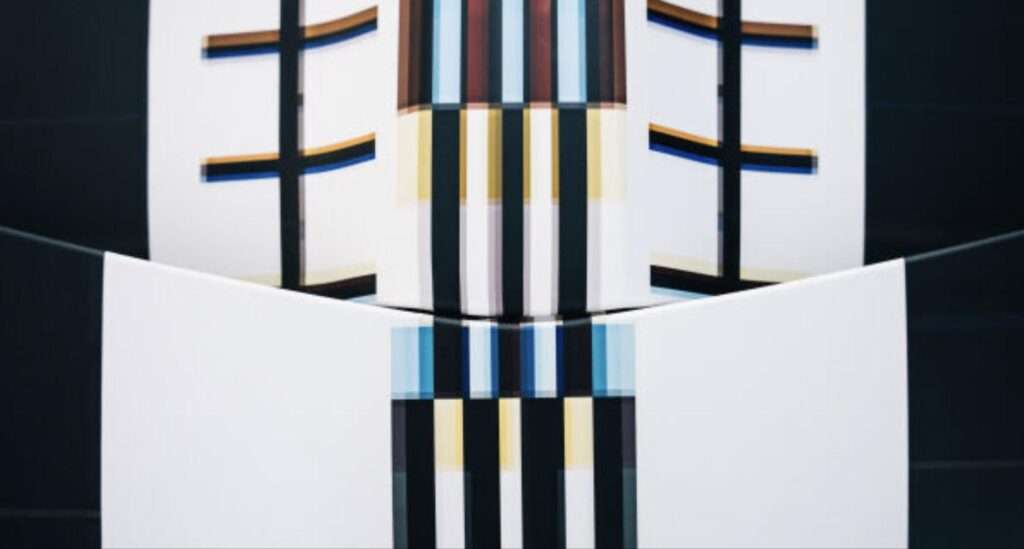
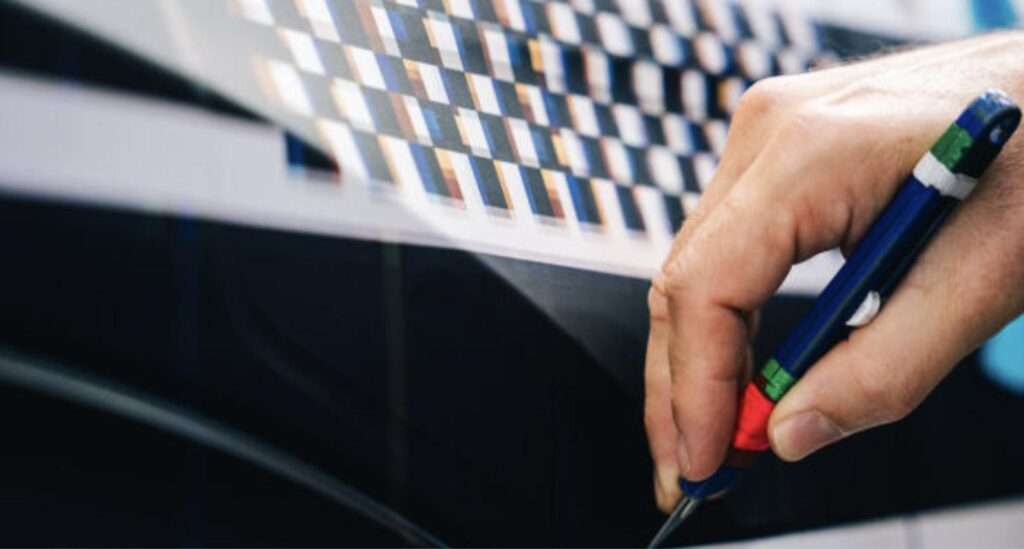
Jackson’s A390 borrows the language of that tradition without, so far, the substance. Alpine’s own materials describe a “design surface” and a graphic treatment rather than paint applied by the artist to a car with its own competition record. There is no indication the car will be sold, campaigned, or otherwise enter private hands — it reads, reasonably, as a marketing and brand-image object that will most likely stay in Alpine’s own fleet. That is a legitimate use of a one-off. It is not, on current evidence, a nascent collectible.
Why Now: The EV Halo Problem
The more interesting question is why a manufacturer reaches for this kind of commission at all, and the answer says more about the collector market than about Jackson’s design work. Electric performance cars have struggled to earn the emotional premium that combustion-era halo cars built through decades of motorsport drama, mechanical theater and sound. Alpine has been attacking that problem from several directions at once — engineering around the weight penalty of its split-battery EV platform, laying out a broader supercar and hypercar strategy, and pursuing a hydrogen-combustion prototype in the Alpenglow that hints the brand isn’t fully committed to batteries as the only answer. A commissioned art treatment, unveiled at one of the world’s most heritage-conscious events, is simply another version of the same project: manufacturing a “moment in history” for a car that hasn’t yet earned one the old-fashioned way, through racing.
There is nothing wrong with that strategy. It is honest marketing, well executed. But serious buyers should recognize it for what it is rather than mistake spectacle for signal.
The Real News Is Standing Next to It
The rest of Alpine’s Goodwood display makes the actual collector case. The current A110’s production has ended at Dieppe, and what’s left is finite in a way the A390 art car will never be — a genuine closing-window signal, the same dynamic that has already driven collector attention toward the A110 R Ultime as Alpine’s most extreme road-legal expression of the platform. An A110 Berlinette in rally specification will also be on the stand, a direct link to the car that won Alpine the inaugural World Rally Championship for Manufacturers in 1973 — the kind of documented competition lineage no wrap can borrow. And the Alpine Lacoste A290 Rallye, built on Alpine Racing’s first all-electric customer competition car, carries real hardware behind its graphics: 220 hp, a ZF limited-slip differential and rally-tuned suspension. That is the car worth watching for future collector relevance, precisely because its performance credentials are verifiable rather than aesthetic.
Goodwood Revival has always rewarded cars with a documented past — it is the same instinct that makes a Series IV Aston Martin DB4 Vantage convertible or a race-proven AC Cobra crossing the block nearby worth a serious buyer’s attention during Revival week. A one-off livery, however striking, doesn’t yet have a past to document.
Collectors rarely pay a premium for paint. They pay a premium when the paint can’t be separated from the car’s own history — when the artwork and the machine become the same story. Jackson’s A390 will be the car everyone photographs at Goodwood this weekend. The A110 quietly running out at Dieppe is the one serious buyers should actually be calling their dealer about.
The collector car market, every weekday morning.
Auction results, price moves and what’s crossing the block, read in four minutes. Free, from Modern Car Collector.
No spam, unsubscribe in one click. Or read more about the Brief.
Related Posts:
- Is the Alpine A110 a Future Collector Car? Only Some of Them
- The Collector Car Market Paid Up for Certainty This…
- Record Ferraris, Rare Icons and 15,000 RPM: The Week…

- Best Car Covers for Classic & Collector Cars: Indoor…
- Everything Modern Car Collector Covered Last Week
- Today in Collector Car History: 'Little Red' Met Its…
 Kyle Matthews