

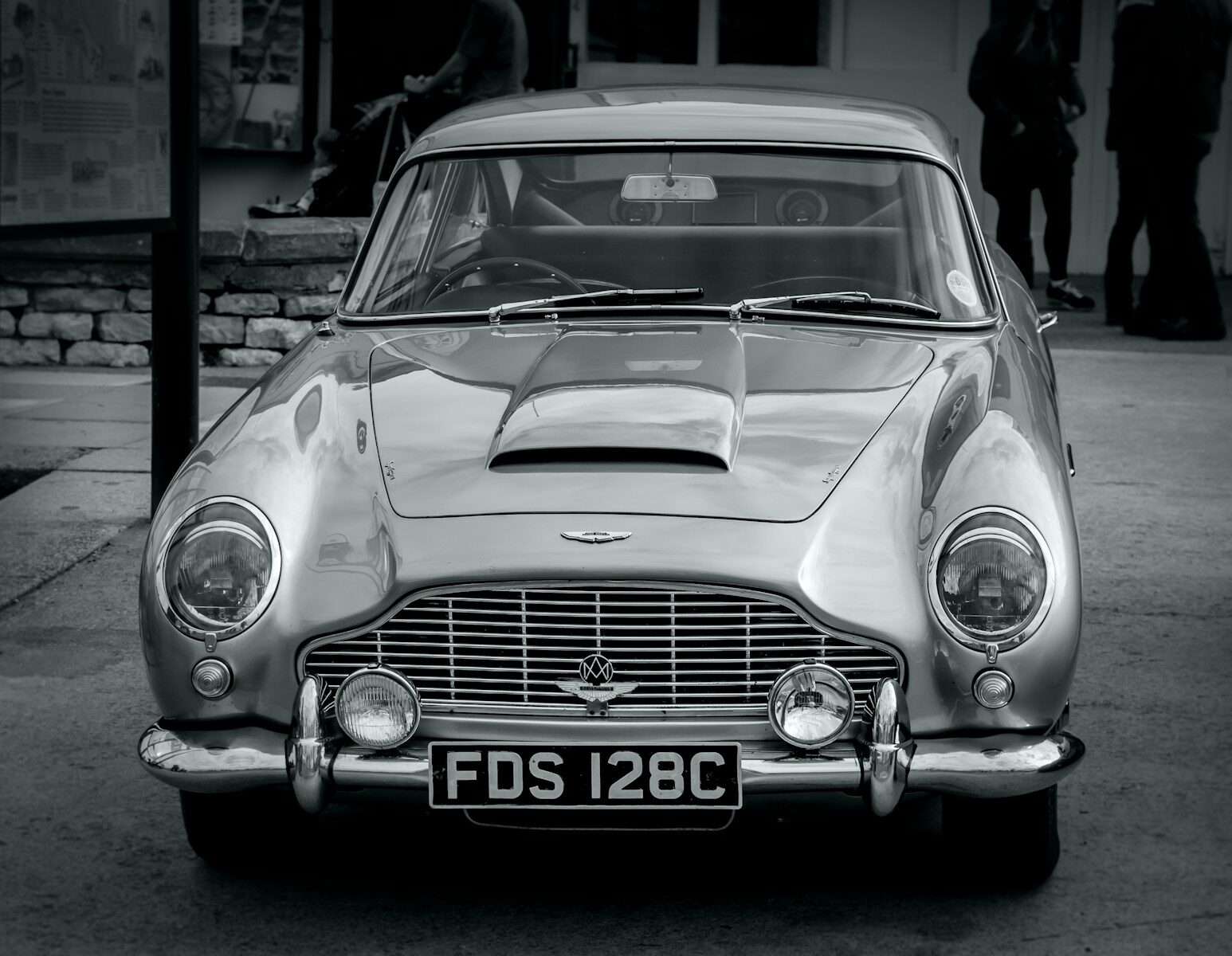
Bonhams will offer a 1962 Aston Martin DB4 Series IV Vantage Convertible at its Goodwood Revival sale on 19 September, carrying a pre-sale estimate of £700,000 to £900,000. The number worth remembering from this listing isn’t the estimate. It’s thirty – the number of Series IV convertibles Aston Martin built with the optional Vantage engine, making this one of the rarest meaningful combinations in the entire DB4 range outside the Zagato. Rarity by itself, though, has never been a reliable predictor of value. This car earns its significance a different way: through timing, mechanical specification, and a documentation trail that most 1960s British sports cars simply don’t have.
The Series That Got the Formula Right
The DB4 arrived in 1958 as a genuine leap for Aston Martin. Carrozzeria Touring’s Superleggera body sat on a new platform chassis engineered by Harold Beach, powered by Tadek Marek’s twin-cam, 3.7-litre six. The combination made the DB4 the first production car capable of accelerating from a standstill to 100mph and back to zero in under thirty seconds, a benchmark that embarrassed most of its contemporaries. Aston Martin built the DB4 for less than five years, from October 1958 to June 1963, but refined it constantly along the way. The Aston Martin Owners Club later grouped those changes into five “Series,” a classification the factory never used at the time but which collectors now rely on to navigate the model’s evolution.
Series IV, introduced in September 1961, brought the most consequential mechanical change in the DB4’s run: an optional “Special Series” engine, known to enthusiasts as the Vantage unit. Higher compression, larger valves, and triple SU carburettors lifted output from 240 to 266bhp. The same month, Aston Martin finally offered the DB4 as a factory convertible, priced £250 above the saloon. It’s a detail worth sitting with: the convertible body and the Vantage engine entered production at the same moment, which is why so few cars combine both. Of the roughly seventy DB4 convertibles Aston Martin built in total, only thirty left the factory with the Special Series engine under the hood.
This is where the car’s real argument begins. Author Robert Edwards, in his history of the marque, Aston Martin – Ever the Thoroughbred, made the case that the Series IV Vantage represented the DB4 at its best, before it “put on weight to become the Series V.” That isn’t nostalgia talking. The Series V gained a taller roofline and a longer wheelbase, changes that improved comfort but diluted the tautness that made the DB4 feel special in the first place. The Series IV Vantage sits at the exact point where Aston Martin had solved the DB4’s early cooling and reliability issues but hadn’t yet started softening the car for a broader market. Collectors who understand the DB4 in depth tend to gravitate here, rather than toward the more common Series V or the earliest Series I cars, and understanding why separates a serious buyer from someone simply chasing a badge.

One Family, One Story, No Gaps
Specification explains why this configuration matters. Ownership explains why this particular car matters. Chassis DB4C/1072/R carries engine 370/1030/SS – the SS suffix marking it as one of the Special Series units – and Aston Martin’s original guarantee form ties the two together from new, the kind of matched documentation many surviving DB4s lack. The car was first registered on 15 October 1962 to Reginald T. Gwynn, at the time managing director of the F.W. Woolworth retail chain, who paid a little over £4,513 for it – roughly £105,570 in today’s money. The accompanying history file includes his original order form, correspondence with the Bond Street dealer who supplied the car, and letters from John Wyer at Aston Martin Lagonda. Wyer’s signature is not a minor detail. He ran the works competition department that won Le Mans with the DBR1 in 1959, and later built the Ford GT40 program into a Le Mans-winning force with Gulf Racing. A dealer letter bearing his name doesn’t make this a competition car, but it places the DB4 squarely inside the orbit of the people who defined Aston Martin’s most important era.
The car stayed within Gwynn’s family for fifty years. In 2012, his grandson – described in the auction listing as effectively only the car’s second owner – bought it back through a Bonhams sale at Aston Martin Works Service. That kind of continuity is rare enough on its own. Compare it with a DB4 pulled from thirty years hidden in a barn, where decades of missing history have to be reconstructed after the fact. Here, there was never a gap to fill. Every MoT certificate, every invoice, every change of hands is accounted for, which is precisely the kind of paper trail that determines whether a six-figure classic authenticates cleanly or becomes a headache for its next owner.
A Restoration Built to Preserve, Not Reinvent
Between 2012 and 2015, marque specialists Pugsley & Lewis carried out a full restoration: bodywork and repaint, re-chromed brightwork, a rebuilt gearbox and overdrive, and an engine taken out to 4.2 litres on unleaded fuel. The work also included sympathetic upgrades – a Harvey Bailey front anti-roll bar, uprated brake calipers, and a negative-earth alternator disguised to look like the original dynamo – the kind of changes that make a DB4 usable on modern roads without altering its character or its original Black Pearl metallic paint and grey Connolly leather interior. Bills on file exceed £300,000, and the car has covered only around 1,300 miles since the work was finished. That combination of restoration quality and subsequent running-in confirms the work holds up in practice, not just on paper, a distinction that matters more with each passing year as the pool of craftsmen capable of this standard of work continues to shrink.
It’s the same standard collectors have come to expect from Aston Martin’s own restoration arm, evident in projects like the marque’s fifty-year restoration of a rare DB5 Vantage. The difference here is that the Vantage name predates the DB5 entirely – it began with this engine, in this Series IV, which is part of why specialists treat the option so seriously.

What This Means for Collectors
None of this changes what the DB4 fundamentally is: a well-built, fast, good-looking British sports car from a company that, in period, had far more racing credibility than sales volume. Aston Martin’s competition pedigree, visible in cars like the DB3S currently drawing attention ahead of its own Monaco sale, is part of why the marque commands the loyalty it does. But pedigree on the track and desirability on the road are different currencies, and this convertible trades in the second one. Its value case rests on configuration, paperwork, and originality, not lap times.
That’s also why the venue matters. Bonhams has increasingly used its Goodwood Revival sale to place cars with exactly this kind of story in front of buyers who understand it, the same audience that turned out for the 1966 AC Cobra with genuine race history offered there previously. It’s a sale built around cars that reward homework, not headlines.
The lesson worth carrying forward is one worth remembering at every price point: the auction estimate is the least interesting number in any listing like this one, a point proven again this summer by the Keller Collection’s no-reserve Bonhams sale. What should catch a serious buyer’s eye here is the absence of question marks. No mystery ownership gaps, no undocumented mechanical work, no ambiguity about which engine left the factory in this chassis. As the market for postwar British sports cars matures, cars like this – thoroughly specified, thoroughly documented, thoroughly original – increasingly get treated the way blue-chip paintings are treated, where the provenance file becomes as valuable as the object itself. That shift is visible even outside four wheels, in sales like the Steve McQueen Husqvarna earlier this year. This DB4 simply happens to wear its provenance with unusual completeness.
The collector car market, every weekday morning.
Auction results, price moves and what’s crossing the block, read in four minutes. Free, from Modern Car Collector.
No spam, unsubscribe in one click. Or read more about the Brief.
Related Posts:
- Record Ferraris, Rare Icons and 15,000 RPM: The Week…

- The Collector Car Market Paid Up for Certainty This…

- The 8 Most Expensive Cars for Sale at Bonhams Right Now
- Collector Car Auctions To Watch: September 17–21, 2026

- No-Reserve 1970 Lamborghini Miura P400S Heads to…
- The Aston Martin AMB 002 Isn't Collectible Because…

 Shawn Henry
  Eve Nowell