

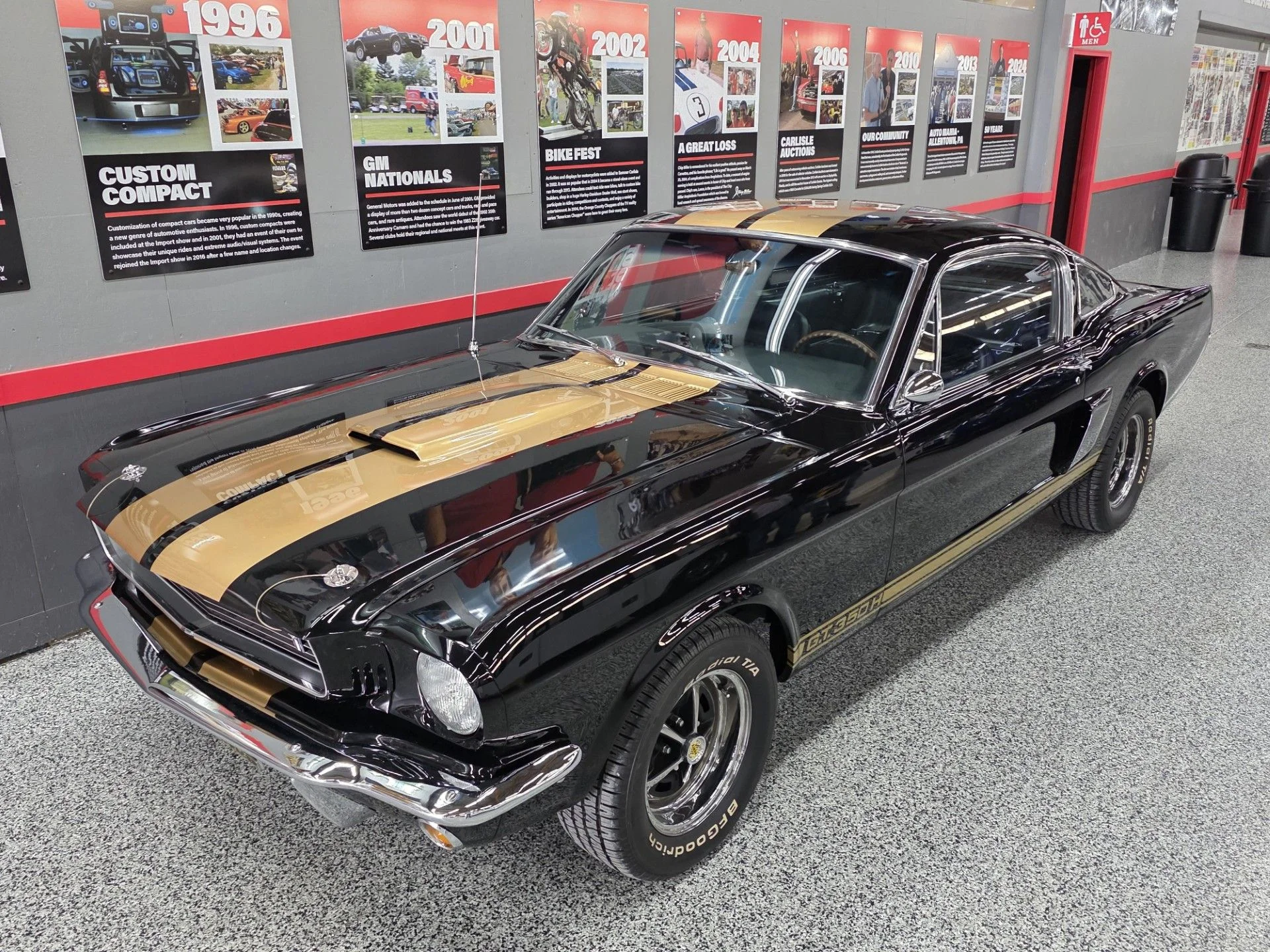
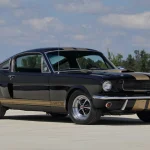
A black fastback with gold LeMans stripes, a scooped hood, and a Shelby signature on the glove box just came up for sale on Bring a Trailer, bid to $25,000 with several days still on the clock. At a glance, it reads like one of the most storied nameplates in American performance history. It isn’t one.
This car is a 1965 Ford Mustang fastback, a base-model donor car that was refurbished and reengineered around 2015 with a 347ci stroker V8, then dressed years later in the black-and-gold livery of a Shelby GT350H at a Ford dealership in Ontario. The hood, the stripes, and the badging, even the Shelby signature decal on the glove box, all look correct, and none of it is factory. That distinction is not a technicality. It is the entire story.
The real GT350H is one of the strangest and most beloved chapters in Shelby history. In 1966, Carroll Shelby built roughly a thousand fastbacks specifically for Hertz’s Sports Car Club rental program, finished mostly in black with gold stripes and, unusually for a homologated performance car, mostly fitted with automatic transmissions to suit rental customers rather than racers. Renters returned them to the counter with worn brake pads and lap times bragged about that same night. Decades later, that oddball rental fleet became one of the most collected variants in the entire Shelby lineage, precisely because of its unconventional origin, not despite it. Shelby’s name still carries that weight today, as this year’s one-of-one 2026 Shelby GT350/TA proved when it became the first of its kind offered to the public.
The Mustang currently bidding on Bring a Trailer carries none of that lineage. Its body was media-blasted and repaired under prior ownership, repainted black, and fitted with a replacement hood, over-the-top gold stripes, and GT350-branded badging and floor mats added at a dealership in Rexdale, Ontario. Under the skin sits a 347ci stroker crate V8 fed by a Holley Sniper electronic fuel-injection system, paired with an AOD automatic modified with a manual valve body, an 8.8-inch rear axle with a limited-slip differential, tubular front control arms, a four-link rear suspension, QA1 coilovers, and Wilwood disc brakes. It is a well-executed resto-mod. It is not, and does not claim on paper to be, a Shelby product.
There is also a pattern worth noting. This fastback sold on Bring a Trailer in November 2020, was modified further in Canada, sold again on Bring a Trailer in May 2025, and is now back on the site barely sixteen months later. Cars that resurface this quickly on the same auction platform are not automatically suspect, but the pattern is a useful prompt for due diligence: ask why an owner is moving on so soon, and read the comment history from prior listings before bidding. The seller also notes that registration lapsed in mid-2026, with possible back fees attached to the plate, a small but real reminder that paperwork friction is part of buying any car at auction, not just the exotic ones.
Tribute and resto-mod builds occupy a real and growing segment of the collector market, and there is nothing dishonest about them when they are represented accurately, as this one appears to be. They let enthusiasts experience the look, sound, and character of an icon without competing for the real thing. The licensed Eleanor-spec Mustangs built off the 1967-68 body have created an entire sub-market on that same logic, and restomods like the award-winning Plymouth ‘Cuda Hell’s HEMI show how far builders will go to combine vintage style with modern engineering. What separates all of these from fraud is disclosure. This Mustang’s seller is transparent about what the car is and isn’t, which is exactly how the system is supposed to work.
The contrast with genuine, documented Shelby product is where the real lesson sits. A numbers-matching original, like the 1969 Shelby GT350 recently consigned to Carlisle Auctions, carries build sheets, factory documentation, and a verifiable chain of ownership that a tribute car, by definition, cannot replicate. That paperwork is not bureaucratic overhead. It is the entire reason a real Shelby trades at a multiple of a car that merely looks like one, regardless of how well the tribute drives or how faithfully it was built.
None of this makes the Mustang on Bring a Trailer a bad car. It is an honestly built, well-documented driver with modern manners and genuine period style, priced like exactly what it is. But it is worth remembering, every time a black-and-gold fastback crosses the block: a costume is not a pedigree. The collector market has spent sixty years learning to tell the two apart, and the price of this car is proof that the lesson has stuck.
The collector car market, every weekday morning.
Auction results, price moves and what’s crossing the block, read in four minutes. Free, from Modern Car Collector.
No spam, unsubscribe in one click. Or read more about the Brief.


 Eve Nowell