
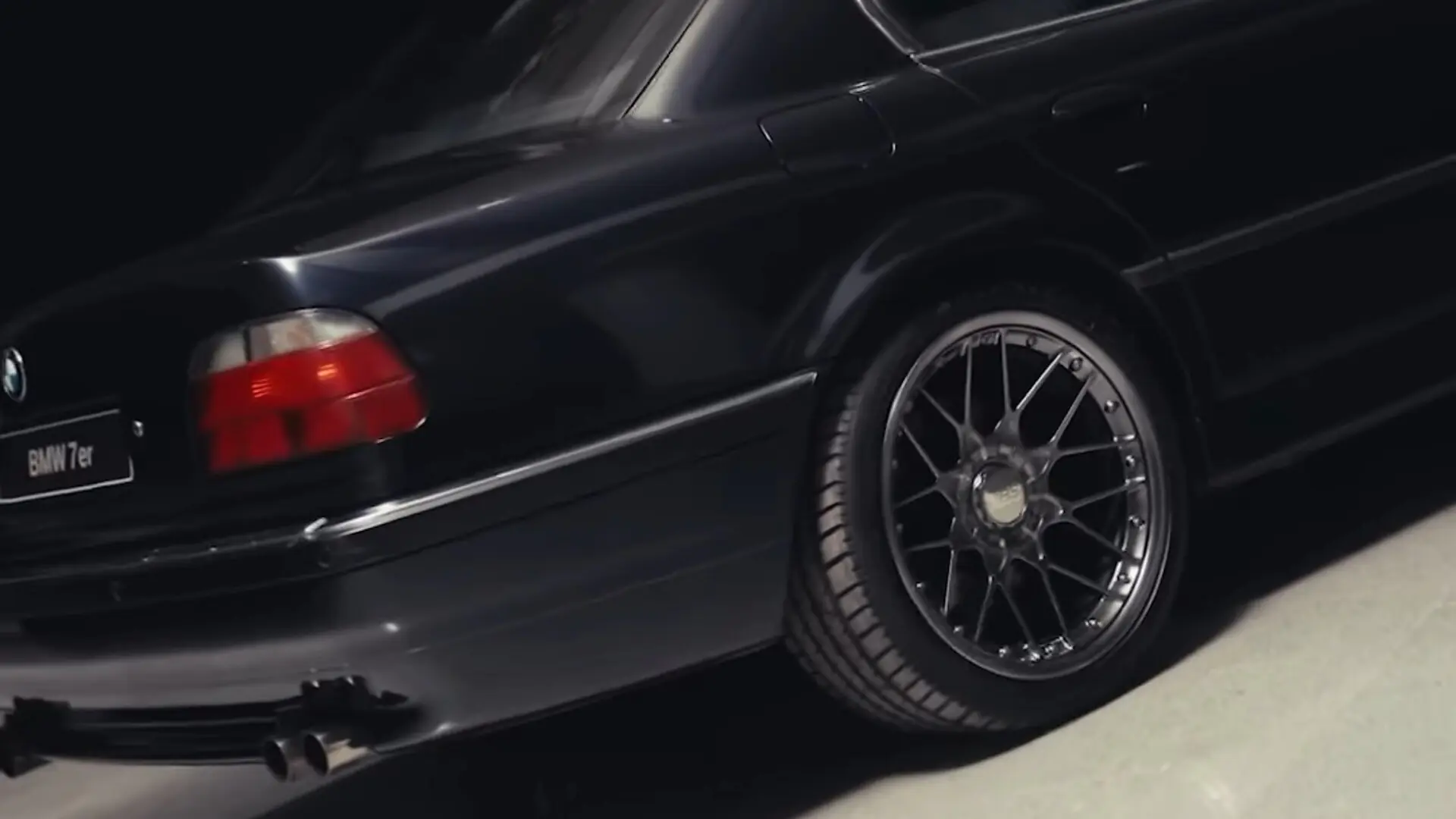
For three decades the BMW M7 has existed only as a hypothetical, argued over by enthusiasts, rendered by digital artists and approximated by tuners. This month BMW Classic quietly settled the matter. In a 27-second video, the company’s heritage department showed a black E38 7 Series carrying an internal designation many assumed had never been used: BMW M7. It is the latest in a run of archive disclosures that keep adding depth to the modern classics collectors now chase.
The specification reads like a wish list. The car began life as a 1997 740i, then received the 4,941-cc S62 V8 from the E39 M5, rated at 400 hp at 6,600 rpm, driving the rear wheels through a six-speed manual. BMW quotes a weight of 1,875 kg, roughly 4,134 lb, and a top speed of 250 km/h, the same governed figure as the M5.
View this post on Instagram
A cute footnote? Not quite. The M7 prototype matters less for what it might have been than for what BMW decided its flagship should not be, and that decision helps explain why the E38 and the E39 M5 are collected the way they are today.
A sleeper by design
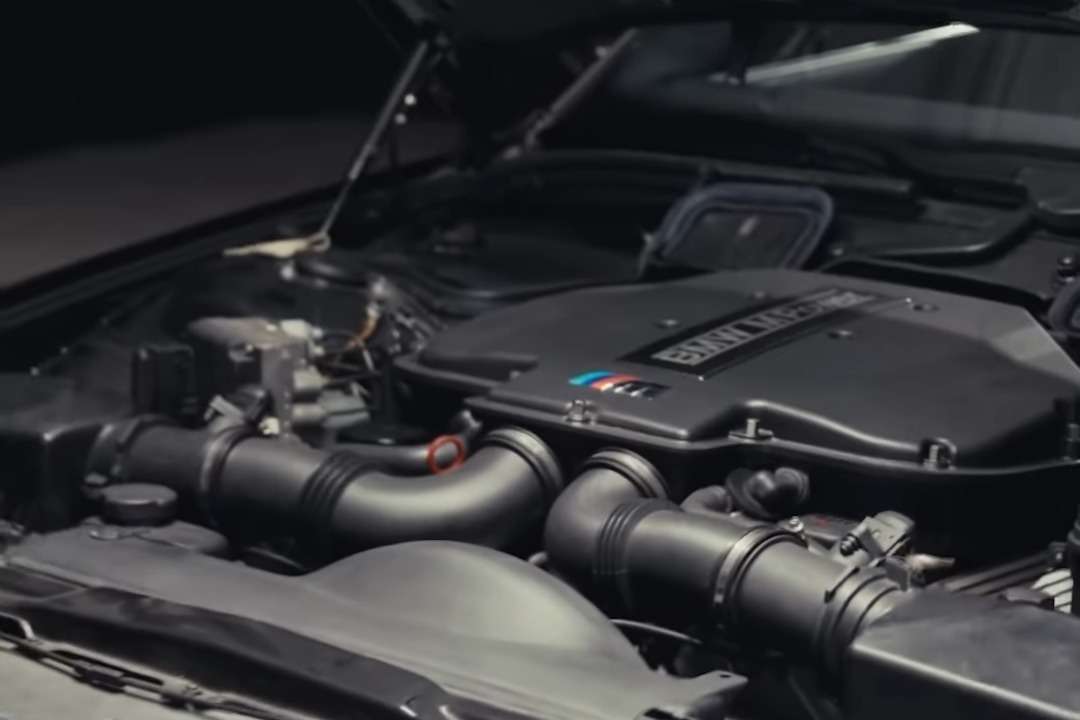
Nothing about the exterior announces the conversion. In BMW Classic’s footage, the only visual tells are dark cross-spoke wheels and four exhaust outlets, split in pairs beneath the rear valance. There is no body kit, no flared arches and no M badge on the boot lid. Inside, the black-and-tan leather and wood trim are pure executive 7 Series. The giveaway is a gear lever where the automatic selector would normally sit, and under the bonnet, the S62’s M Power cover occupies the space where the 740i’s 286-PS M62 once did.
That restraint matters. BMW M in the 1990s was not yet a sub-brand spreading its letter across SUVs and luxury coupes. Its road cars were the M3 and the M5, and the E39 M5, which arrived for 1998 with this same engine, was conceived as a discreet business sedan that happened to embarrass sports cars. A 7 Series with the identical drivetrain was the same idea taken one size larger. The question was never whether it would work. It was whether BMW needed it.
Why the M7 stayed in the archive
BMW has not said why the project went no further, and BMW Classic’s post offers no explanation. The product logic of the period, however, points in a clear direction. In 1997 the 7 Series flagship was the 750i, and its prestige rested on a 5.4-liter V12 rated at 326 PS. An M7 would have handed a V8 car with a manual gearbox 74 more horsepower than the twelve-cylinder model, undercutting it on performance and muddying the hierarchy BMW had built around the V12. It would also have shared its entire drivetrain with the M5, a smaller and more agile car aimed at the same driver.
The rest of the market offered little encouragement. Mercedes-Benz had proved the super-sedan formula with the Porsche-assembled 500 E, and the Lotus Carlton and Lancia Thema 8.32 showed Europe had an appetite for improbable performance saloons. Every one of those cars, though, was built on a mid-size platform. A full-size flagship with a motorsport-bred engine and three pedals would have been a niche inside a niche, and on the evidence, BMW chose not to test it.
What the archive is telling collectors
BMW Classic has made a habit of these reveals. In 2017 it showed the original E32 “Goldfisch,” a 7 Series fitted with an experimental V16. In 2024, at Techno-Classica Essen, it brought out a second, far more resolved V16 750iL that had been kept out of sight for more than three decades. The M7 joins that lineage, and the pattern is instructive. None of these cars will ever be sold. Each one adds context to production cars that collectors can buy. The Goldfisch did not create a V16 market; it deepened the story of every E32. The M7 will not create an M7 market; it adds a chapter to every E38 and every S62.
That engine already enjoys a second life beyond the M5. BMW used the S62 again in the Z8, now one of the defining BMW collector cars of its generation. The M7 shows how highly BMW M rated the unit internally: highly enough to try it in the flagship.
Collectors tend to think of archives as places where history is stored. BMW is using its archive to show where history was edited.
If You’re Shopping E38s
The prototype itself is not coming to market. It remains with BMW, and like the Goldfisch cars, its value is narrative, not financial.
Expect imitators. The S62 and its six-speed gearbox are well-understood parts, E38 shells are plentiful, and BMW Classic itself framed the car as an engine swap. The reveal will hand some sellers a convenient name for privately built conversions. A converted 740i, however well executed, is a modified car, and it should be valued and documented as one. Only one car carries BMW M’s internal designation, and it was built by the factory.
The reveal also sharpens the case for the right production cars. The E39 M5 is the car that actually received this drivetrain, and it remains the purest expression of BMW M’s late-1990s thinking. Among 7 Series, the most compelling E38s are the original, documented and well-specified examples that capture the same understatement the M7 embodied. Buyers who want a period super-7 that was actually sold should look to Alpina’s V12 B12 E38s, with the usual attention to build documentation and service history.
BMW M built a 400-hp, three-pedal 7 Series in 1997, then decided nobody else would get one. Twenty-nine years later, with the M5 doing that exact job, it’s hard to call that wrong. Harder question: with an S62 and a clean 740i shell in your garage, would you build one, knowing it will only ever be valued as a conversion?
Sources: BMW Classic, BMW M7 prototype video (Instagram, November 2026); BMW Classic, BMW 750iL V16 “Goldfisch” presentations (Techno-Classica Essen, 2017 and 2024).
The collector car market, every weekday morning.
Auction results, price moves and what’s crossing the block, read in four minutes. Free, from Modern Car Collector.
No spam, unsubscribe in one click. Or read more about the Brief.
Related Posts:
- Most Expensive Cars Ever Made (By Launch Price)
- The Complete Guide to the Yenko Camaro
- Toyota Supra Mk IV Turbo (1993–1998): Collector Spec Sheet
- First-Generation Acura NSX (1991–2005): Collector Spec Sheet
- Depreciation and Market Comparison of the Pontiac…
- A Ferrari F50 With 106 Miles Isn’t Competing With Other F50s
 Shawn Henry