

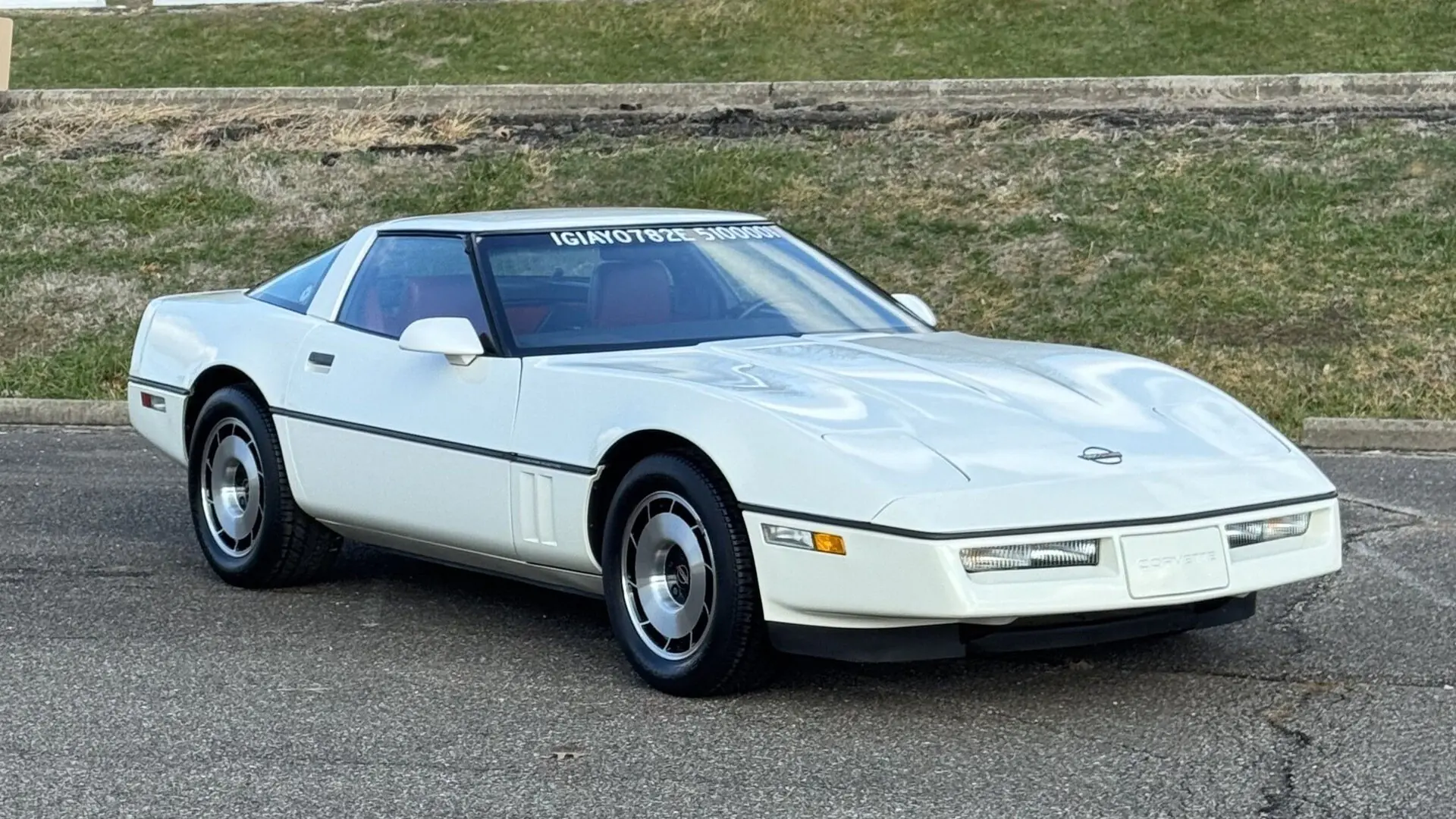
A year ago this month, the first 1984 Chevrolet Corvette ever built sat in an estate auction in Bowling Green, Ohio, still wearing the white paint, red leather and factory Goodyear tires it left the line with. It sold for a reported $110,000, roughly ten times what an ordinary 1984 Corvette brings. On Saturday, November 7, the same car, VIN 1G1AY0782E5100001, crosses the block again as Lot ST0071 at GAA Classic Cars in Greensboro, North Carolina. It carries a reserve and shows 279 miles, two more than were reported last fall.
GAA’s materials for its November 5–7 sale lead with ten Ferraris, a Corvette once owned by George Strait and a numbers-matching big-block Chevelle. Those are the headlines. The more instructive car is the one with nothing to prove mechanically and everything to prove commercially. A fast return to the block puts a question in public that the market rarely answers so directly: is the premium for being first a permanent part of the car, or a price one enthusiastic bidder paid once?
That question runs through the entire 750-car catalog. Read it closely and the consignment divides into two kinds of value: cars that are valuable for what they are, and cars that are valuable for what happened to them. Knowing which is which is the most useful skill a buyer can bring to Greensboro.
Why VIN 0001 Matters, and Why It Is Hard to Price
The C4 arrived under unusual circumstances. Chevrolet skipped the 1983 model year for public sale entirely, building a small run of pilot cars and selling none of them; the lone survivor lives at the National Corvette Museum in Bowling Green, Kentucky. When the all-new 1984 car finally reached showrooms, it brought a digital instrument cluster, a clamshell hood, a lightweight new chassis and the 205-hp L83 Cross-Fire Injection V8. The car offered in Greensboro pairs that engine with the 700-R4 four-speed automatic.
It also arrived in volume. Chevrolet built more than 51,000 Corvettes for 1984, a long, front-loaded model year that makes the ’84 one of the most common Corvettes on the road. That is precisely the point. Nothing about this car’s specification is scarce. Every dollar of premium rests on the number stamped into it, the documentation behind it, and the fact that it has barely moved in four decades. GAA notes that it spent more than 35 years in northern Ohio and is offered with original documentation and history; when it sold last year, the file was described as including the window sticker, build sheet and ownership records.
Collectors should be careful about the comparisons that get attached to cars like this. General Motors has sold VIN 0001 of several modern Corvettes for seven-figure sums, including the first production C8, which brought $3 million at Barrett-Jackson in 2020. Those were charity sales of brand-new cars, and they measure generosity as much as collectibility. They are not comparables for a 42-year-old car being resold between private parties. The relevant evidence is narrower: one public sale at $110,000, and whatever happens next weekend.
There is also a practical reality buried in the 279 miles. A car this original is not a car to drive. Forty-year-old tires, original hoses and untouched fluids are part of what is being purchased, and they are also reasons the car should leave Greensboro on a trailer. The buyer is not acquiring transportation. The buyer is acquiring a document that happens to have four wheels, and the obligation to keep it that way.
A first is a fact. The premium for it is an opinion, and opinions get retested every time a car crosses the block. After a year of transport, storage and two rounds of auction costs, the consignor needs a meaningful gain simply to break even. A strong result would suggest the market sees serial-number-one C4s as durable artifacts. A soft one would suggest last year’s price belonged to a single buyer on a single day.
The Cars That Are Valuable for What They Are
The contrast is clearest in the cars whose significance does not depend on anyone’s memory or anyone’s checkbook.
1970 Chevrolet Chevelle SS LS6. Lot ST0104 is finished in Fathom Blue over black buckets and pairs its numbers-matching LS6 454 with a Muncie M22 “Rock Crusher” four-speed. Chevrolet built 4,475 LS6 cars for 1970 across the Chevelle and El Camino lines, and its 450-hp rating was the highest of the classic muscle era. Because it is the defining muscle car, it is also among the most frequently cloned. That is why the Protect-O-Plate matters here. The embossed metal warranty plate was issued with the car at delivery and records the VIN along with engine and transmission codes. It is one of the few pieces of evidence that ties a drivetrain to a specific car from the day it was sold. Buyers should still reconcile it against the engine pad stamping, the cowl tag and the VIN itself, but a car with all of those agreeing is a different asset from one that merely looks right. For more on how originality language is used and misused, see our analysis of a 1971 Chevelle sold as a survivor.
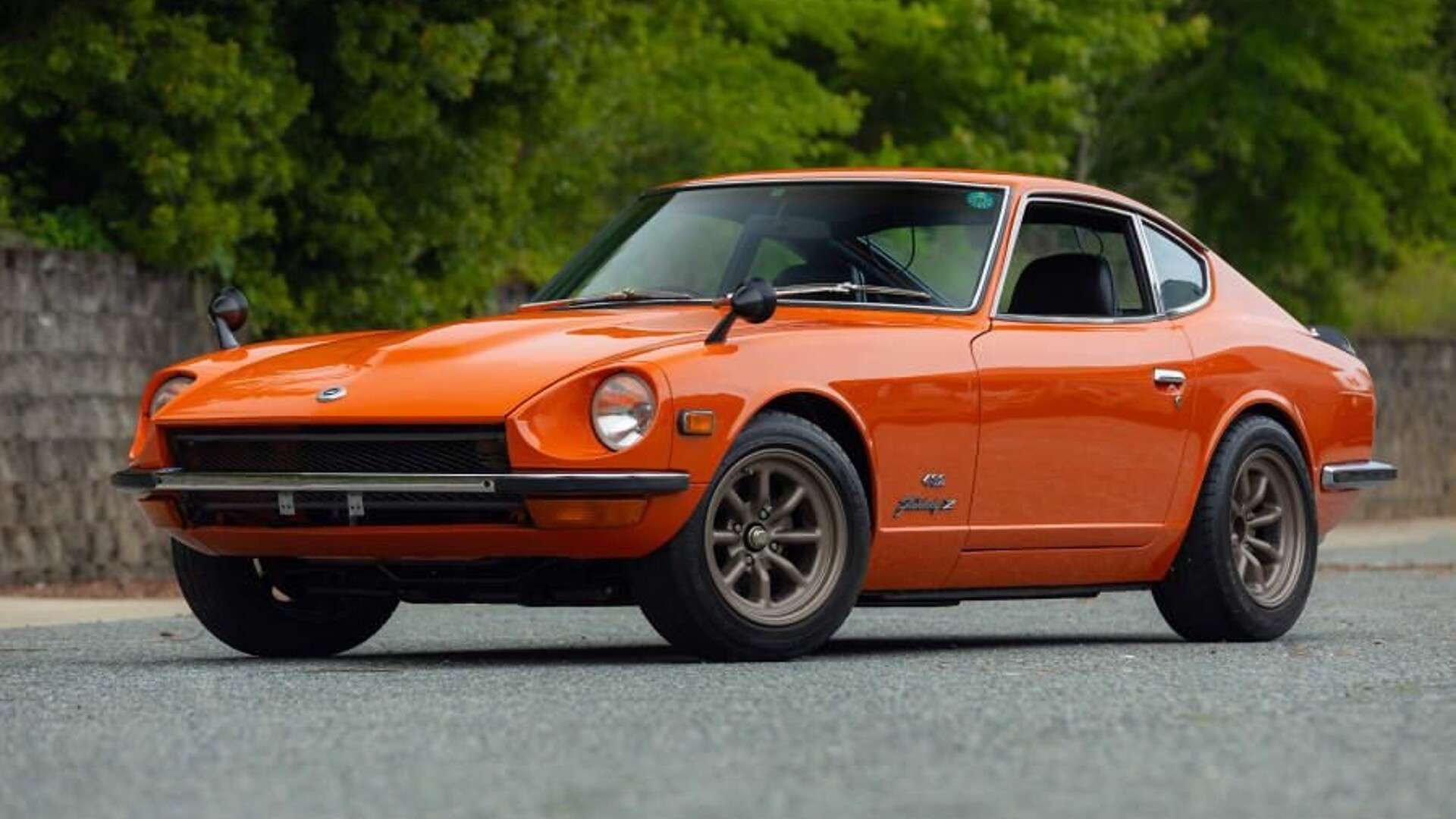
1969 Nissan Fairlady Z432. The Z432 is the most significant car in the Japanese section, and the reason is engineering, not scarcity. The name describes four valves per cylinder, three carburetors and two camshafts, all belonging to the S20 twin-cam six developed by former Prince engineers and shared with the original Skyline GT-R. Roughly 420 were built between 1969 and 1973, with 299 produced in 1969 and 1970. This orange, right-hand-drive example is matching numbers, has been restored twice and took Best of Show at the 2021 ZCON, as we reported in our closer look at this Z432. The Z432 is to the S30 family what a homologation special is to any racing lineage: the car that explains why the others exist. Our Datsun 240Z collector spec sheet covers the broader family.
1999 Ferrari 360 Modena, six-speed manual. When the 360 was new, the F1 paddle-shift gearbox was the forward-looking choice, and most buyers took it. A generation later, the gated manual is the configuration collectors seek. Owner-registry estimates put U.S.-market manual Modena coupes at fewer than 500 of roughly 1,800 delivered between 1999 and 2004, consistent with GAA’s figure. Lot FR0184 is Rosso Corsa over beige and runs Friday. It also carries a detail worth reading twice: the title is mileage-exempt, and the 45,000-mile figure is stated by the owner. The gearbox can be verified on inspection. The mileage cannot be verified the same way. Bid accordingly, and ask for the service file.
The same logic applies to the 458 Speciale in the Ferrari group, the last naturally aspirated mid-engine V8 special from Maranello, which we examined in detail in our look at the 458 Speciale headed to GAA. Its value is in what it is, and that does not need to be re-argued at every sale.
The Cars That Are Valuable for What Happened to Them
George Strait’s 1958 Corvette. Celebrity provenance is real, but it is often overpriced. A 1958 is a desirable solid-axle car in its own right, the first year of the quad-headlight C1. The Strait connection adds interest, and the size of that addition depends on documentation: title history, period photographs and a clear link between the owner and the car. As our coverage of Doug DeMuro’s Ford GT showed, the market tends to pay for the car first and the name second. Buyers should price the Corvette, then decide what the story is worth to them.
The CQ Ultra Low Mileage Collection. This no-reserve group is the most revealing consignment in the sale for anyone tracking collector demographics. A 1992 Dodge Stealth R/T Twin Turbo and Chevrolet’s 1990 Indianapolis 500 pace-car edition of the Beretta, the latter showing 84 miles, are not historically important in the way an LS6 or a Z432 is. They are important to the people who were teenagers when they were new, and those people now have the means to buy. Because these cars sell without reserve, the results will be true price discovery: no consignor floor, just what the room believes delivery-mileage cars of the 1990s are worth.
Buyers should understand what they are paying for. On a mass-produced car, unused mileage is a dividend that can only be collected once. The first owner who drives it spends the asset. That is not an argument against buying; it is an argument for knowing whether you are buying a car to enjoy or a time capsule to preserve, and paying accordingly.
1977 Datsun 280Z ZZZAP Edition. The ZZZAP is a period marketing story that has become nostalgia. Datsun built 1,000 of them in Sunburst Yellow with special graphics and rear-window louvers, tied to Midway’s arcade racing game of the day. Its value lives in the details that are easiest to lose, so original decals, louvers and paint deserve scrutiny before the bidding starts.
The George Shinn Collection. The Charlotte Hornets founder’s cars, from 1930s Ford street rods to a 2019 Bentley Bentayga, also sell without reserve. Here the provenance is a regional story, and the cars will trade largely on their own merits.
What Serious Buyers Should Watch in Greensboro
- Lot ST0071 against last year’s result. It is the cleanest test in the sale of whether a serial-number premium survives resale.
- Depth of bidding on the no-reserve CQ cars. Strong results would confirm that Gen X and millennial collectors are setting prices for their era, not just participating in them.
- Which documents win. On the LS6 and the Z432, paperwork and matching stampings should separate the best cars from the merely good ones.
- Inspection time. GAA operates from a permanent, climate-controlled building where cars are staged in advance. Use the preview days. The questions that matter most, from tire date codes to stampings, are answered in person, not in a catalog.
- Corvette breadth. More than 65 Corvettes are consigned, from a custom 1954 to a 2026 ZR1 with under 1,000 miles. For a sense of where the new end of the market sits, see our look at a ZR1 convertible offered by GAA.
The Verdict
Take the prices out of this catalog and the lesson remains. Cars that are valuable for what they are, an LS6 with its paperwork, a Z432 with its S20, a 360 with its gated shifter, carry their value with them from sale to sale. Cars that are valuable for what happened to them have to persuade a new room every time. Neither is a lesser category, but they are different purchases, and they reward different kinds of diligence.
VIN 0001 sits at the exact point where those categories meet: a common car made singular by a number. Whatever it brings on Saturday, it will tell collectors more about the durability of the “first” premium than any charity sale ever could.
GAA Classic Cars’ November auction runs November 5–7, 2026, at 301 Norwalk St., Greensboro, North Carolina. Gates open at 8 a.m. ET, with memorabilia at 9 a.m. followed by vehicles. Bidding is available in person, online and by phone, and the sale streams on YouTube, with RACER Network coverage Friday from 1–5 p.m. ET and Saturday from 11:30 a.m.–3:30 p.m. ET. Inventory and registration are at GAAClassicCars.com. GAA’s earlier highlights from this sale include a 1963 Ford Galaxie R-Code 427 and a Rally Green 1969 Camaro Z/28.
The collector car market, every weekday morning.
Auction results, price moves and what’s crossing the block, read in four minutes. Free, from Modern Car Collector.
No spam, unsubscribe in one click. Or read more about the Brief.
Related Posts:
- Record Ferraris, Rare Icons and 15,000 RPM: The Week…

- Here's Your Chance to Buy George Strait's Signet Red…
- Original-Paint 1972 Chevrolet Corvette Convertible…
- 1969 Chevrolet Camaro Z/28 For Sale From GAA Classic…
- The Collector Car Market Paid Up for Certainty This…

- Low-Mile 1987 Chevrolet Monte Carlo SS Aerocoupe for…
 John Lloyd
 Shawn Henry