

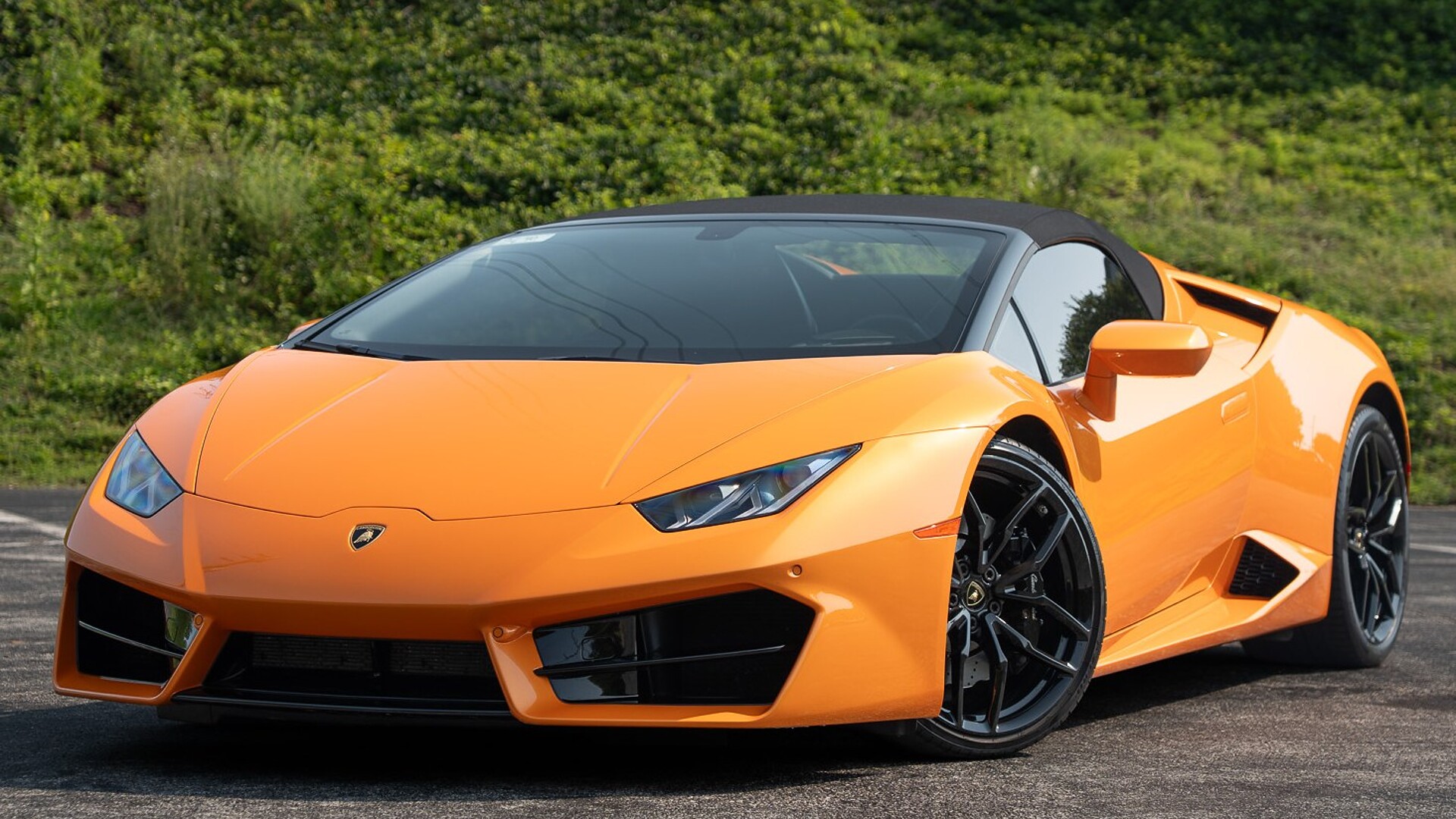
There is a moment in the life of every modern supercar when it stops being a used car and starts becoming something else. Nobody announces it. It shows up first in how bidders behave, and this 2018 Lamborghini Huracán LP580-2 Spyder on Bring a Trailer is a useful place to watch for it.
Finished in Arancio Borealis over black leather, showing roughly 8,000 miles and offered by a dealer in Douglassville, Pennsylvania, the car stood at $167,000 with hours remaining on Monday, September 28. Dealers are currently asking roughly $180,000 to $270,000 for comparable LP580-2 Spyders. That gap is more instructive than any hammer price. It says the market still values the base rear-drive Huracán as a depreciating exotic, not as a member of the last generation of naturally aspirated V10 Lamborghinis.
That distinction is why serious buyers should look closely at this car rather than scroll past it. The end of an era raises the ceiling first. It lifts the floor last, if at all, and only for the cars that give collectors a reason.
The V10 Is Over. The Market Has Only Half Noticed.
Lamborghini built the Huracán from 2014 through the end of 2024, and it overtook the Gallardo to become the most-produced model in the company’s history. Its successor is a different proposition entirely. The Temerario pairs a twin-turbocharged 4.0-liter V8 with three electric motors for a combined 920 CV and a 10,000-rpm redline. By every objective measure it is faster. It is also the car that closed the door on the high-revving, naturally aspirated V10 that defined Sant’Agata’s core model for two decades, from the Gallardo through the Huracán.
The market has responded the way it usually does, by reaching for the definitive versions first. Collector attention has concentrated on the Performante, STO, Tecnica and Sterrato, the cars that express the Huracán at its most extreme or most final. Lamborghini, meanwhile, is exploring what makes a new car collectible from the other direction, with commissions like the Temerario Tricolore. The standard Huracáns have been slower to feel any of it, for a simple reason: there are a great many of them. Rarity is not the argument for a base Huracán. Character is.
Why Rear-Drive Is the Detail That Matters
Among the standard cars, the LP580-2 is the one with a point of view. Lamborghini removed the all-wheel-drive hardware, set the 5.2-liter V10 at 580 CV, or 572 horsepower and 398 lb-ft, and tuned the chassis for drivers who wanted the rear axle to do the work. The Spyder followed the coupe in late 2016. The factory quoted 0–100 km/h in 3.6 seconds, a 319 km/h top speed and a soft top that stows in about 17 seconds. The Evo RWD replaced it in 2020, which makes the LP580-2 Spyder the first-generation rear-drive open Huracán, built for the 2017 through 2019 model years.
The idea had a precedent. In 2009 Lamborghini built 250 examples of the Gallardo LP550-2 Valentino Balboni, named for the company’s longtime test driver and his well-known preference for rear-wheel drive. Collectors have treated the Balboni as one of the more desirable Gallardos ever since. The Huracán LP580-2 took that philosophy from a limited edition to a regular-production model. That is both its appeal and its limitation: it carries the Balboni’s thinking without the Balboni’s scarcity.

Reading This Particular Car
The color deserves a note. Arancio Borealis is the orange Lamborghini used to introduce the Huracán in 2014, and on a Spyder with black 20-inch twin-spoke wheels and a black power top it reads as correct rather than loud. The black leather carries orange stitching and embroidered headrests. Equipment includes the front-end lift system, front and rear parking sensors, a rearview camera, heated power seats, cruise control and the three-mode ANIMA selector. Braking is by cross-drilled steel rotors with Lamborghini-branded calipers, the LP580-2’s standard setup rather than carbon ceramics.
For future resale, the lift is the option that matters most. It is the feature buyers most consistently look for on a low-slung modern Lamborghini, and cars without it tend to sit longer. Beyond that, the listing describes a car specified for pleasure rather than performance, without mention of magnetorheological dampers, dynamic steering or carbon-fiber trim. That is not a fault. It is arguably the purest expression of the LP580-2 brief. Buyers should simply understand that this is a driver’s specification, not a collector’s one.

Eight Thousand Miles, Four Owners
Here is the overlooked detail. The Carfax report shows no accidents or reported damage, ten service records and a last reported odometer reading of 7,491 miles. It also shows four previous owners. That works out to fewer than 2,000 miles per owner over eight years, and the selling dealer acquired the car only this year.
Nothing about that is a red flag on its own. But it changes what the mileage means. Collectors pay for low mileage when it represents continuity: one owner, one garage, one consistent story of care. Here the low mileage mostly records a car that passed quickly from hand to hand as a weekend toy. As we observed with Buick GNX #450, the odometer is only as valuable as the narrative around it. And as the market showed us earlier this month, bidders pay up for certainty and discount almost everything else.

There are practical points as well. The Pirelli tires carry 2017 and 2019 date codes, so a new set belongs in the budget regardless of tread. The seller has, to its credit, posted paint-meter readings and a video walk-around of imperfections, and both are worth studying. The car comes with its owner’s manual, a clean Carfax and a Pennsylvania title. No window sticker or original build documentation is mentioned. On a car with this ownership history, tracking down the original Monroney or a factory build printout would be worth the effort, because paperwork is what will eventually separate a future collector Huracán from a well-kept used one. Provenance details can reshape a Lamborghini’s story entirely, as a single plate did for the Diablo VT Roadster we examined recently.

What Serious Buyers Should Take From This
At $167,000 with time left, the bidding looks rational. It prices a well-presented, lightly used exotic with a modest discount for ownership count and a conventional specification. For a buyer who wants an open, rear-drive, naturally aspirated V10 to use, that is the opportunity. Most of the depreciation has already happened, the end-of-era argument is real, and the car can be driven without eroding a collector premium it does not yet carry.
For a buyer thinking about long-term value, discipline matters more. The Gallardo market offers the precedent. The cars that pulled away were the ones with a reason: the gated manuals, the Balboni, the Superleggeras. Low mileage alone rarely did it. Standard Huracáns will be sorted the same way over the next decade, by specification, color, documentation and continuity of ownership. Some will become sought after. Most will remain very good used supercars.
Collectors do not pay for the end of an era in general. They pay for the cars that explain it. The LP580-2 Spyder explains a good deal: rear-drive, ten cylinders, open sky and no turbochargers, the way Lamborghini’s core car felt before electrification. Whether this particular example earns a premium one day will depend less on its odometer than on what its fifth owner does with its history.
The collector car market, every weekday morning.
Auction results, price moves and what’s crossing the block, read in four minutes. Free, from Modern Car Collector.
No spam, unsubscribe in one click. Or read more about the Brief.



 Shawn Henry