

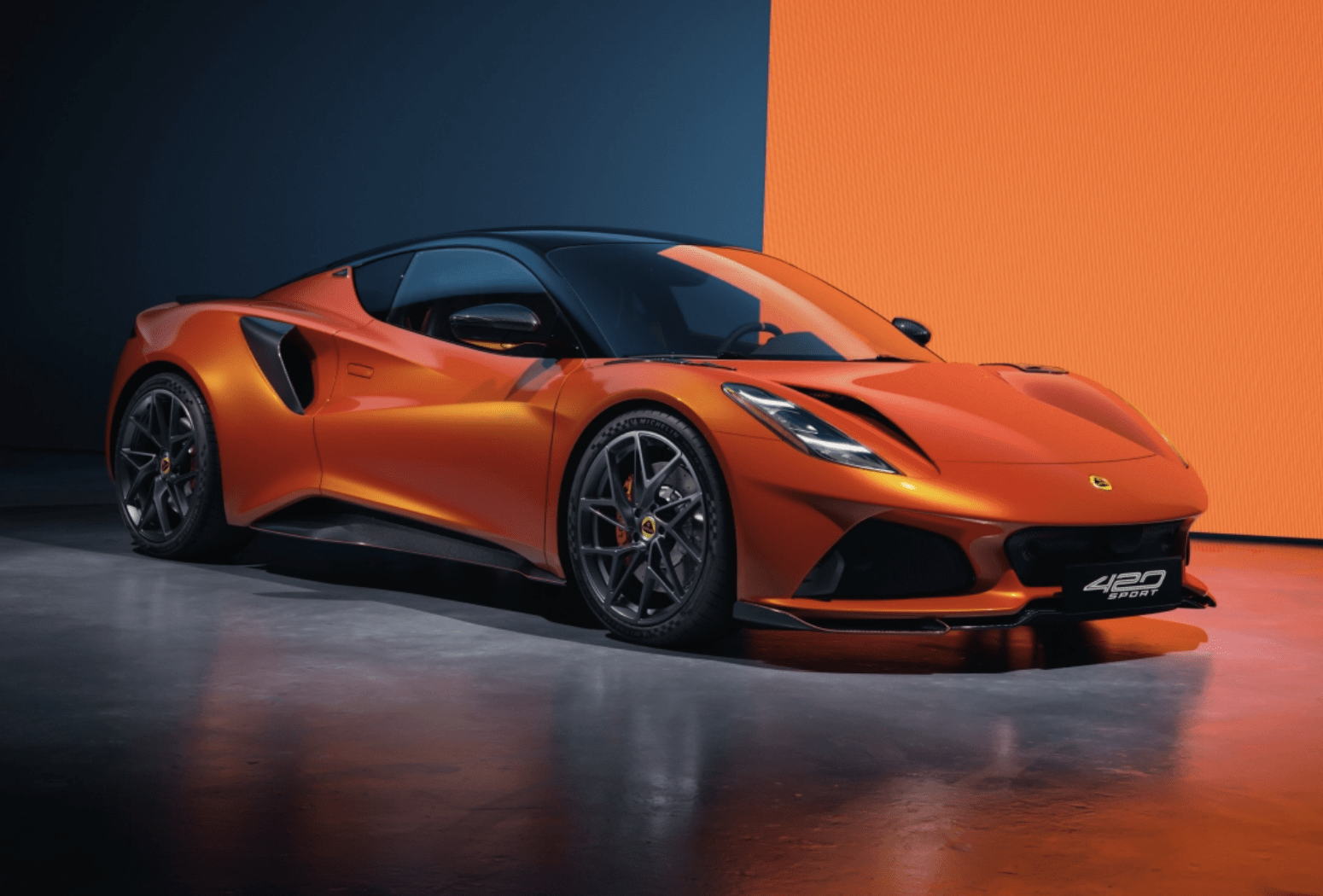
Lotus has a habit of taking a good thing and quietly obsessing over it until the numbers move, and the Emira 420 Sport is exactly that kind of exercise. It’s the range-topping Emira now, built solely around the Mercedes-AMG four-cylinder, and Lotus is calling it the fastest four-cylinder production car in the world. That claim is worth unpacking, because the interesting part isn’t the marketing — it’s what Lotus actually did to the engine.
Here’s the nugget most of the coverage will skip. The 420 in the name is 420 PS, which converts to 416 bhp, and that is not a random tune. It’s the exact peak output of Mercedes-AMG’s M139 in full A45 S trim — the world’s most powerful series-production four-cylinder, at 416 hp and 500 Nm. Earlier Emiras with this engine were dialed back: the Turbo sat around 360-plus horsepower, the Turbo SE at 400. The 420 Sport finally lets the AMG four off the leash and runs it at the same ceiling AMG uses in its hottest hatchback. The 16-horsepower bump over the Turbo SE comes from software and, crucially, cooling.
Related Articles
- 5X More Entries for Readers — Restored 1965 Corvette Sting Ray Headlines the Dream Giveaway
- No. 9 of 30: The GMMG Dick Harrell Camaro and the Case for Modern Tribute Cars as Real Collectibles
And that’s the mechanical story worth understanding. When Lotus headlines a 30% increase in exhaust-valve cooling airflow and 15% more air to the outboard radiators, that’s not aero theater. The M139 is a savagely stressed engine — a hand-built 2.0-litre running north of 30 psi of boost — and asking it to hold its maximum output in a mid-mounted engine bay, rather than the airy nose of an A45, is a thermal problem before it’s a power problem. The seven aero additions (a deeper front splitter, opened intakes, wheel-arch vents, extended sills, and a louvred tailgate) exist largely to feed and cool the thing, with a claimed 25kg of extra downforce as a bonus and, Lotus says, no increase in drag. There’s even a party trick for track days: the number-plate panel and a brake-duct blanking plate pop out to shove more air into the radiators and front brakes. Just remember that running with the plate panel removed is a track-only move unless you enjoy conversations with law enforcement.
Also note what this engine went through to get here. In the A45, the M139 is a transversely mounted, turbo-at-the-back hot-hatch motor driving all four wheels. In the Emira it’s mid-mounted and sends everything to the rear through AMG’s eight-speed dual-clutch. Same block, completely different personality — a front-drive-based screamer repurposed as a proper mid-engine sports car powertrain. That’s the sort of engineering repackaging that doesn’t show up on a spec sheet.
The weight loss is real but modest, and Lotus is honest enough to asterisk it: the 25kg saving requires the optional Lotus Lightweight Handling Pack. Dig into the pack and you find the actual grams. A titanium exhaust drops 6.5kg, a carbon-fibre louvred tailgate saves 4kg over the standard glass, and a lithium-ion battery swaps out roughly 12kg of lead-acid. That’s about 22.5kg from three parts, with the rest coming from smaller changes. The pack also brings the hardware that matters more than mass: two-way adjustable Multimatic dampers with proper track-to-road range, and Michelin Pilot Sport Cup 2 tyres. Those Cup 2s are the tell — this is a car set up to be quick on a circuit, and that comes with the usual ownership footnotes. Cup 2s wear fast, cost real money, and are not your friend on a cold, wet morning. Budget accordingly.
On the “fastest four-cylinder” claim: it’s a top-speed argument, and at 186 mph it’s defensible. There are four-cylinder cars that will out-accelerate this Emira — AMG’s hybrid-assisted fours make far more combined power — but they’re heavier and speed-limited, so the outright velocity crown is fair enough. Lotus is picking the metric it wins, which is what everyone does.
Related Articles
- Win a 1965 Pontiac GTO Convertible — Dream Giveaway’s Latest Charity Sweepstakes
- This 1930 Packard 734 Speedster Isn’t Valuable Because It’s Rare. It’s Valuable Because of Who Owned It.
A couple of things to file away. The removable roof panel — Lotus leans on Esprit nostalgia here — turns the coupe into a targa-ish thing without pretending to be a convertible; the panel stows behind the seats. It’s a nice option, though open-panel cars always deserve a look at wind sealing and long-term rattles before you sign. The launch colour, Tangelo Orange, nods to old Exige Orange, and there’s a Carbon Fibre Pack for the people who want to spend more to weigh less.
The bigger context: the Emira is Lotus’s last combustion sports car, and after the company walked back its all-electric plan, this is the swan song for the internal-engine Lotus for now. It’s telling that the survivor is the AMG four rather than the supercharged Toyota V6 the Emira also launched with — the small turbo motor is the easier one to keep alive under modern emissions rules, and now it’s the one wearing the halo. If you want a new Lotus with a combustion engine and a manual-adjacent sense of purpose, the clock is running. This is a fitting way to end that chapter — provided you go in knowing you’re buying a hot-hatch engine at full boil, wrapped in a lot of very deliberate cooling.
Images Via: Lotus
The collector car market, every weekday morning.
Auction results, price moves and what’s crossing the block, read in four minutes. Free, from Modern Car Collector.
No spam, unsubscribe in one click. Or read more about the Brief.



 John Lloyd
  Shawn Henry