

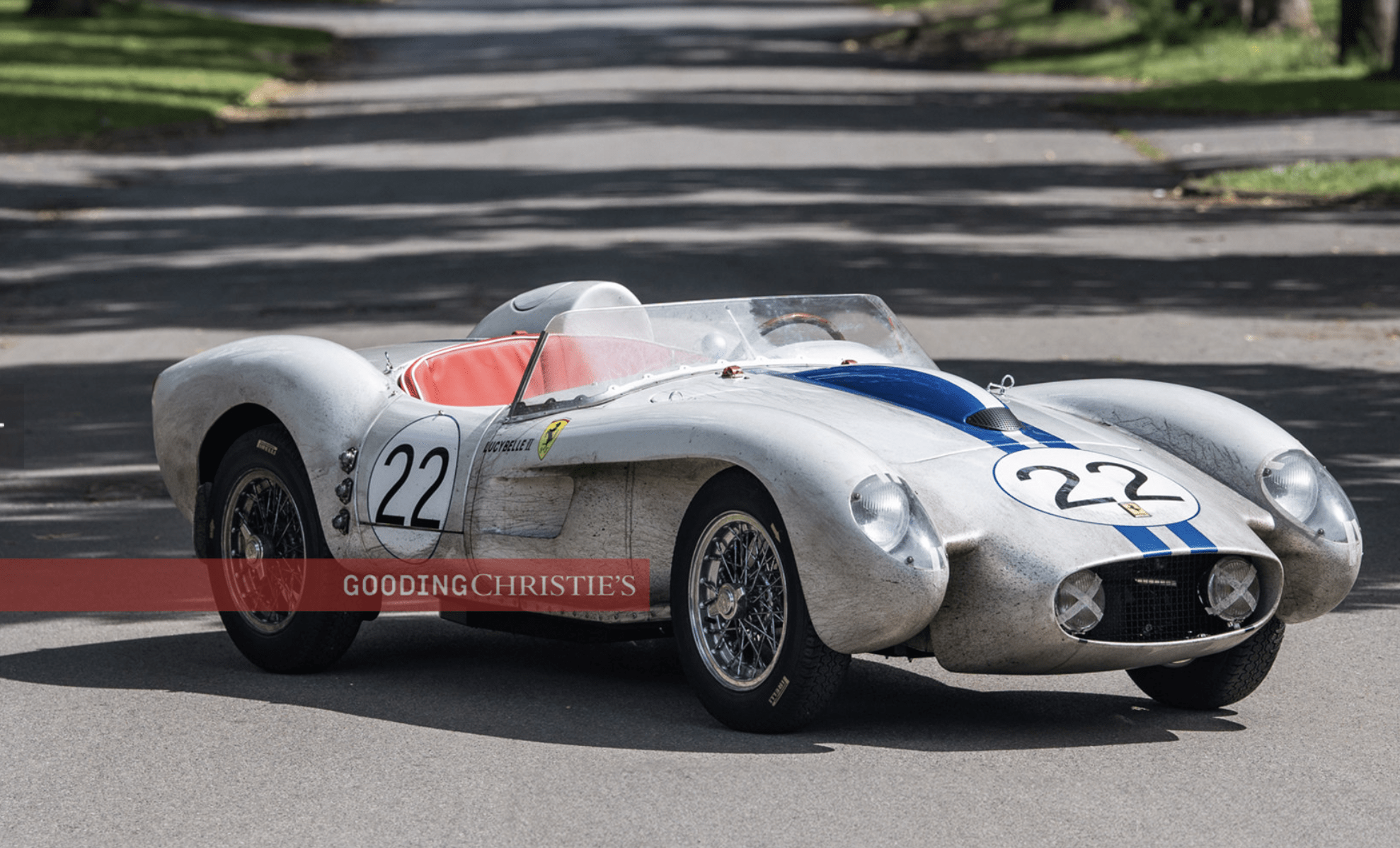
At Gooding & Christie’s Pebble Beach sale, a “Ferrari” sold for $75,000 against a $140,000-$180,000 estimate, without reserve. By any conventional measure, it is not actually a Ferrari. It is a three-quarter-scale, electric-powered tribute car with a top speed of 50 mph, hand-built by a specialist studio and cataloged as chassis “Serial No. 181.” And yet Ferrari’s own Classiche department and Centro Stile Ferrari signed off on it, working from the factory’s original 1957 archive drawings. That detail, not the hammer price, is the real story here.
The Testa Rossa J by Hedley Studios recreates the 250 Testa Rossa “Pontoon Fender,” one of the defining sports-racing Ferraris of the 1950s. Hand-formed aluminum bodywork covers the scaled chassis; the interior carries working lights and instruments; power comes from a speed-controlled electric motor rather than a V12. It rides on genuine 12-inch Borrani wire wheels and Pirelli Cinturato tires, with Bilstein dampers, Eibach springs, and Brembo calipers, a Nardi steering wheel, and a Ferrari 812-inspired Manettino selecting among four drive modes. None of that hardware makes the car fast. It makes the car correct, which is the same standard Ferrari applies when it authenticates a matching-numbers race car worth eight figures.
More telling than the componentry is the choice of livery. Hedley Studios and Centro Stile Ferrari did not default to a factory works car or an outright class winner. They chose chassis 0732TR, “Lucybelle II,” a privateer 250 Testa Rossa driven by Americans Ed Hugus and Ray “Ernie” Erickson, finished in Bianco Cervino with blue stripes, which placed 7th overall at Le Mans in 1958, according to the auction house’s catalog description. Recreating the car’s post-race patina reportedly took roughly 100 hours of hand-applied weathering, stone chips, exhaust staining, and track grime, rather than presenting a showroom-clean tribute. Only three examples carry this specific livery.
That is a deliberate, and revealing, choice. A generic pretty-Ferrari tribute would have sold just as easily and cost far less to produce. Instead, the team built a scaled object around one specific, documented motorsport narrative rather than raw fame. It suggests that even at three-quarter scale and even running on a battery, what collectors are actually being sold is not horsepower or paint. It is a story, the same currency that drives real auction premiums far more reliably than rarity alone.
The original 250 Testa Rossa earned that reverence honestly. Powered by a three-liter V12 producing roughly 300 horsepower and good for around 270 km/h, per Ferrari’s own factory figures, it was engineered specifically to exploit a new displacement limit the FIA was expected to impose on prototypes, and it delivered Ferrari the 1958 World Sportscar Championship for manufacturers. Total production across all series ran only in the dozens. A genuine, documented 250 Testa Rossa remains among the most coveted competition Ferraris in existence, in a different universe of value entirely from its electric namesake.
Against that backdrop, a $75,000 result on a $140,000-$180,000 estimate is a useful data point rather than a disappointment to explain away. Sold without reserve during the same Monterey Car Week that also produced record results elsewhere on the block, the Testa Rossa J tested what buyers will actually pay for a manufacturer-blessed, heritage-grade tribute object, and the market answered with less than the consignor hoped. That is not a verdict on the craftsmanship. It is a signal that this category, licensed, museum-quality scale vehicles built with direct factory participation, is real, but still thinly traded and still finding its price.
For serious collectors, the Testa Rossa J is not a substitute for the real thing, and Ferrari does not present it as one. What it represents instead is the company formalizing a bridge category, using the same archive drawings, the same Classiche rigor, and the same Centro Stile design authority it applies to million-dollar restorations, and increasingly, to entirely new formats. That is a different proposition than a die-cast model or a licensed pedal car. It is a signal about where Ferrari expects its next generation of collectors to enter the world the company has spent seventy years building.
Collectors have always paid a premium for verified history over raw performance; Ferrari’s Classiche department exists because of that fact. Applying that same institutional rigor to a child-scaled electric car is either an odd stretch for a serious authentication department, or a quietly serious bet that the instinct to pay for a true story, rather than a fast one, starts earlier in a collector’s life than the industry has assumed. See it here.
The collector car market, every weekday morning.
Auction results, price moves and what’s crossing the block, read in four minutes. Free, from Modern Car Collector.
No spam, unsubscribe in one click. Or read more about the Brief.
Related Posts:
- Porsche Didn't Build a Smaller 550 Spyder. It Built…
- Everything Modern Car Collector Covered Last Week
- Today on MCC: Everything You Missed Yesterday
- Record Ferraris, Rare Icons and 15,000 RPM: The Week…
- Lot of the Day: A Factory-Converted 1983 Lancia 037…
- The Collector Car Market Paid Up for Certainty This…
 Shawn Henry
  EL Puckett