

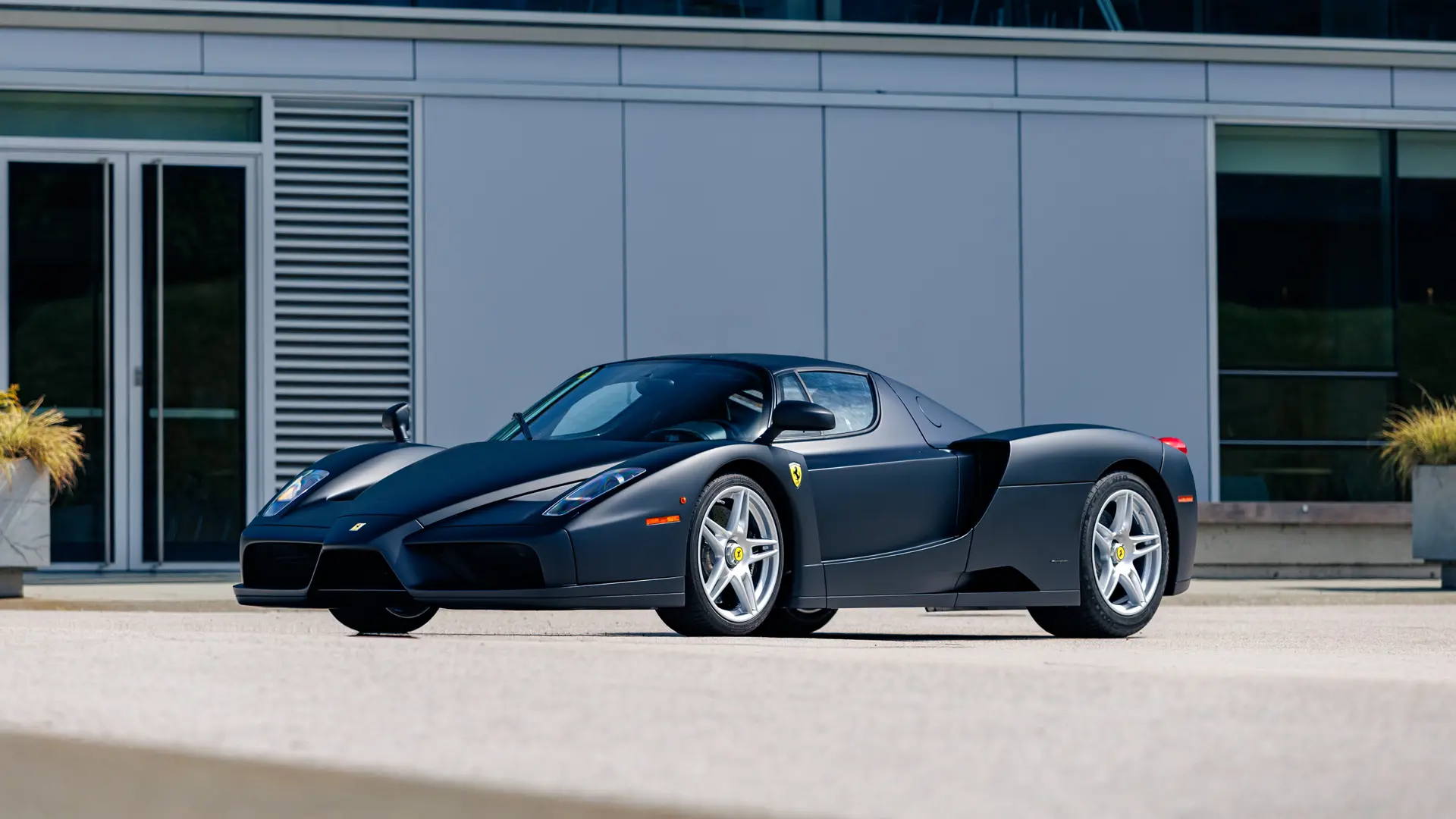
When RM Sotheby’s opens its Sealed September online sale on September 23, 2026, one of the four hundred Ferrari Enzos ever built will change hands without a published estimate, without a podium, and without a room of collectors watching a number climb. That absence of theater tells you something important about where the top of the collector market is heading. The car itself, chassis ZFFCZ56B000136069, is arguably even more instructive.
This Enzo is finished in Matte Nero Opaco, a satin near-black that Ferrari has confirmed was never applied to any other example of the model from the factory. It was specified new by a member of the Royal Family of Brunei, a family with a long history of commissioning one-off and bespoke coachwork from Europe’s grand marques, and delivered to London in October 2004. Every Enzo is nominally rare. This one is rare in a way none of the other 399 are.
Rosso Corsa was, unsurprisingly, the most common color ordered on the Enzo, followed by Giallo Modena and then Nero. Matte finishes were not yet part of the supercar vocabulary in 2004; they would not become fashionable across the industry for another decade. That a matte hypercar existed at all, years ahead of the trend it anticipated, is the kind of detail that separates a merely rare car from a genuinely significant one. It is also why Enzos continue to headline dedicated Ferrari sales even as the broader market for 2000s exotics has cooled: color and originality, not simply chassis number, now decide what a buyer is willing to pay.
Paint alone does not make a case. Documentation does. This car retains its original chassis, engine, gearbox, and bodywork, and it holds Ferrari Classiche certification issued in 2022, confirming the factory’s own authentication of matching numbers. At the time of cataloging it showed 5,763 km from new. Its 2022 restoration was carried out by Carrozzeria Zanasi, the same Italian coachbuilder Ferrari entrusts with its Icona series and Tailor Made program cars, at a cost exceeding €110,000, and subsequent mechanical work, including a clutch and fuel pump replacement, was completed by Ron Tonkin Gran Turismo in 2024. That is a paper trail as complete as the paint job is unusual. The same principle drives value in far older machinery: as we noted when a matching-numbers Ferrari 250 GTO sold for $38.5 million earlier this year, sophisticated buyers pay for what can be proven, not merely what can be claimed.
The sealed-bid format itself is worth pausing on. RM Sotheby’s Sealed platform lets qualified bidders submit confidential offers over a set window rather than compete in a public room, and it is increasingly the venue of choice for cars whose ideal buyers have no interest in a spectacle. That shift mirrors what is happening across the top of the hypercar market generally, where a new generation of collectors is reshaping how, and how visibly, these transactions happen. An estimate listed as “available upon request” is not coyness. It is a filter, ensuring the only people discussing price are the people capable of paying it.
RM Sotheby’s is a fitting house for this consignment. The firm has built its Ferrari expertise across decades of significant single-marque sales, from road cars to competition history, including Michael Schumacher’s championship-winning Formula 1 machinery. That track record matters to consignors of unusual cars, because a house that has handled genuine outliers before is one that knows how to find the buyer who understands why an outlier is worth pursuing in the first place.
Prospective bidders should also read the fine print. The car is being sold under a temporary import bond in Canada, carrying a New Zealand certificate of registration, and any buyer will be responsible for duties, tariffs, taxes, and registration fees in their own jurisdiction. American buyers face an added wrinkle: at just over twenty-one years old, this Enzo is too young for the United States’ twenty-five-year import exemption, meaning a US purchaser will need to federalize the car before it can be legally registered domestically. None of this diminishes the car’s desirability, but it is a reminder that provenance paperwork and import paperwork are two very different things, and both deserve a specialist’s attention before a bid is placed.
None of this is to say the color is a gimmick. It is the opposite. Ferrari’s own cataloging calls this “one of the most desirable Enzos in existence,” and for once the auction-house language undersells the point. The Enzo was never going to be scarce in any meaningful sense; Ferrari built exactly the number it intended to build, for exactly the clientele it intended to sell to. What buyers are actually competing for now is distinction within that fixed population, and distinction was never going to be measured in kilometers. It was always going to be measured in the decisions a single original owner made in 2004, decisions this car preserved rather than erased.
That is the real story behind Sealed September’s Enzo. The headline, if there ever is one, will be a price. The lesson is that in a mature collector market, rarity is a starting point, not a conclusion, and the buyers paying the closest attention are the ones asking what a car’s originality, documentation, and history reveal that a production number never could.
See it here.
The collector car market, every weekday morning.
Auction results, price moves and what’s crossing the block, read in four minutes. Free, from Modern Car Collector.
No spam, unsubscribe in one click. Or read more about the Brief.
Related Posts:
- Two T.50s Have Sold at Auction, $2.4 Million Apart.…

- This No-Reserve Ferrari 458 Speciale A Is Priced for…
- Record Ferraris, Rare Icons and 15,000 RPM: The Week…

- Dan Gurney's Eagle Chassis 103 Didn't Win at Spa.…
- The Collector Car Market Paid Up for Certainty This…

- The Only Matte Black Enzo Ferrari Wasn't a Custom…
 Eve Nowell