

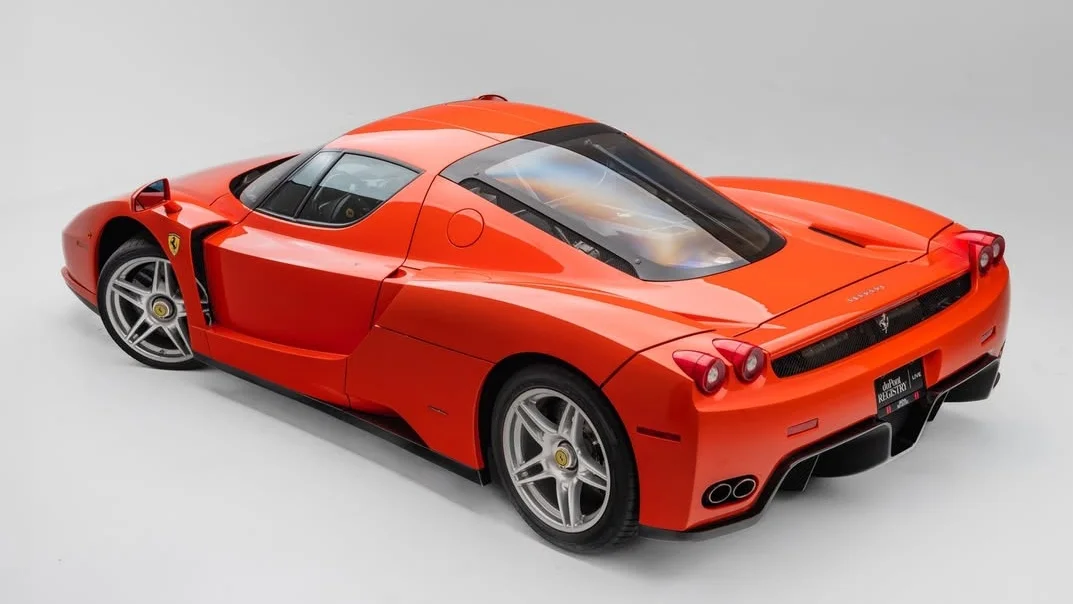
Broad Arrow Auctions closed its inaugural presentation as the official auction house of The Quail by The Peninsula on August 14 with $97.4 million in sales and an 85 percent sell-through rate across 186 lots. The headline lot, a 2003 Ferrari Enzo finished in the rare reversal of Nero D.S. over Rosso leather, brought $10,675,000 to Jesus Ortiz Paz, the frontman of the Mexican-American group Fuerza Regida. It is the kind of number that makes wire copy. It is not, however, the most important thing that happened in that tent in Carmel.
The real story sat one line below the top of the results sheet, where a 2019 Ferrari 812 Superfast, a 1998 Ferrari 550 Maranello, a 2001 Ferrari 550 Barchetta Pininfarina, and a 2020 Ferrari 488 Pista Spider each quietly set new world auction records of their own. None of them were headline lots. None carried unusual paint or celebrity provenance. They were simply well-documented modern Ferraris, and the market paid record prices for all of them in the same room, on the same weekend — much as Modern Car Collector found when a Jaguar XJ220’s record sale turned out to matter less than everything that sold around it. That pattern, repeated across four brands and nine separate lots, is the more durable data point to come out of Carmel this month.
The Car That Made the Headline
Start with the car that made the headline, because it earns the scrutiny. Ferrari built 399 examples of the Enzo between 2002 and 2004, the naturally aspirated, Formula 1-derived V12 flagship that closed out the analog supercar era before electronics and hybrid assistance reshaped the halo-car conversation. Nearly all left Maranello in the familiar red over black. Only three were finished in Nero D.S. over Rosso leather, inverting that formula. Offered without reserve, the car drew sustained, competitive bidding before selling to Ortiz Paz. Modern Car Collector has covered the Enzo’s presence at auction before, and the model’s trajectory has been consistent: steady appreciation for standard-specification cars, with real premiums reserved for unusual color combinations, low mileage, and documented ownership history.
The buyer matters here, but not for the reason the celebrity headline suggests. Ortiz Paz represents a collector who did not come to the Enzo through motorsport history or period road tests. He came to it as a poster car and a video-game unlockable, a number on a spec sheet that once felt unreachable. Barney Ruprecht, Broad Arrow’s Vice President of Auctions, described the sale as illustrative of “the generational shift in collecting,” and the phrase holds up under scrutiny rather than reading as sales copy. Buyers in their twenties and thirties are not entering the hobby through the same doorway their parents did. Their capital increasingly comes from music, sports, technology, and finance, and their reference points for automotive greatness run through the 2000s and 2010s rather than the 1960s. The Enzo, as the last analog Ferrari flagship, sits precisely at that generational hinge.
The Records That Made the Case
That generational argument would be easy to overstate if it rested on one sale to one buyer. It doesn’t. The 550 Maranello that broke its model’s record was Ferrari Classiche certified with 527 miles on the odometer — a distinction that matters more than the mileage headline suggests. Classiche is Ferrari’s own factory authentication program, verifying that a car retains its matching numbers and original specification against the factory’s build records. It functions as a notarized provenance file, and it increasingly separates cars that merely look original from cars the factory itself will vouch for. The Barchetta Pininfarina that broke its own record carried Classiche’s Red Book certification alongside an uncommon Nero D.S. over Cuoio specification. Buyers at The Quail were not simply chasing horsepower or scarcity. They were paying for documentation.
Hypercars Enter the Blue-Chip Column
Beyond Ferrari, the hypercar results confirmed the same thesis from a different angle. A one-of-99 2025 Bugatti W16 Mistral sold for $8,805,000, a record for the model, while a 2011 Veyron 16.4 Grand Sport brought $3,305,000, also a record. A 2023 Hennessey Venom F5 Revolution Coupe brought $2,837,500, the highest price ever paid for a Hennessey at auction. Bugatti’s W16-powered cars are no longer speculative new-car flips; they are trading as established collector hardware with their own auction history. Hennessey, a Texas tuner-turned-manufacturer with none of Bugatti’s century-old pedigree, now has a genuine auction record of its own. Rarity alone does not explain either result — plenty of rare, low-production cars sell for far less. What both prices reflect is buyers treating modern hypercars as a legitimate, liquid asset class rather than a novelty.
Depth All the Way Down the Catalog
Porsche’s results showed the same depth further down the price ladder. An unmodified 1988 Porsche 959 Komfort brought $2,865,000, a record for that configuration, reinforcing the 959’s standing as the analog-era benchmark against which every subsequent Porsche halo car is measured. Further down the catalog, a 1989 Porsche 911 Carrera Targa built for the Dutch national police, the “Rijkspolitie,” sold for $252,000 — itself a world record for a G-body police car. That result deserves attention precisely because it is strange. Nobody needs a police-liveried 911 Targa. Its value is almost entirely cultural and narrative, and buyers paid a record price for that narrative anyway. When money moves that decisively into a genuinely eccentric niche, it tells you the broader market has depth well beyond its headline lots.
The Classics Held Their Ground, But Didn’t Lead
None of this means the classic era went quiet. A 1968 Lamborghini Miura P400 S in period-correct Azzurro Mexico Metallizzato brought $4,075,000, and a 1957 Mercedes-Benz 300 SL Roadster — one of just 15 built new in Sonderlackierung Light Green Metallic — sold for $2,040,000 against a $1.5 to $1.8 million estimate. Modern Car Collector has tracked the 300 SL market closely, and this result fits a pattern of steady, estimate-beating demand for well-documented, factory-special-order examples rather than a sudden classic-era surge. The difference at The Quail was proportional: cars from the 1990s through the 2020s produced the majority of the outright world records, while pre-war and mid-century classics performed well but within expected ranges. That imbalance is the clearest evidence yet of where the newest collecting capital is actually pointed.
What This Means for Broad Arrow — and for Collectors
The results also matter for what they say about Broad Arrow itself. This was the house’s debut as the official auction partner of The Quail by The Peninsula, and a $97.4 million total with an 85 percent sell-through rate is a strong opening statement, arriving during a Monterey Car Week that Modern Car Collector examined in detail for what half a billion dollars in combined auction sales does and doesn’t say about the broader economy. Broad Arrow’s calendar doesn’t slow from here: an online sale of 40 youngtimer Mercedes-Benz models called Global Icons: The Patina Collective closes this week, followed by inaugural sales tied to the Audrain Newport Concours in October and the Zoute Concours in Belgium. The Patina Collective is worth watching in its own right, arriving just as Mercedes-Benz Heritage has begun formally documenting factory production data for the same generation of cars — a reminder that documentation, not just demand, is what will determine which youngtimers become tomorrow’s blue-chip classics.
For buyers watching this market from the outside, the takeaway isn’t that modern Ferraris or Bugatti hypercars are suddenly fashionable. It’s that the infrastructure supporting them — factory certification programs, documented ownership chains, single-family collections like the Casa Bella Macchina cars that anchored Thursday’s session — has matured to the point where these cars now trade with the same rigor once reserved for pre-war classics. Buyers entering this segment should treat Classiche certification, matching numbers, and documented mileage as non-negotiable, not as nice-to-have extras, because the record prices at The Quail went overwhelmingly to cars that could prove their own history.
Strip the Enzo’s price out of this auction entirely and the story barely changes. Nine other lots still set world records. A police car still outsold every reasonable expectation. A Texas hypercar brand still posted a record price against a French marque with a century of racing pedigree behind it. That is the actual headline: collectors are no longer paying premiums for rarity or horsepower in isolation. They are paying for documented, certified, well-specified examples of the cars that defined the moment their buyers came of age — and that moment increasingly runs through the 1990s and 2000s rather than the 1950s and 1960s. The Enzo made the wire copy. The nine records around it made the argument.
The collector car market, every weekday morning.
Auction results, price moves and what’s crossing the block, read in four minutes. Free, from Modern Car Collector.
No spam, unsubscribe in one click. Or read more about the Brief.
Related Posts:
- Ferrari Monza SP2 Value Nearly Doubled in Three…
- Five Built, Three That Count: How to Read the MCA…

- The Collector Car Market Paid Up for Certainty This…

- This No-Reserve Ferrari 458 Speciale A Is Priced for…
- Collector Car Market Brief: Sampras's BMW Z8, Two…

- Ferrari F50 Value Nearly Tripled in Two Years.…
 Eve Nowell