
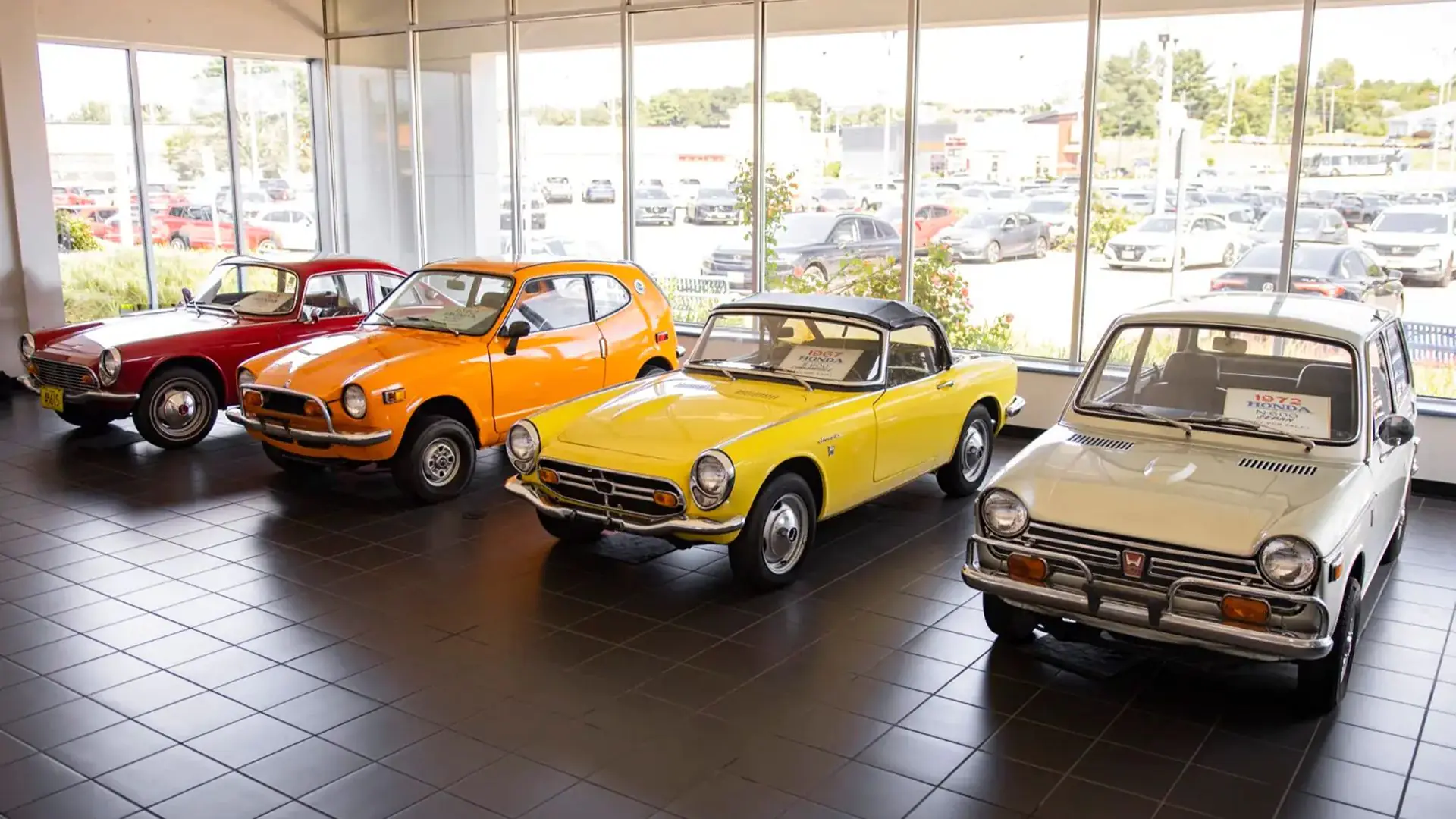
When Bring a Trailer lists a group of non-running project cars at no reserve, the eventual sale price is almost never the headline. In the case of four early Hondas just consigned by Manchester Honda of Connecticut, the hammer price may end up being the least interesting number attached to the listing. The real story is what these cars represent: an unbroken, six-decade chain of custody connecting a single family-owned dealership to the exact moment Honda stopped being merely a motorcycle importer in America and became a car company.
From Motorcycles to Motorcars
Manchester Honda traces its roots to 1964, when founder John Larabee opened the dealership to sell the only Honda products available in the United States at the time: motorcycles. It would take Honda another decade to establish a real four-wheeled presence in America, and when that moment arrived in 1969, Larabee’s dealership was already positioned to sell the cars alongside the bikes.
That continuity is unusual on its own. Most franchised dealers from the 1960s changed hands, changed brands, or disappeared entirely as American auto retail consolidated over the following decades. Larabee’s family kept the doors open long enough, and kept enough of its own inventory, that four of the earliest cars to pass through the showroom never actually left. Nicknamed the “Core Four” within a private collection that eventually grew to more than forty Honda cars and motorcycles, they spent over forty years rotating on and off showroom display rather than serving as daily transportation or resale stock.
That detail is worth sitting with. Collectors typically chase down build sheets, window stickers, and old service records to reconstruct an ownership history after the fact. Manchester Honda never lost that thread to begin with: dealer invoice to showroom floor to auction block, with no intervening owner to introduce uncertainty. It is close to the platonic ideal of documented provenance, even though the cars themselves are simple, inexpensive, and currently in rough mechanical shape. A restoration can always be redone. An ownership history, once broken, cannot.
Meet the Core Four
The earliest of the four, a 1966 Honda S600 coupe, is also the dealership’s most recent acquisition, purchased in 1983. Honda built roughly 1,800 S600 coupes over a three-year run, powered by a 606cc dual-overhead-cam inline four that drove the rear wheels through a dual chain-drive setup, an approach borrowed more from motorcycle engineering than automobile convention, and a detail that says as much about Honda’s origins as any spec sheet. This example is consigned alongside a parts car, an increasingly valuable asset in its own right for anyone attempting a correct restoration of a model this scarce.
The 1967 S800 that follows is a Japanese-market car Larabee discovered and purchased while traveling on business in Japan around 1972. He imported it, drove it as his personal daily driver, and converted it to left-hand drive in the mid-1970s before it was retired to showroom display in the early 1980s. That kind of personal ownership history, predating the car’s life as display furniture, is normally the sort of detail that requires oral history or family letters to document. Here it survives because the same family has held the car for more than fifty years.
The 1972 N600 carries the deepest historical weight of the group. It was the first four-wheeled Honda officially exported to the United States, arriving for the 1970 model year badged as the 600 Sedan. Mechanically, it was a stretched interpretation of the Japanese-market N360, fitted with a larger 598cc air-cooled parallel-twin to cope with American highway speeds. Larabee bought this particular car in 1977, and by the dealership’s own account it has covered barely 50 miles in the past three decades. It, too, is consigned with a parts car.
The final car, a 1972 Z600 finished in orange with its distinctive “scuba mask” front fascia, represents the end of the line for Honda’s earliest US-market experiments. Sold stateside only for the 1971 and 1972 model years and badged Z600 in America to reflect its 598cc twin rather than the 354cc unit that qualified it as a kei car at home in Japan, it was effectively the model that cleared the runway for the Civic’s arrival in 1973. Larabee purchased it for showroom display in 1981.
Why the No-Reserve Number Isn’t the Point
None of these four cars will set an auction record for anyone. They are project cars: two of the four don’t currently run, condition ranges from showroom-preserved to genuinely tired, and none carry the six-figure ambitions that dominate typical collector car headlines. That’s precisely why the sale is worth watching.
For most of the past decade, early Honda automobiles occupied a strange market position: culturally significant and historically documented, but financially overlooked next to their European and domestic contemporaries. That has been changing. As the generation that grew up idolizing the S2000 and the Civic reaches the point in their careers where they can write real checks, the collector base for Honda’s back catalog has widened and matured, pulling early, oddball models like the S600 and N600 along with it. A no-reserve sale is a useful stress test for exactly this kind of shifting category: rather than protecting a number behind a reserve, the seller is trusting the market to tell the truth about where four foundational, documented, but non-running Hondas actually belong on the value ladder.
It’s a strategy Bring a Trailer has leaned on across nearly every price point, from no-reserve Ferraris to big-block Corvettes, and consignors’ growing willingness to use it signals confidence that transparent bidding will find fair value faster than a defended estimate would. When it works, a no-reserve listing doesn’t mean desperation. It means the seller believes the story is strong enough to sell itself.
What Serious Buyers Should Actually Evaluate
For collectors circling this listing, the diligence is less about horsepower than about paperwork and metallurgy. Confirm what documentation Manchester Honda can actually produce, including original invoices, factory build information, or period photography that corroborates the ownership chain described in the listing. That paper trail is worth more than it looks on cars this inexpensive, because it is exactly the kind of documentation that gets lost once early Hondas change hands outside a controlled, single-family environment, the same reason unbroken ownership chains matter so much when evaluating provenance on far more expensive machinery.
Buyers should also budget realistically. A non-running 598cc air-cooled twin or a 606cc chain-drive four that hasn’t turned over in years is a mechanical unknown until it is inspected in person, and the parts cars accompanying two of the four lots exist precisely because Honda’s earliest twin- and four-cylinder architectures share almost nothing with anything else on the road. Thin-gauge steel and decades of New England winters are the other variables that photographs rarely tell the whole truth about.
Strip away the auction platform and the eventual hammer price, and what’s left is a cleaner story: a Connecticut dealership that quietly kept the first four cars of its own history intact for sixty years, and is now handing that continuity to whoever wants to become its next chapter. Collectors rarely get the chance to buy directly from the source that created a market in the first place. That, far more than whatever these four Hondas ultimately bring, is the detail worth remembering.
The collector car market, every weekday morning.
Auction results, price moves and what’s crossing the block, read in four minutes. Free, from Modern Car Collector.
No spam, unsubscribe in one click. Or read more about the Brief.
 Shawn Henry
  Eve Nowell