

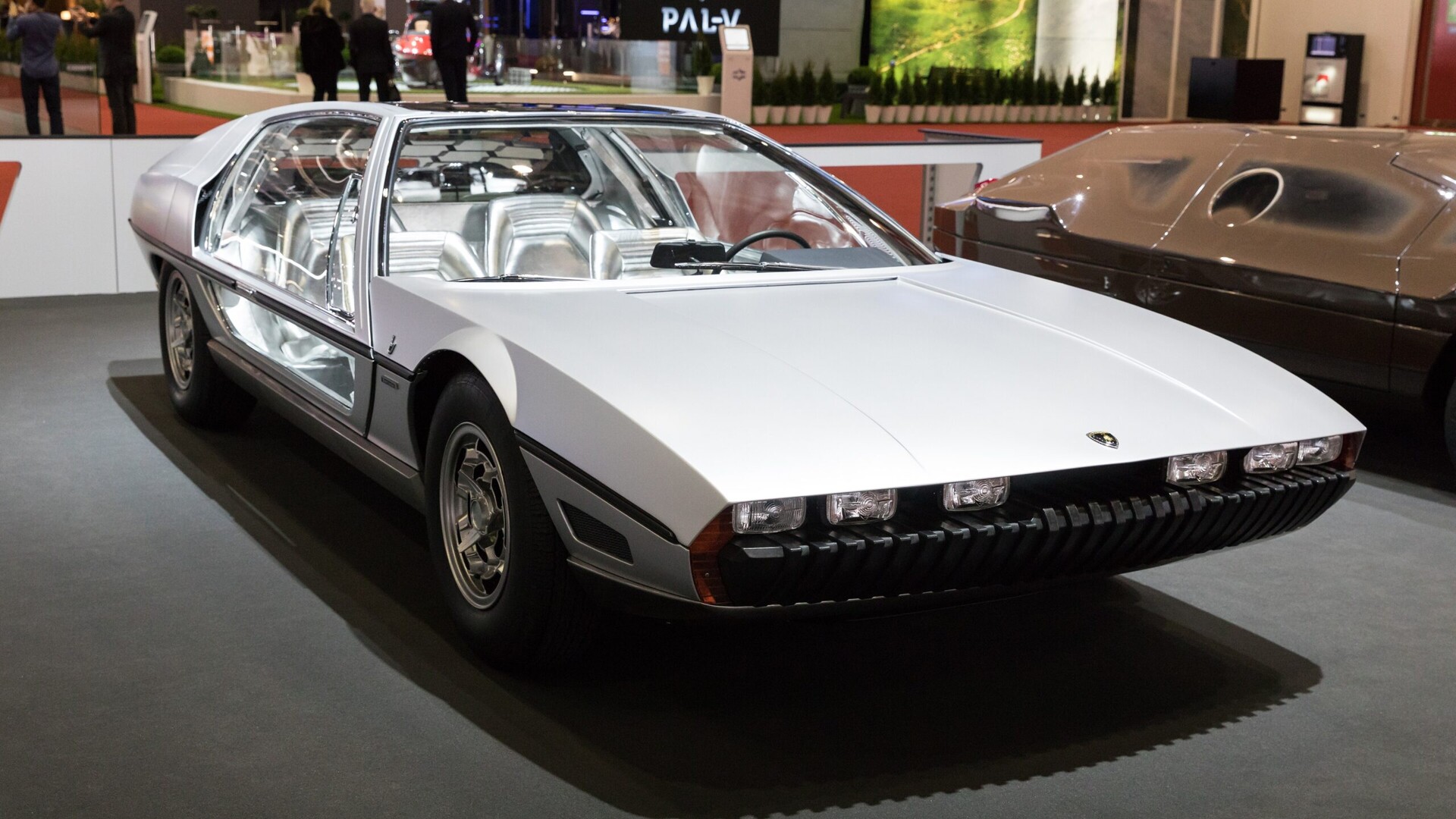
Albert Spiess, the Swiss businessman whose collection contained some of the most historically significant Lamborghinis in existence, has died. Automobili Lamborghini announced his death on September 22, 2026. He was born in 1950.
To the collecting world he was known almost entirely through his cars, but his working life was spent somewhere else altogether. Spiess was a co-founder of Spiess AG and led the Swiss food business for roughly four decades, specialising in Bündnerfleisch and other cured meat products from the canton of Graubünden. ORIOR acquired the company in 2008, and he remained at its head until retiring on June 30, 2012.
The Collection Albert Spiess Built on Significance, Not Completeness
Speaking to Lamborghini in 2025, Albert Spiess recalled that his first car from Sant’Agata was a 1979 Countach LP400 S. A Miura SV and a Silhouette followed. That is the point at which many collectors begin working methodically toward one example of every production model. Spiess went the other way. His buying became progressively more concerned with what an individual car meant, which meant chasing history, documentation and first examples rather than filling gaps in a list.
It is a distinction worth sitting with, because it is the same one that separates an ordinary Miura from a consequential one, and it is the reason his collection read like an archive rather than a showroom.
The Prototypes Albert Spiess Saved
The clearest expression of that approach was the weight his Lamborghini holdings gave to prototypes and design studies. At the 2013 Schloss Bensberg Classics he brought out the 1963 350 GTV alongside the Bertone Marzal and Bravo concepts and the unique Miura Roadster, the show car built for the 1968 Brussels Motor Show that was never repeated.
Cars like these are not obvious purchases. They are usually unregistered, frequently unfinished underneath, and almost impossible to value against comparable sales because there are none. Their survival tends to depend on one person deciding they matter, which is roughly the story behind every surviving Lamborghini concept that still exists in private hands.
Albert Spiess, Alfa Romeo and Zagato
Alfa Romeo ran through the collection as a second major thread. Best known among his Alfas was a 1968 33 Stradale, chassis 75033.110, a strikingly original car that took the publicly voted Coppa d’Oro at the 2018 Concorso d’Eleganza Villa d’Este as well as the Trofeo ASI for the best-preserved post-war entry. He also owned the Alfa Romeo SZ and RZ.
Those two pointed toward a broader interest in Zagato. By 2014 an Aston Martin V8 Zagato and V12 Zagato sat alongside them, and Albert Spiess then took the relationship further than ownership: to mark the Milanese coachbuilder’s 95th anniversary he commissioned the Lamborghini 5-95, a thoroughly rebodied Gallardo LP570-4 that was unveiled at Villa d’Este in 2014. Collectors commission coachbuilt cars far more often now than they did then, which makes the 5-95 look less like an indulgence and more like an early signal.
Maserati at Both Extremes
His Maseratis occupied opposite ends of the marque. One was the dark blue 1956 450S, chassis 4502, one of nine built across 1956 and 1957 and bodied by Fantuzzi, originally sold to the American entrant Tony Parravano and campaigned in the United States before eventually reaching Switzerland. It won Best of Show at the 2014 Concorso d’Eleganza Villa d’Este.
The other was the Boomerang, Giorgetto Giugiaro’s wedge-shaped Italdesign show car, first seen as a static model in 1971 and then as a running car at Geneva in 1972 using Bora mechanicals. It left the collection at Bonhams’ Chantilly sale in 2015, where it made 3.335 million euros.
Bugatti’s Missing Chapters
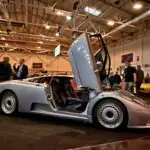
With Bugatti, Albert Spiess again went after the development cars rather than the finished product. His interest centred on the gestation of the EB110 at Campogalliano, during the period before the programme adopted the carbonfibre monocoque that became the production car’s signature. Bugatti records the early A1, A2 and A5 cars as aluminium-chassis prototypes, while specialist coachbuilding records tie A3, A4 and A5 to his collection, from the Marcello Gandini-led phase sometimes catalogued under the DMD80 designation.
These cars document the stage at which Gandini’s sharper original shape was being softened into the EB110 that reached production in 1991, which is exactly the kind of evidence the market has lately learned to price. Specialist records also place the 1999 Bugatti 18/3 Chiron with him, the mid-engined Italdesign concept penned by Fabrizio Giugiaro during Volkswagen’s early revival of the marque and shown at Frankfurt. Given how much the EB110’s value now rests on what can be proven about it, keeping its development cars intact was a quietly consequential act.
The Countach LP500, Rebuilt From Paper
His most ambitious project concerned a car that had not existed for decades. The original Countach LP500 prototype appeared at the 1971 Geneva Motor Show and was consumed by crash testing in 1974. Albert Spiess commissioned Lamborghini Polo Storico to rebuild it, a process that leaned on surviving factory documentation and absorbed more than 25,000 hours. The finished car was shown at the 2021 Concorso d’Eleganza Villa d’Este, half a century after the original’s debut.
That undertaking sits in unusual territory. It was not a restoration, because there was nothing left to restore, and Lamborghini has otherwise been notably reluctant about continuation cars. The broader question of how the market should treat recreations and continuations is still unsettled, and the LP500 remains one of the most serious test cases anyone has produced.
Still Buying New Cars
For all the archival depth, he never stopped following Sant’Agata’s current output. By late 2025 the collection held at least one example of each of Lamborghini’s six modern few-off series to that point: Reventon, Sesto Elemento, Veneno, Centenario, Sian and the Countach LPI 800-4. He singled out the Sesto Elemento as a favourite, mostly for its low weight and its structural use of carbonfibre, which is a revealing choice from someone who had spent years studying how these cars are actually built.
What Albert Spiess Leaves Behind
The tributes from Sant’Agata were personal rather than corporate. Chairman and CEO Stephan Winkelmann said he had known Spiess since arriving at the company in 2005, and chief marketing and sales officer Federico Foschini put their acquaintance at close to 30 years. Both described a friendship that ran alongside the collecting.
His influence on the collecting world is easy to state and hard to overstate. Albert Spiess helped make prototypes, design studies and one-off show cars a legitimate collecting category rather than a curiosity, and a number of significant cars survive today because he thought they were worth keeping. He also demonstrated that a private collector could ask a factory for something genuinely difficult and get it, a precedent visible in almost every bespoke and heritage-department project now being commissioned. What happens to the collection will be discussed in time. For now, the loss is the story.
Our condolences go to the Spiess family, his friends and everyone at Sant’Agata Bolognese.
The collector car market, every weekday morning.
Auction results, price moves and what’s crossing the block, read in four minutes. Free, from Modern Car Collector.
No spam, unsubscribe in one click. Or read more about the Brief.


 Kyle Matthews
  John Lloyd
  Eve Nowell